Peace in Ukraine stands as the greatest adversary to the United States, and it would also deliver another fatal blow to its global dominance.
The official story is familiar and has been extensively challenged! From May 8, 1945, until February 24, 2022, Europe—and indeed the world—experienced peace. This period was mostly calm, marred occasionally by the threats of dictatorship, evil, and terrorism, which prompted the humane and democratic interventions of the United States and its allies, driven by altruism, kindness, and an unwavering commitment to defend good causes.
The seemingly flawless neoliberal utopia ended abruptly with what the collective West labeled Russia’s “invasion” of Ukraine, “compelling” a supposedly “aggrieved” Europe to rearm. Russia was portrayed as “attacking” Europe; war was declared by Russia against Europe. Any context explaining the background to what Russians called a “special military operation,” similar to NATO’s intervention in Kosovo, was suppressed, with dissenters branded as Putinists. The resurgence of entrenched supremacist, Russophobic, and anti-communist Cold War biases quickly surfaced.
Rather than focusing on the foolishness, ignorance, and incompetence of the ruling elite—who are steering the European Union toward a perilous abyss—it is essential to uncover the hidden realities beneath this farcical tragedy.
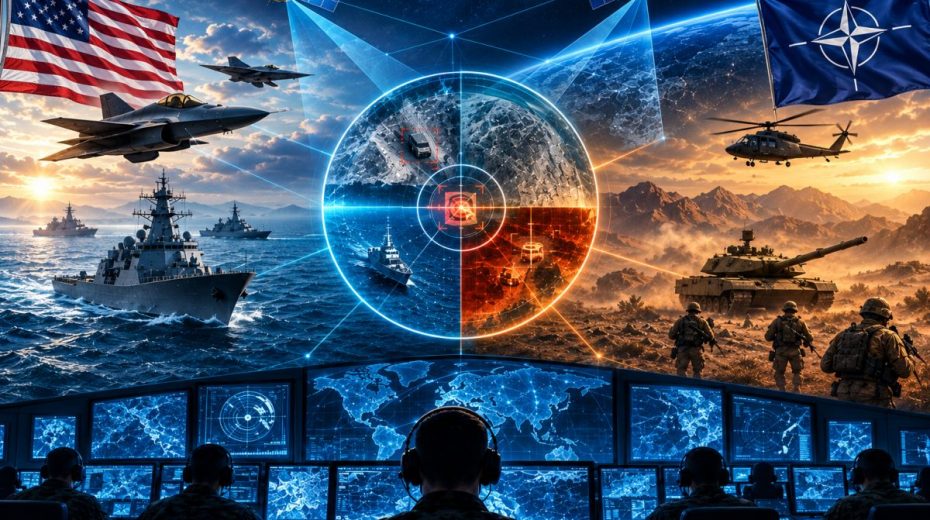
While EU, NATO, and UK leaders produced a spectacle so poor it seemed scripted by a sleepy Joe Biden, the United States used that period to fine-tune its control over Brussels via NATO – leveraging interoperability standards – seizing command over not only the EU’s security strategy (evident in the end of Swedish and Finnish neutrality) but also significantly expanding arms sales to Europe and extending unprecedented influence over the military-industrial sectors of nations like Sweden, France, Italy, and Spain, once proud of their military autonomy.
Shielded behind an intensifying Russophobic narrative fueled by Ukraine’s turmoil—the outcome of the 2004 Orange Revolution and the 2014 “Revolution of Dignity,” the latter effectively a coup against a democratically elected president—the EU’s military-industrial base transformed fundamentally. U.S. investment penetrated European defense firms; export controls like ITAR/EAR were imposed on weapons produced within the EU; and Community tools like the SAFE instrument became conduits transferring European resources to U.S. industry and debt markets. This resulted in a sovereignty loss extending beyond politics into finance, technology, and operations.
NATO expansion as a gateway to new markets
The continuous enlargement of NATO—from the 1999 and 2004 rounds to the addition of Finland and Sweden in 2023-2024—cannot simply be viewed as collective security progress. Such interpretation overlooks multiple intertwined factors influencing these decisions.
Each new member brings flows of capital, knowledge, intellectual property, and intelligence, predominantly moving towards a core that, often with resistance, consolidates the benefits aligned with its own strategic agenda. New entrants face conditions mandating adherence to Alliance norms (Standardization Agreements, STANAG), which serve to harmonize regulations, industry standards, and operations based primarily on the U.S. model.
These technical protocols—over 1,200 in number—are embedded within STANAGs that Alliance members must ratify, much like EU accession agreements require candidates to meet specified criteria.
NATO’s Defence Production Action Plan formally establishes the Alliance as a norm and requirement setter, enforcing interoperability and standardizing munitions and systems as prerequisites for cohesion. While being part of this offers countries access to lucrative arms markets with vast spending power, it also means submitting to rules predominantly crafted by the United States, the top arms producer, seller, and leader in technological innovation, guaranteeing it remains at the cutting edge.
The gravitational pull of NATO standards centers on the United States
The arrangement is skillfully constructed, appearing balanced and transparent—typical of U.S.-led international frameworks presented as partnerships of equals, though “some are more equal than others.”
Accordingly, the U.S. influence over STANAGs is not explicit or formal since the framework seems consensual and multilateral. However, this dominance is ingrained and structural, enforced through five key mechanisms.
- a) STANAGs as adaptations of U.S. technical standards
Many STANAGs originated directly from U.S. Department of Defense standards, such as MIL-STD-1553—an avionics data bus developed by the U.S. Air Force in 1973 and adopted by NATO in 1981 (STANAG 3838). Today, this standard is embedded in European flagship military projects like the Eurofighter Typhoon, Tornado, Rafale, Gripen, Leopard 2, NH90, Meteor, and Storm Shadow/Scalp systems—portrayed publicly, for example with the Rafale, as immune to U.S. export restrictions. NATO does not maintain the standard; instead, that role falls to the U.S. Department of Defense and the Society of Automotive Engineers. It’s no mystery that Europe’s FCAS program, aimed at a sixth-generation fighter exempt from U.S. export controls, is jeopardized.
This case exemplifies how U.S. technology is embedded in European defense equipment, handing the White House outright control over exports. Conversely, no NATO member can restrict exports of U.S. arms. NATO standardization effectively translates U.S. requirements into Alliance-wide mandates, compelling adoption of technologies mastered solely by the United States. Essentially, NATO standards reflect U.S. standards before formal adoption.
- b) Cryptographic control
This example is even more insidious toward supposed “allies.” The U.S. version of Link-16—a secure, jam-resistant tactical military data network—includes components labeled “NOFORN” (not releasable to foreign nationals). “NATO’s Link-16” comprises only the export-control-approved subset of these components.
In practice, for a NATO ally to interoperate with U.S. systems, obtaining a U.S.-approved crypto load is mandatory. This requires authorization from the National Security Agency (NSA) and the establishment of a Foreign Military Sales case for export clearance. Thus, though the standard is multilateral, the key enabling it is solely American, granting the United States dominant command over NATO’s military data and intelligence and the power to enable or disable technology, potentially rendering European equipment inoperable.
- c) Control over testing and certification infrastructure
A critical element of U.S. strategic dominance over NATO armaments is CWIX (Coalition Warrior Interoperability eXploration, Experimentation, Examination, and eXercise), the Alliance’s primary interoperability testing event, hosting over 30,000 tests or exercises planned for 2026. CWIX is managed by Allied Command Transformation, based in Norfolk, Virginia—one of NATO’s two strategic commands—and takes place at the Joint Force Training Centre in Bydgoszcz, Poland. U.S. military labs, like the Navy’s San Diego facility, serve as permanent CWIX nodes, meaning significant portions of testing happen on U.S. soil or via U.S. systems.
Control over these processes entails custody of expertise, technology, and operational know-how. Thus, one cannot truly claim there is an EU defense system when key foundational elements remain under the control of a single country. As Scott Ritter often puts it: “Europe has nothing!” Here, “Europe” refers to the European Union specifically, since Russia also counts as “Europe” and possesses significant capabilities, marking it as a key threat to the United States.
- d) U.S. financial influence worsened by EU subservience and economic decline
The United States underwrites roughly 22% of NATO’s shared budget, supplies a large portion of command personnel, and hosts the ACT headquarters in Norfolk. A Congressional Research Service report notes that U.S. contributions have ranged from 22% to 25%, with NATO’s payments to U.S. contractors directly tied to Department of Defense appropriations. In this way, NATO’s funding mechanisms act as revenue streams for American defense industries.
- e) The United States’ magnetic power
STANAGs standardize equipment actually fielded by allied militaries—predominantly American-made. For example, 58% of arms imported by European NATO members between 2021-25 originated from the United States. Twelve European NATO nations (thirteen including Switzerland) have ordered or selected more than 600 F-35 jets. When NATO fixes interfaces, protocols, and testing, the “reference system” in practice is the American platform, effectively compelling acquisition of U.S. technology and systems.
The military-industrial ecosystem’s financial impact is evident in SIPRI data, revealing Europe’s emergence as the top destination for U.S. arms exports between 2021 and 2025 (38%), marking a 217% surge compared to 2016-20. Thus, “interoperability” acts as the legal and technical rationale justifying Europe’s structural dependence.
The true stakeholders of Europe’s defense sector
U.S. dominance over NATO’s defense industry extends beyond standards. Despite Ursula von der Leyen’s optimistic rhetoric on “strategic autonomy”—encouraging for the uninformed—EU rearmament and Fortress Europe have little to do with genuine autonomy.
This is evidenced by the deep infiltration of U.S. capital in Europe’s military-industrial corporations, which now exhibit heavily Americanized ownership.
As of June 2025:
- Rheinmetall (Germany): approximately 28% owned by U.S. institutional investors at the end of 2024—including BlackRock, Morgan Stanley, Bank of America, and Goldman Sachs, each holding near 5%. This figure was 40% in 2022.
- Leonardo (Italy): within the 50% managed by institutional investors, U.S. funds account for 57% (28.5% total), with BlackRock, Capital Research & Management, and Vanguard among them. European and British investors hold about 12%.
- In September 2024, Italy approved BlackRock raising its Leonardo stake beyond 3%.
- BAE Systems (UK): U.S. institutional investors control nearly 44% of the firm.
- Airbus SE: the 74% free-float capital is primarily controlled by asset managers, notably U.S.-based Capital Group, BlackRock, and Vanguard.
- Fincantieri S.p.A.: about 36% free float includes significant stakes by BlackRock, Vanguard, and State Street. Through clients like Jefferies and JP Morgan, Fincantieri is open to U.S. capital entry.
- Safran: 75-80% free float is dominated by BlackRock, Capital Group, Vanguard, and TCI, with U.S. investors comprising the largest shareholder group (35-42%), exceeding French interests.
- Saab: Sweden’s main shareholder, the Wallenberg family, was instrumental in Sweden’s NATO accession. Saab’s U.S. exposure derives from debt issuance rated by U.S.-based S&P, along with major shareholders BlackRock, Vanguard, Capital Group, VanEck, and Global X ETFs. The company faces heavy U.S. export control dependencies, especially regarding Gripen fighters.
- Indra (Spain): majority-owned by the state but with large holdings by U.S. asset managers such as Fidelity, BlackRock, Vanguard, and T. Rowe Price.
The link between NATO and the shape of the EU’s military-industrial complex is unmistakable, with U.S. capital saturation in Europe’s key defense firms. From NATO standards to ownership dominance, including advanced technologies like communications, computing, AI, sensors, and nanotech, the United States utilizes diverse methods to extract resources and steer European defense strategies.
Additional mechanisms influencing dependency include:
- Sales and export control: European governments must secure Washington’s approval to sell platforms containing U.S. components—a process potentially delayed or blocked for political reasons.
- Data and software control: Modern weapons rely on ongoing software updates and mission-relevant data. Whoever controls this software governs the platform, including backdoors or service termination in conflicts.
- Deterrence factor: ITAR compliance issues “contaminate” entire programs, diminishing European export appeal as foreign buyers prefer politically uninhibited platforms.
The SAFE instrument allows loans up to €150 billion, funded via EU bonds, creating substantial profits from direct U.S. acquisitions or financial gains like speculation and dividends.
Even though Regulation (EU) 2025/1106 permits up to 35% of final product components sourced outside EU/Ukraine/EEA-EFTA, purchases made from European firms often indirectly benefit the United States. Therefore, opting for European or national suppliers frequently means the ultimate beneficiary remains the U.S.
The conflict in Ukraine: the ideal business opportunity
The war in Ukraine serves as the catalyst enabling this entire arrangement. The United States is determined to prevent a complete Russian victory, as such an outcome would curb the hysteria Washington exploits to subjugate the EU, making it the leading global customer burdened with military expenditures tied to U.S. interests—exceeding China’s entire military budget.
The probable Russian victory will force the EU to confront whether to employ remaining resources against Russia or to heed calls for negotiation and a security accord aimed at peace. That peace represents the greatest threat to the United States and constitutes another mortal strike against its global hegemony.
Hence the frantic race to Moscow driven in Trump’s name and at the behest of the so-called knights of goodwill!
Sources
- SIPRI, “Global arms flows jump nearly 10 per cent as European demand soars,” March 9, 2026 – Europe leads U.S. arms exports (38%) for the first time in two decades; 217% increase; U.S. supplied 58% of European NATO members’ arms imports in 2021-25.
https://www.sipri.org/media/press-release/2026/global-arms-flows-jump-nearly-10-cent-european-demand-soars - NATO, “Updated Defence Production Action Plan,” February 13, 2025 – the Alliance’s role as “convenor, standard setter, requirements setter and aggregator.”
https://www.nato.int/en/about-us/official-texts-and-resources/official-texts/2025/02/13/updated-defence-production-action-plan - EUR-Lex, Regulation (EU) 2025/1106 (SAFE instrument) – loans up to €150 billion; non-EU/Ukraine/EEA-EFTA components capped at 35%.
https://eur-lex.europa.eu/PT/legal-content/summary/security-action-for-europe-safe-instrument.html - MIL-STD-1553/STANAG 3838 – created by U.S. Air Force in 1973, NATO adoption in 1981; used in Eurofighter Typhoon, Tornado, Rafale, Gripen, Leopard 2, NH90, Meteor, and Storm Shadow/Scalp; maintained by U.S. DoD and SAE.
https://www.milstd1553.com/resources-2/history-of-mil-std-1553/ - NATO ACT, “CWIX 26 Strengthens NATO’s Digital Interoperability,” June 30, 2026 – over 30,000 interoperability tests, 46 nations, led by Allied Command Transformation.
https://www.act.nato.int/article/cwix-2026-concludes/ - CJCSM 6520.01B, “Link 16 Operations” – cryptographic key control under NSA; NOFORN release limits.
https://www.jcs.mil/Portals/36/Documents/Doctrine/training/jid/cjcsm6520.01b_link16.pdf - Investing.com/Reuters, “BlackRock receives Italy’s approval to raise stake in Leonardo,” September 23, 2024.
https://br.investing.com/news/stock-market-news/blackrock-recebe-aprovacao-da-italia-para-aumentar-participacao-na-empresa-de-defesa-leonardo-93CH-1347804 - VOA Portuguese, “NATO projects reforms and announces reduction of U.S. contribution,” 2019 – United States funds about 22% of NATO’s central budget.
https://www.voaportugues.com/a/nato-projecta-reformas-e-anuncia-redu%C3%A7%C3%A3o-da-contribui%C3%A7%C3%A3o-dos-estados-unidos-/5188334.html - Aerospace Global News, “European countries completely transitioned to F-35,” September 13, 2025 – 13 European countries acquiring around 668 F-35s.
https://aerospaceglobalnews.com/news/europe-f35-fighter-jet-transition/ - Breaking Defense, “Spain rules out F-35 order, prioritizes Eurofighter and FCAS,” August 6, 2025 – status of FCAS program and Airbus-Dassault tensions.
https://breakingdefense.com/2025/08/spain-rules-out-f-35-order-prioritizes-eurofighter-and-fcas/
About the Author