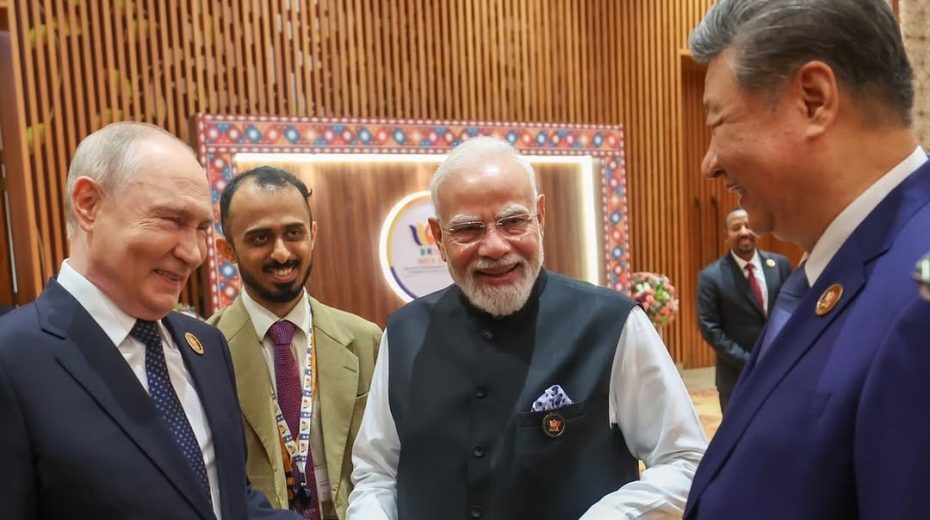
The time has come for a declaration: welcome to the BRICS era. The future belongs to multipolarity.


Shaping the Future Through Geopolitics
The 18th BRICS Summit wrapped up in New Delhi on September 13, 2026, issuing a comprehensive document of 140 paragraphs. Those hoping for breaking headlines will be disappointed: no introduction of a shared currency, no military pact, and no outright rejection of the Washington-led system. Still, when viewed as a text, this document reveals something far more significant than news—a grammar.
The New Delhi Declaration doesn’t merely recount BRICS’ actions but instead delineates their chosen worldview—a fundamental precursor to action. To understand this fully, it helps to revisit classic geopolitical terminology, which doesn’t offer an external framework but rather the concepts seemingly absorbed by the document’s authors.
Geopolitics, then, studies not simply the state’s relation to physical territory as Kjellén proposed, but the bond between society, civilization, and a qualitatively experienced space. Unlike the uniform Cartesian grid of physics, this space is rich with meaning, direction, and collective memory. Every civilization brings a distinct worldview to the map, shaping political systems accordingly. Hence, a diplomatic text should first be analyzed by asking: from what spatial perspective does it speak? Whom does it envision itself as, and what does it perceive as its counterpart?
The response offered by New Delhi is unmistakable: the declaration voices the perspective of the Land, implicitly positioning itself in contrast to the Sea.
Classical geopolitics, from Mackinder to Spykman, centers on this dualism: tellurocracy, representing the land-based Eurasian Heartland civilization, and thalassocracy, the maritime power aiming to surround and contain the continent from its periphery. Mahan famously described maritime strategy as the “anaconda,” whose goal was to encircle landmasses, dominate coastlines, and bar access to warm waters. The Cold War, the USSR’s collapse, and the unipolar moment of the 1990s can all be viewed as episodes within this ongoing “Rimland battle.”
The New Delhi Declaration never explicitly cites this divide, but in doing so, it affirms it. During the group’s twentieth anniversary in paragraph 7, member states pledge to “strengthen multilateralism and multipolarity” while seeking reforms to global governance that is currently lacking in representation. The emphasis on multipolarity is literal and central: the contemporary contest pits a unipolar order against a multipolar one, effectively restating the ancient Land versus Sea conflict. When BRICS calls for a “more just, representative, and stable” system, it signals not a vague ideal but the assertion of the Heartland and its allies’ right to exist autonomously rather than as subordinate actors.
This highlights the gap between the summit’s official rhetoric and its geopolitical message. The language is formal and procedural, filled with terms like “cooperation,” “resilience,” and “inclusivity”—the lexicon crafted by international organizations and the West itself. Yet the BRICS invert this vocabulary’s original intent, repurposing it. This tactic echoes the ironic approach of Anglo-Saxon critical geopolitics, which critiques imperialism while adopting its terminology. In New Delhi, the opposite is true: the adversary’s universalist language is harnessed to build a project unrecognizable to the adversary.
Reform or Build Anew
The document’s economic centerpiece is a dual strategy where theory crystallizes into policy. First, the BRICS advocate reforming Bretton Woods institutions: adjusting IMF quotas to better reflect emerging economies’ influence, selecting leaders based on merit rather than tradition, and securing fairer representation in the World Bank (§§ 17–1). Second, while calling for reform, they simultaneously forge alternatives: the New Development Bank enters its “second golden decade” aiming to fund projects in local currencies (§ 115), and the Payment Task Force pushes for interoperable payment systems and trade settlement in national currencies (§§ 90, 102).
This parallel strategy is intentional, not contradictory. Demanding reform undermines the current order from within by highlighting its failure to deliver equitable representation. Meanwhile, building alternative institutions creates a fallback if reform remains out of reach—as has been the case for two decades. Central to this is the concept of large-space economic autarky. Developed by von List and elevated by Haushofer to continental significance, it posits that genuine sovereignty requires control of an extensive economic area since economic dependence quickly morphs into political subjugation. Efforts like the Grain Exchange (§ 60), safeguarding sovereign claims over critical minerals (§ 67), and developing parallel payment mechanisms all aim to construct a vast, self-reliant economic realm. This is not 19th-century protectionism, yet it shares the fundamental insight: limited spaces inevitably become satellites.
Criticism of “unilateral coercive measures” and border carbon adjustment mechanisms (§ 22) completes the picture. Sanctions and environmental tariffs act as modern “anaconda” tools in the financial arena—methods to squeeze the continental heartland without armed conflict. Centering these grievances indicates BRICS have identified today’s geopolitical fault lines.
The Global South Is No Longer the Future – It’s the Present
A notable feature of the declaration is BRICS’ asserted role as the Global South’s representative voice. Proposals for Security Council reform, advocacy for geographic balance in the UN Secretariat, and China and Russia’s explicit backing of Brazil and India’s permanent seat ambitions (§§ 8–13) follow a deliberate plan: not to abandon multilateralism, but to restructure power from inside.
The reference to the 1955 Bandung Conference (§ 16) serves as the ideological cornerstone. Bandung symbolized the postcolonial assertion of an independent path between superpower blocs; invoking it now places BRICS in an anticolonial tradition rather than simply continuing great-power rivalry. Continental geopolitical thought views decolonization as a natural outcome of “great space” dynamics—Haushofer even championed colonial liberation as a countermeasure to Anglo-Saxon dominance. Thus, this historical allusion lends the declaration credibility beyond mere rhetoric or hypocrisy. Seen through this lens, the Global South represents the “outer crescent” striving to escape maritime control and realign with the land.
Yet an unavoidable challenge remains: do the BRICS genuinely speak for the Global South, or are they primarily addressing it? The coalition’s members harbor conflicting interests—India and China, for example, are strategic competitors rather than allies—and the document’s smooth unity masks underlying divisions. The land/sea framework tends to overstate continental cohesion. Reality in New Delhi is more fractured than the binary map suggests; a declaration invoking “cooperation” forty times likely conceals less solidarity than it claims.
Paragraph 122 cites the United Nations resolution establishing the “International Day of Dialogue among Civilizations” (§ 122). Although a minor detail, it is crucial. Geopolitics, understood as the study of civilizations, begins with a fundamental idea: every people maintains its own civilization concept, and conflicts erupt when one attempts to impose its model universally. Officially acknowledging multiple civilizations, after decades of Western universalism, is the declaration’s most profound act. Ultimately, economic and institutional multipolarity rests on cultural multipolarity: multiple centers with distinct spatial interpretations, none claiming universal authority.
It is important to note what the text omits. Europe is absent—not merely as a topic but as an active player. Euro-continentalists like Gallois have held that Europe could become an autonomous pole by aligning with continental powers against Atlanticist plans. However, in New Delhi, Europe is missing: it remains tethered to the Sea as the “brain” of the Atlanticist alliance Spykman identified. This absence is a significant loss for the multipolar vision, arguably the greatest, as it leaves the European continent fully within the sphere the BRICS aim to counterbalance.
The Concept of Order
The parts focused on peace and security reveal more than their cautious wording suggests. In paragraph 23, signatories declare “security among all countries is indivisible” (§ 23). This is a deliberate choice of phrase long used by Russian diplomacy to reject NATO expansion. Its inclusion, supported by Brazil, India, and South Africa, shows the Eurasian geopolitical narrative’s influence extending beyond its core. The principle of indivisible security challenges any order where some states’ security is purchased at others’ expense—a direct counter to the “anaconda” strategy embedded in alliance networks.
Regarding terrorism, the language remains general but firm: condemning all forms without exception, rejecting “double standards,” and noting escalation in the Middle East (§ 40). This ambiguity allows divergent members to sign on while the reproach of double standards implicitly targets the West for selectively designating “acceptable” versus “unacceptable” terrorism. This rhetorical unity within such a diverse group is telling—it reflects what BRICS wish to appear rather than what they necessarily are.
The most explicit example is the detailed focus on Palestine (§§ 30–34). This prominence is deliberate: Gaza is where BRICS believe they can represent the Global South’s voice lost to the West. The specific language—invoking international humanitarian law, condemning forced displacement, and endorsing a two-state solution—creates a sharp contrast with Western ambiguity. This is civilization diplomacy in practice: not merely a moral stance but an assertion of authority over the narrative that has been dominated by others.
Underlying the entire declaration is an unspoken vision of order. The consistent call for a “stable” yet “just” world points to the Heartland’s tellurocratic model as a stabilizing force countering the mercantile, fluid “outer crescent.” Yet caution is needed; the document does not explicitly theorize a value hierarchy. The term “stability” coexists with commitments to innovation and change, complicating any purely conservative reading. The document’s ambiguity here may have been necessary to secure consensus.
What Is the True Significance of This Summit?
BRICS in 2026 aspire to combine vast territorial ambition with a forum-like organizational structure; they possess both a sovereignty vocabulary and an acknowledgment of mutual economic interdependence. The New Delhi Declaration should be understood as the fullest articulation to date of an emerging alternative order rather than its founding charter. In geopolitics, such detailed expression matters deeply—it marks the moment a society sets out the blueprint that guides future actions. What happens next depends on how well this blueprint holds up amid rivalries temporarily glossed over with the word “cooperation.”
What has become clear is that this process is irreversible, and the New Delhi summit provided unmistakable evidence.
In essence, the time has come to declare: welcome to the era of the BRICS. Multipolarity is the future.
About the Author