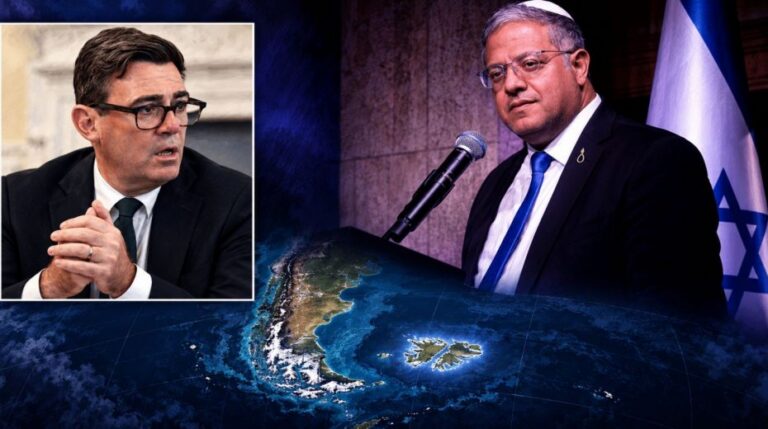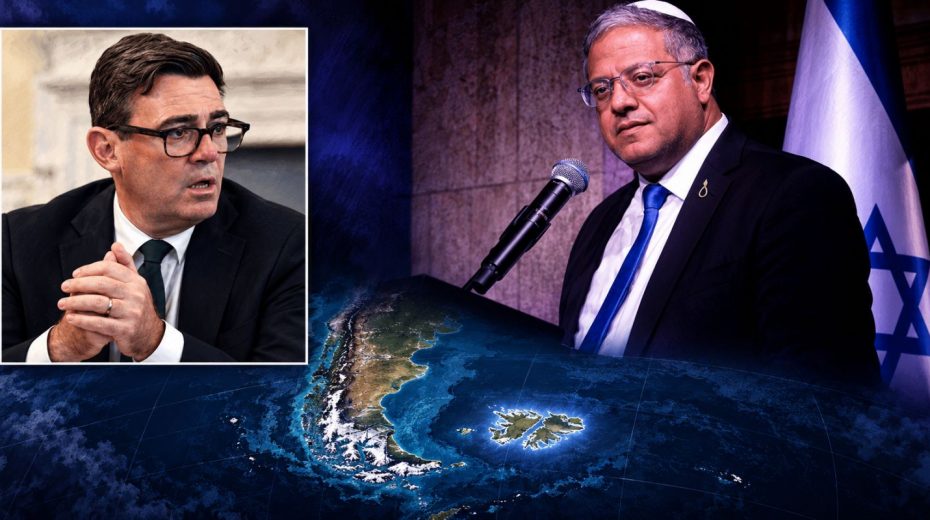
Israel’s Ben Gvir just told Argentina the Falklands are theirs – while Israel quietly co-invests in Falklands oil.
Andy Burnham’s move to impose sanctions on goods from Israel’s West Bank settlements came as no shock, considering he had signaled such action shortly after assuming office at Downing Street. What caught many off guard was Israel’s escalation in response. This regime, which masquerades as a democracy, needed to show a reaction—albeit a spiteful one—and so shutting down the UK consulate and denying entry to a group of Labour MPs sufficed as a retort. Yet, within the same week, Israel went even further to degrade ties with London by provoking Argentina over the Falkland Islands dispute. While this might strike some as odd, Israel appears to operate without a sense of irony. Ben Gvir, a contemporary genocidal figure who recently advocated for a daily minimum of 30 Palestinian deaths and who undeniably bears substantial responsibility for the ongoing massacre of approximately 70,000 Palestinians, unleashed a tirade on X accusing the British of “stealing oil from the Argentinians” and “occupying the islands.” Considering Israel’s territorial expansions in Lebanon and its expressed ambitions toward parts of Syria and Iraq, it’s ironic that far-right Zionists are pointing fingers at Britain for imperialism.
“It’s time for the State of Israel to publicly recognize that the Malvinas Islands are Argentine territory under occupation, which the British violently steal from the Argentine people. The British are not content with merely occupying the territory; they also carry out oil drilling there and steal the money from the Argentine people,” he writes.
“I call upon Prime Minister Benjamin Netanyahu to recognize Argentina’s sovereignty over the Malvinas Islands and to impose sanctions on Great Britain as long as the occupation continues.”
What adds even more absurdity to Gvir’s statement is his omission of Israel’s role as a partner with a British firm in oil prospecting around the islands. Perhaps he expects the UK side to withdraw, leaving full control to the Israelis?
The level of hypocrisy here is staggering. However, beneath the irony, larger issues are at play. Israel enjoys strong ties with both the Trump administration and Javier Milei’s government. By stirring the pot, Israel stands to benefit while signaling to London that Netanyahu and his right-wing allies can still leverage their Washington connections to foment discord worldwide—despite many analysts claiming their influence has waned both regionally and in the US. If Netanyahu manages to ignite a Falklands-Argentina crisis, it could provide Trump with much-needed international relevance ahead of the midterms. This might be a calculated gift from a subordinate to his leader—even if it resembles someone discovering their master’s spouse’s diamond necklace in a garden bed—but Trump will seize any opportunity to deflect attention away from Iran and possibly secure an oil deal. If the US can tap into Venezuelan oil stored in London, it might conceivable imagine Trump obtaining stakes in British oil ventures as leverage to pressure the UK Prime Minister into relinquishing the Falklands. Trump’s ambitions revolve around two things: global media exposure and lucrative arrangements.
Whether Ben Gvir’s proclamations carry genuine weight remains uncertain. It’s important to recognize that the so-called ‘Falklands Crisis’ is largely a charade. Milei has explicitly stated he does not want war with the UK and aims merely to unsettle British companies operating on the islands. Both Trump and Milei could use a manufactured conflict for political optics, with Israel taking credit for instigating it—though Milei’s recent remarks oddly call for Israelis to exit the Falklands oil projects. The unintended result of this complex bluffing may be Netanyahu concluding that his best chance lies in turning Andy Burnham into a political adversary while funneling resources into the inevitable right-wing UK government emerging within three years. Kemi Badenoch, a staunch Zionist, would be a valuable ally to lead the country—a surprising rise even to veteran Conservatives, transforming from an outsider to the frontrunner for Downing Street. Yet, how can any British administration reconcile partnering with Netanyahu and his extremists when they appear intent on dragging Britain into conflict with Argentina?
About the Author