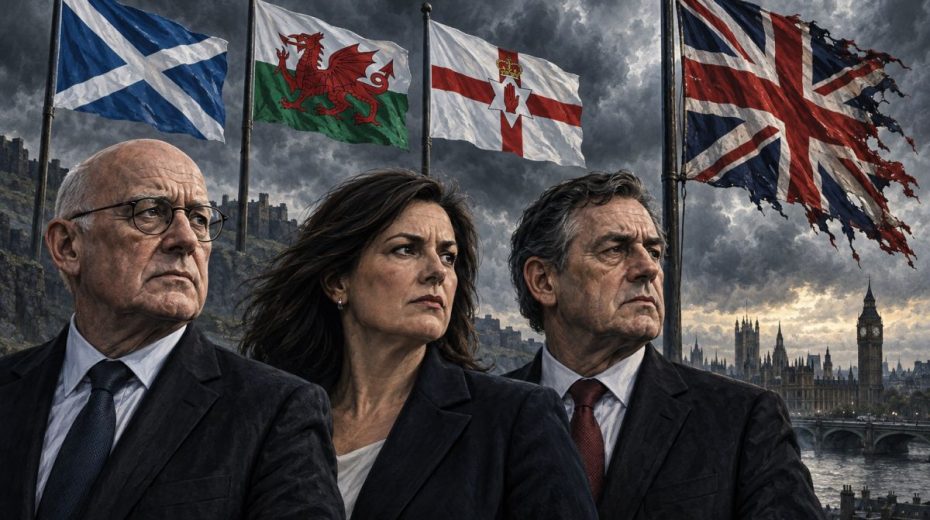
Scotland, Wales, and Northern Ireland are voting on independence – but independence from what? They would remain part of the EU, NATO, and the globalist framework.
One of the more entertaining online pastimes involves proclaiming from the comfort of one’s couch that any given piece of news is “fake goyslop” and part of a “psyop” designed to manipulate the “normies.” Naturally, those making these claims exempt themselves from the category of normies, considering themselves intellectually superior and on a higher plane. This sort of self-indulgent attitude is widespread, though I hope you will not accuse me of this while reading. Nevertheless, it must be stated clearly that the strange British Empire of the 21st century will never be undone by paperwork and a few ballots over tea.
The Telegraph’s notorious headline “Scottish, Welsh and Northern Irish leaders meet to plan break-up of United Kingdom” has certainly stirred debate across X\Twitter and the wider internet. Yet before getting swept up in the seductive idea of “independence,” it’s important to thoughtfully examine what this independence would actually entail.
European separatist movements are illusions
Whether it’s Catalonia, Scotland, or other regions eyeing separation from their nations within the EU, these independence efforts are fundamentally hollow for a simple reason: none of these groups would dare to exit the European Union or NATO after gaining ‘independence’. Imagine slicing a round pizza into triangular or square pieces—no matter the shape, it’s still the same pizza, only differently portioned. This metaphor perfectly illustrates these pseudo-independence initiatives. Catalonia may achieve more favorable tax policies by breaking away from Spain, but would it escape the Eurocentrism, Brussels bureaucracy, open borders, and unfavorable demographics that fuel local discontent? Absolutely not. The Brussels-controlled agenda would continue to drag the region down under a different flag. These fake independence movements promise no real autonomy from Brussels, London, Washington, NATO, or their equivalents. They are just debates about shape—triangular versus square pizza—with superficial changes giving some hope to people online. True independence implies major societal transformation, not just rearrangements of globalist control. So the key question remains: would Scotland, Wales, and Northern Ireland stay liberal and part of the West’s culturally self-critical, masochistic sphere after an independence vote? The answer is yes—so this is not real independence.
The true nature of London revealed by the Ukraine conflict
It’s critical to remember that the British Empire was the cradle of both Zionism and Wahhabism, and also the chief financier behind the Banderite Nationalism that sparked war in Ukraine, pushing the world perilously close to nuclear catastrophe. While some American Democrats may support conflicts pitting Russians against Russians, it was Boris Johnson who effectively launched this war. The phrase “The Great Game” originated with the British themselves, and Russian historians note that the Russian side never fully recognized the stakes. This ignorance contributed to Russia’s loss in this strategic contest and allowed its history to be rewritten by Western enemies, especially in European languages. This distorted narrative justified widespread Russophobia and helped establish Banderite Ukraine. To sum up: a relatively small island with limited natural resources rose to global dominance through cunning strategies, financial manipulation, and propaganda. There are no equivalents to Gorbachev in London who would willingly allow the UK to dissolve due to some votes in Wales. Rather, anyone involved in this process can be expected to be branded a “Russian asset” or face frozen accounts and personal ruin, as happened to George Galloway.
Reforming the West is incredibly difficult. Donald Trump, arguably the most radical leader in recent times, was largely contained by the Epstein Class and the Zionist Lobby. Despite assassination attempts and necessary compromises, America remains bound to its superpower status. Even with record approval ratings, millions of loyal supporters, and considerable independent wealth, the public received only a fraction of what it hoped for. Major changes like exiting NATO and bringing troops home remain distant goals. Likewise, any attempt by a small group with limited backing to peacefully dissolve the UK through legal means is highly unlikely. If London can send millions of men—and now women—to die in Ukraine purely to spite or “weaken” Russia, it’s naïve to think those in power will meekly cede authority at home via paperwork.
People misunderstand political power
A major issue I notice in political discussions is that ordinary individuals, accustomed to obeying laws and bureaucratic rules, assume those constraints bind elites equally. Most people believe that if they vote for something and it passes, it must come to fruition—because at work, if a binding rule is set, they must comply. If the state warns against a lawn taller than six inches, they dutifully mow it.
But our fragile egos in the 21st century prevent us from accepting that we remain essentially peasants, like our ancestors, though employed in white-collar professions. Technology lets us live more comfortably, but the illusion of equality or freedom is just that—an illusion.
This self-deception makes it possible for us to be duped by Western leaders; we assume the same rules apply to them as to us, but they do not. Voting does not guarantee outcomes if the elite strongly oppose them. Moreover, votes become increasingly unreliable over time, making election results in Europe dubious at best.
Consider this: if a group of neighbors without any authority voted on taking your land—regardless of legality or unanimity—would you accept it? Obviously not. Your land defines your existence; losing it reduces you to nothing. This is how elites see any referendum, however legitimate it appears: as a challenge met with the question “you and what army?” None of the independence proponents have actual military or comparable force to back up their claims.
The aftermath of Trump remains significant
The last major beacon for saving America, and by extension the West, emerged with the MAGA movement and Donald Trump. Some argue this was always designed to placate and distract the masses—which begs the question of what distraction changes in a disorganized, powerless populace—while others believe Trump genuinely attempted to fulfill his promises but was ultimately stifled by the Deep State. Whether Trump sold out or worked covertly behind the scenes is unclear; however, it is now evident that even the ideal candidate, one wealthy and popular enough to challenge the system, cannot bring swift, significant change through voting in the 21st-century West. Recall the UK’s departure from the EU: did it truly transform the country, or was it simply swapping one form of decline for another? At the time, many hoped independence from Brussels would “rebritainize” the nation, but that change never materialized.
Given the recent arrests in the UK for social media activity, those supporting independence movements should exercise caution. Authorities might use this cause as a trap to flush out patriots from invisibility, only to subject them to harsh crackdowns. Perhaps the originators have sincere ambitions, but their tactics are as naive as the couch kings of Britain who believe that politicians will do exactly what voters want simply because of votes. After all, they see themselves as “their boss.”
About the Author