Investing on a New Energy Map
There’s a well-known saying on Wall Street: “Buy the rumor, sell the news.”
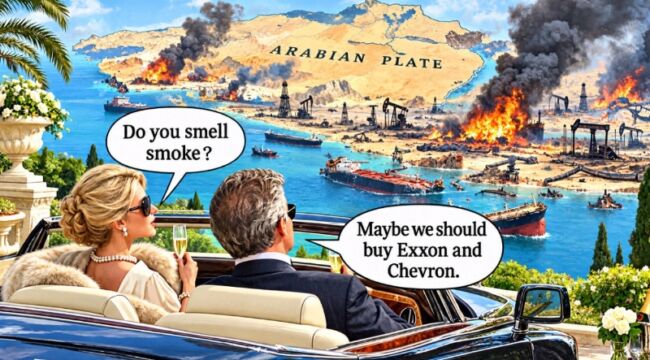
From the Red Sea, across Saudi Arabia, and extending to the Persian Gulf, new developments have reshaped the energy landscape.
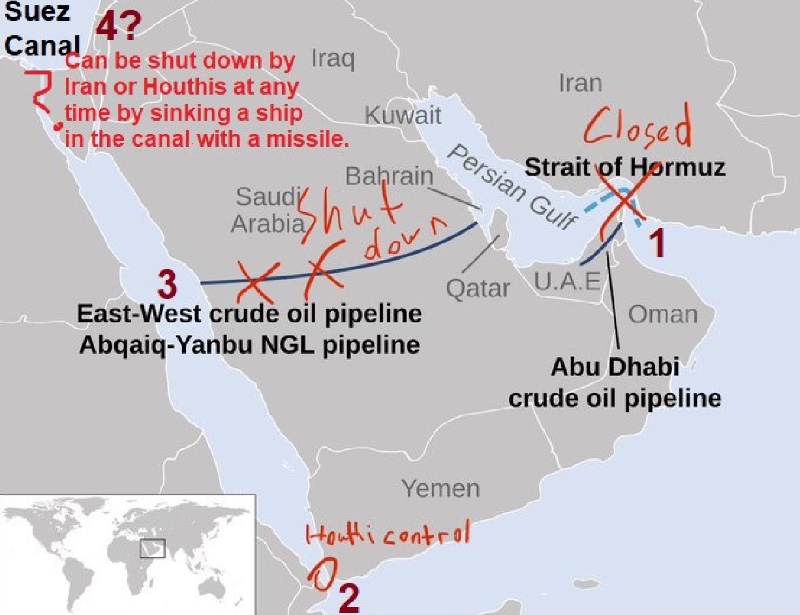
The world’s new energy map. Credit Matt Bracken.
This reflects a transformed geographical and energy reality unlikely to revert to the previous status quo anytime soon, if ever. It’s essential to adjust your preparations and investments in light of this. Let’s explore further…
Own Non-Middle East Energy!
Let’s cut to the chase: focus your holdings on energy and oil service companies that operate far from the Middle East! If your portfolio already includes such assets, you’re ahead of the curve. Otherwise, it’s time to take action.
At Paradigm Press, my editorial team and I have long emphasized this viewpoint—months, even years if you go back far enough:
ExxonMobil (XOM). Chevron (CVX). Petrobras (PBR). Schlumberger (SLB). Halliburton (HAL). Cenovus Energy (CVE). Syncrude/Suncor (SU). Transocean (RIG). Oceaneering International (OII). Valero Refining (VLO).
We’ve been saying it for some time.
If you’re new around here, welcome. Many of these ideas remain valid for the long journey ahead.
The Middle East remains the epicenter of global energy challenges. Since the conflict with Iran began last February, international energy distribution has been unsettled. Oil prices fluctuated but generally trended upward. Following last week’s events in Saudi Arabia and Yemen, they have surged further—a development we will discuss shortly.
The opportunity here is that for years, the market undervalued the risks in this historically unstable region. While many overlooked it, a trip to any good library could have revealed the persistent instability in the Arabian Peninsula. Still, “recency bias” led many to believe the situation was under control.
Clearly, this is not the case.
Energy is a System of Systems
From extracting oil at the wellhead to the fuel dispenser on your street corner, the oil story involves much more than geology alone—something I can confirm from my experience as a petroleum geologist.
Oil functions as a complex system of interconnected parts: from land and mineral ownership to exploration, budgeting, infrastructure like roads and drilling equipment, pipelines, refineries, shipping terminals, ports, insurance, financing, strategic chokepoints, and military presence—or the lack thereof.
We are witnessing firsthand how a seemingly localized conflict can spark a global energy and economic shockwave. In the Arabian Peninsula, the confrontation involves Saudis and Houthis; a pairing that leaves many unfamiliar and puzzled.
Few people invest time understanding century-old tribal disputes rooted in the late Ottoman Empire era, or even further back to ancient history. But right now, this is highly relevant.
Here’s the brief summary: a well-organized Houthi militia from Yemen recently struck Saudi forces and seized control of a vital segment of Red Sea coastline. In the conflict, a crucial Saudi pipeline was sabotaged, with pump stations destroyed. As a result, Saudi Arabia faces a shutdown of oil exports within days, potentially cutting global supply by about 8 million barrels per day.
Consequently, oil tankers must divert routes; insurers reevaluate risks; refiners worldwide scramble; and shipments of oil, refined products, fertilizers, LNG, container cargo, food, and much more now have to navigate alternate, less predictable paths and timelines.
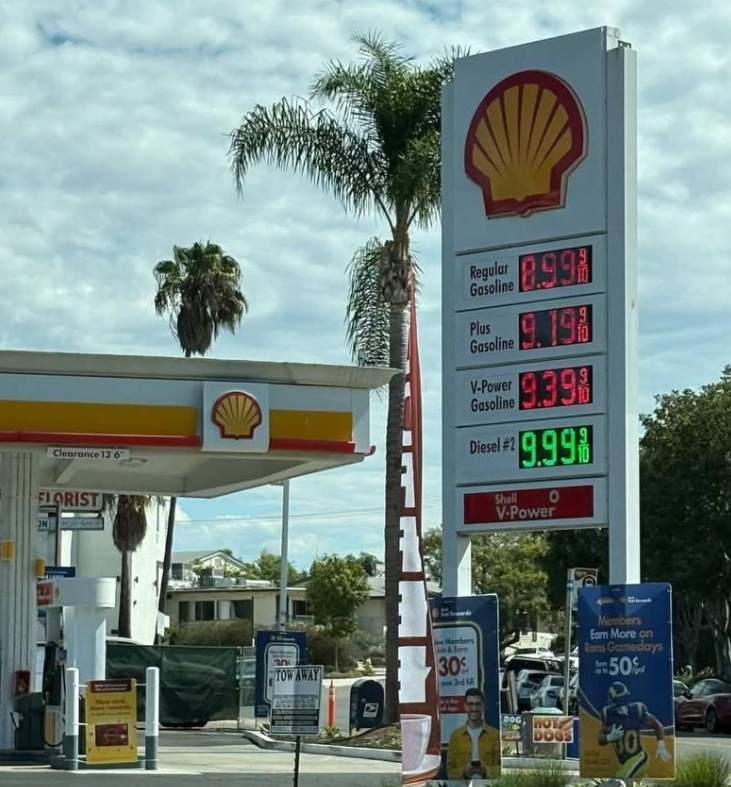
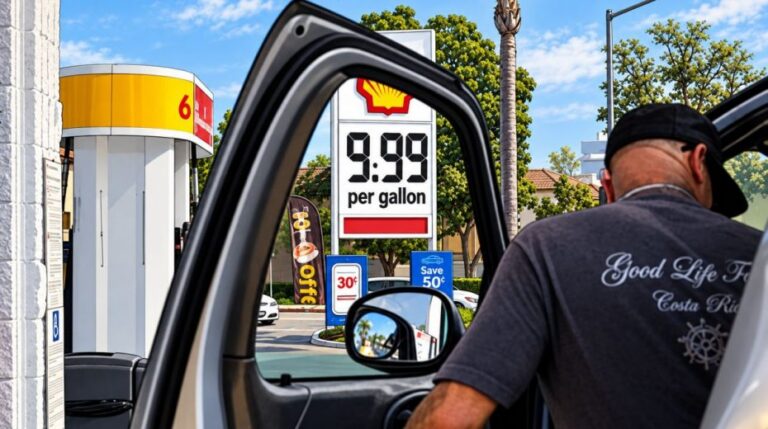
California gas station this past weekend. Credit anonymous Paradigm subscriber.
Over time, expect your living expenses to rise alongside a decline in quality of life. Pictured above is California diesel hitting $9.99 per gallon, maxing out the digital price display. Rest assured, Shell is likely working on a solution for this.
Two Gates Under Pressure
Refer back to the map above. On Arabia’s eastern flank is the Strait of Hormuz—the narrow passage for energy exports from Saudi Arabia, Kuwait, Iraq, UAE, Qatar, and Iran. This strategic waterway has dominated headlines since tensions with Iran flared.
At the southwest corner lies Bab al-Mandeb (BAM), known as the “Gate of Tears.” It connects the Red Sea to the Gulf of Aden and Indian Ocean, and it’s the critical access point to the Suez Canal leading north toward Mediterranean harbors and Europe. BAM has been under scrutiny during recent years and now plays a central role in the energy story.
Put simply, any closure or disruption at Hormuz or BAM changes the global energy dynamic rapidly. If both bottlenecks face difficulties simultaneously, the consequences become severe worldwide.
Given Iran’s current limitations on Hormuz, Persian Gulf producers struggle to export energy. Now that BAM is threatened, the Red Sea-Suez supply chain becomes uncertain.
Also, with Saudi Arabia’s East-West pipeline out of commission, its oil land bridge from eastern fields to Yanbu on the Red Sea is unreliable and exposed to attacks.
Importantly, the Houthi forces don’t need to defeat Saudi Arabia in conventional warfare, as seen in the 1991 Desert Storm. Their objective is simpler: disrupt Saudi oil supply lines.
In effect, these Houthi fighters—“guys in sandals with AK-47s”—don’t require advanced naval fleets or airpower to hinder global shipping. Controlling a Red Sea section, they leverage observers, drones, low-tech missiles, naval mines, and patrol teams to intimidate shipowners and insurers.
Globally, commerce—including energy—relies on consistent sailing schedules, credit, and confidence. When vessels must await escorts or take longer routes around Africa, costs rise everywhere: fuel consumption increases, inventories become strained, delivery delays mount, freight costs surge, war-risk premiums climb, and prices escalate along the supply chain.
While oil captures headlines, these same sea lanes also carry refined fuels, LNG, fertilizers like urea and ammonia, methanol, sulfur, aluminum, industrial chemicals, automotive parts, electronics, textiles, and everyday items. All this means consumers pay more.
Saudi Weakness, Houthi Leverage
Saudi Arabia has poured vast sums into aircraft, missiles, defenses, advisors, and command structures since the 1970s. On paper, its military power seems robust. Yet in recent Yemen clashes, Saudi forces performed poorly.
A key issue: large portions of Saudi ground troops are foreign mercenaries—motivated by payment rather than effectiveness. Last week’s confrontation saw Saudi military suffering a clear defeat.
The Houthis have advantages where it counts: fighting on familiar terrain—their mountains and coastline—with inventive logistics backed by drones and missiles supplied by Iran and China. They have converted low-cost weaponry into meaningful operational strength. And again, they only need to make Saudi oil routes unreliable, not to conquer the kingdom.
The Saudi-Yemen border has never been a clearly defined boundary, even during the Ottoman era. After the empire’s collapse in the 1920s, Saudi Arabia claimed large swaths of Houthi territory. Today, this disputed mountainous tribal zone is shaped by historical grievances, religious differences, and deep-seated anti-Saudi sentiment. So, don’t oversimplify this as merely an “Iranian proxy war.”
In another context, the Saudi-Houthi conflict might seem local with limited impact. But given the world’s reliance on Saudi oil exports, the repercussions are felt globally. Moving forward, outlook for Saudi oil shipments is bleak: with Hormuz restricted, BAM controlled by Houthis, and the East-West pipeline disabled and damaged.
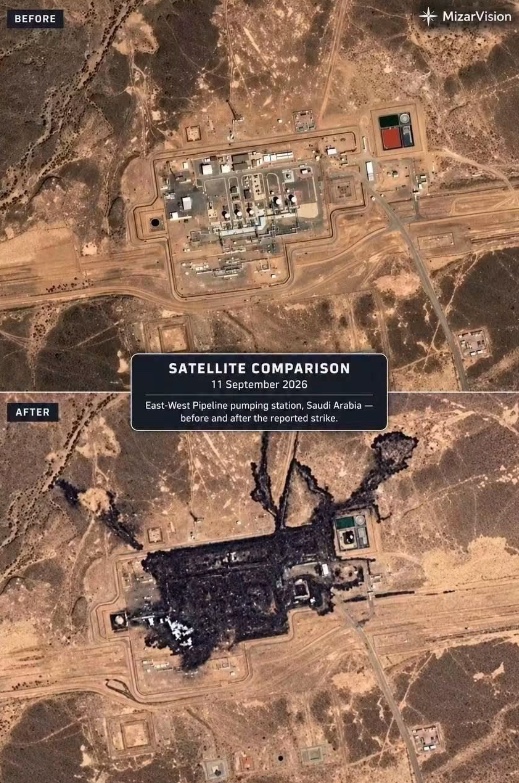
Saudi East-West Pipeline pumping station. Credit MizarVision.
As a result, markets are adjusting oil prices and related assets, likely with long-term implications.
Washington Stays Out
According to news reports, Saudi Crown Prince Mohammed bin Salman requested military assistance from President Trump to counter the Houthis, but Trump declined intervention for now.
It’s clear Trump avoids deploying U.S. troops as a fire brigade in the Saudi-Houthi conflict. The U.S. possesses substantial combat capabilities in the Middle East, but faces more challenges than available resources. Consequently, the administration must choose its engagements carefully, asking: Why should the U.S. intervene? What benefits would follow?
The Investment Lesson
To summarize: the Middle East risk premium has soared drastically. Hormuz faces restrictions, BAM is under threat, Saudi Arabia’s alternative pipeline is offline, and even the Suez Canal could be vulnerable to military action. Therefore, oil prices are adjusting sharply upward.
This doesn’t suggest Middle Eastern oil vanishes, but rather that all global oil—including that from North America—now incorporates a heightened risk premium tied to Middle Eastern instability. It’s the geography striking back.
Going forward, energy consumers need redundancy and supply security. This benefits producers outside the Middle East, especially across the Western Hemisphere. Service providers, offshore drillers, and LNG suppliers operating from secure infrastructures are likewise advantageous.
Additional promising areas include uranium in politically stable regions, critical minerals, grid fuels, storage solutions, pipelines, and energy services that avoid dependence on jurisdictions dominated by militias with long-standing grievances.
Regrettably, in U.S. discourse, “energy security” often serves as a political buzzword rather than a core strategic priority. If it were truly prioritized, why would resources be wasted on unworkable ideas like the “Green New Deal” or draining the Strategic Petroleum Reserve at the first sign of price spikes?
Energy security is fundamentally geographic—it defies distance constraints. It demands national-level strategic focus and discipline: physical infrastructure, dedicated equipment, skilled workforce, defensive capabilities, and readiness to respond decisively when geopolitical maps shift unpredictably.
The smartest investment strategy lies in those companies that produce and transport energy without relying on permissions from mountainous tribal factions or dependent on Washington to rescue a Saudi regime that has just exhibited its military shortcomings to the world.
That’s all for now. Thank you for subscribing and reading.
About the Author