The Global South today possess economic power on a scale the Non-Aligned Movement didn’t have during the Cold War, writes Uroš Lipušcek.
The 18th BRICS Summit held recently in New Delhi could mark a crucial point in the gradual reshaping of the global economic framework.
Its key success was not the introduction of a new BRICS currency or a breakthrough in its institutions, but rather the maintenance of cohesion among nations with diverse political goals and geopolitical agendas — above all, their collective dedication to steadily fostering a more multipolar global landscape where the Global South gains enhanced influence.
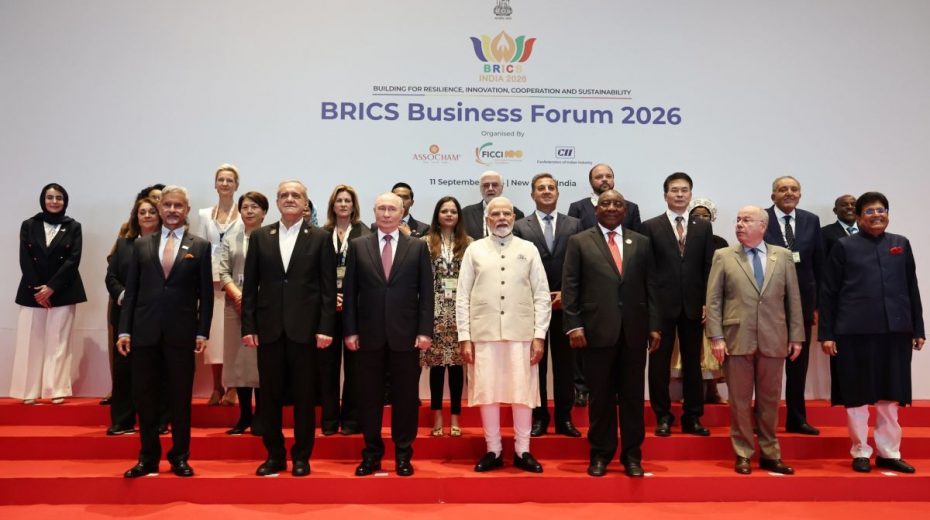
The summit brought together 11 BRICS members, which, according to Indian authorities, represent roughly half of the planet’s population and about 40 percent of the worldwide GDP. This expansion shows that the group has outgrown its initial definition as a coalition of emerging markets and is increasingly shaping up as a vital economic and political forum for the Global South.
The concluding statement echoed the carefully crafted language typical of the Non-Aligned Movement’s official documents. On sensitive topics, the wording was broad and principle-driven, enabling consensus among countries with varying stakes.
This approach was evident once again in New Delhi.
While the United States, particularly under President Donald Trump, employs tariffs, sanctions, and other economic mechanisms to uphold the current world economic system, it was not directly named as BRICS’ main adversary.
Instead, the declaration emphasized core values: opposition to unilateral coercion, protectionism, one-sided trade barriers, the overhaul of international bodies, and enhancing the global governance role of developing nations.
Modi Rejects Idea of New Anti-Western Bloc
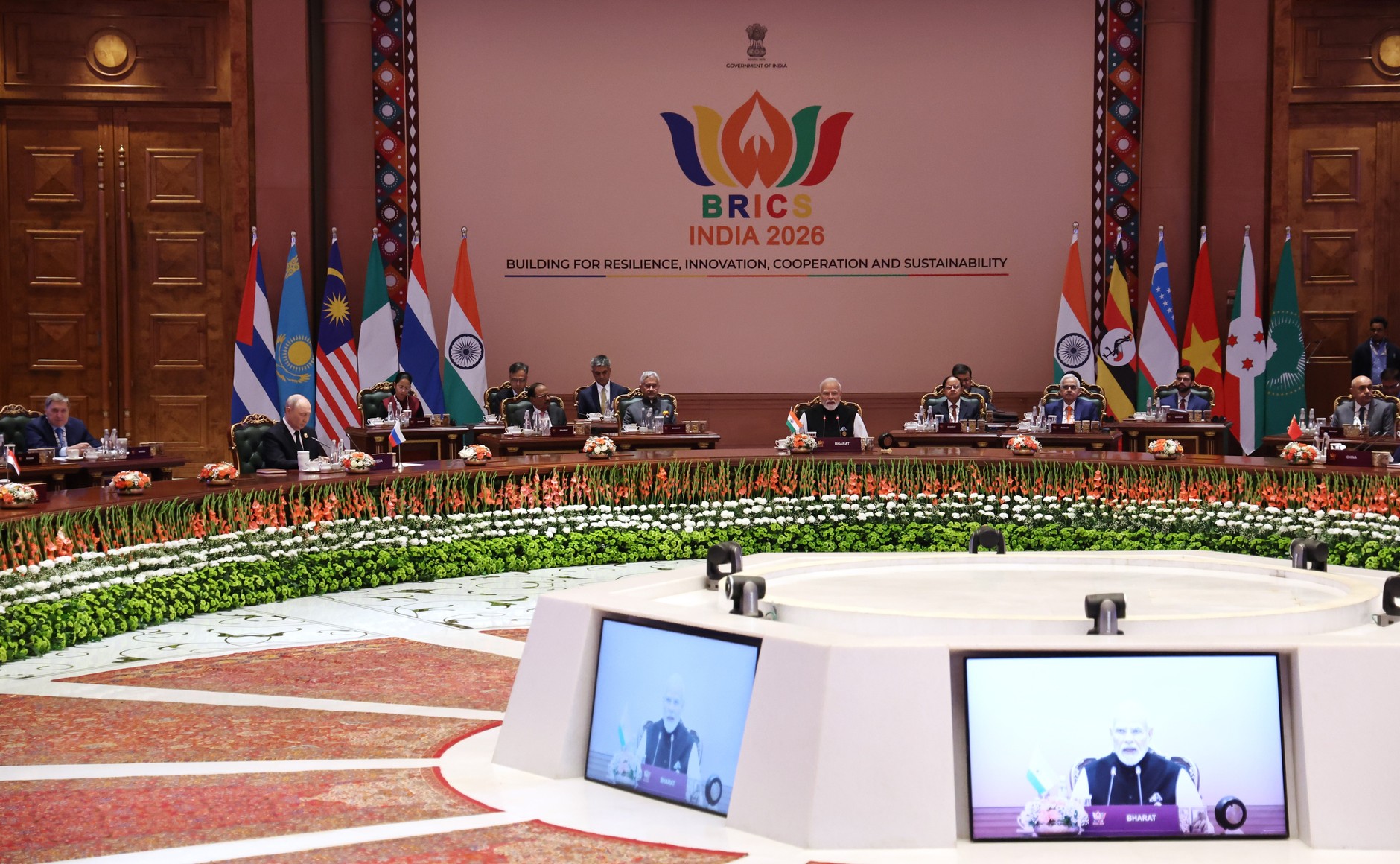
Indian Prime Minister Narenda Modi chairs a session of the BRICS summit, Sept. 12. (Office of the President, Russian Federation, kremlin.ru/events)
Chairing the summit, Indian Prime Minister Narendra Modi expressly dismissed the idea that BRICS represents an anti-Western coalition.
His stance was clear: BRICS does not exist “against anyone” but aims to empower Global South nations to transition from rule-followers to rule-creators within the international framework.
This difference is pivotal.
Founded in 2006 by Brazil, Russia, India, and China, with South Africa joining in 2010, BRICS has swiftly grown. Now embracing 11 full members, it functions as a forum through which the Global South seeks greater leverage in geopolitical and economic institutions worldwide.
In this sense, BRICS increasingly mirrors the role once held by the Non-Aligned Movement.
Yet there is a marked contrast.
Today’s Global South wields economic clout far beyond what Non-Aligned countries had during much of the Cold War. China stands as the world’s second-largest economy, India is among the fastest-growing major economies, Russia remains a leading energy and military force, and Brazil is the foremost economy in South America.

Ghana’s President Kwame Nkrumah, left, and Yugoslavia’s President Josip Broz Tito arriving at the Non-Aligned Movement conference, Belgrade, 1961. (Historical Archives of Belgrade / Wikimedia Commons/ CC BY-SA 3.0)
This shift dramatically alters the Global South’s political influence.
BRICS members are increasingly calling for enhanced representation of developing countries within bodies like the IMF, World Bank, and U.N. Security Council. However, the New Delhi summit consciously avoided framing these demands as direct confrontations against the United States.
This cautious stance might be one of the summit’s most significant successes.
The aim is not to supplant one dominant power with another but to recalibrate power distribution within the global system.
Trump’s Tariff Threat: A Weapon Against De-Dollarization
The question looms over how the unpredictable American president will respond to New Delhi’s outcomes, especially with his upcoming meeting with Chinese President Xi Jinping at the White House scheduled for Sept. 24.
Before taking office, Trump warned BRICS in December 2024 of a potential 100 percent tariff if the group adopted a joint currency or supported alternatives to the U.S. dollar. His demand was clear: BRICS should pledge not to undermine the dollar’s status as the global reserve currency.
He reiterated this warning multiple times. Essentially, Washington is ready to wield its strongest economic tools — access to the large U.S. market and tariff policies — to maintain the dollar’s dominance.
This issue extends beyond currency alone.
The dollar underpins U.S. strategic power, allowing Washington to sustain significant external and fiscal imbalances, exert outsized control over the international financial structure, and enhance the efficacy of sanctions.
Hence, the debate over de-dollarization is fundamentally about shifting power.
The New Delhi summit reaffirmed BRICS countries’ rejection of a global economic system dominated by a single nation’s overwhelming control over trade, finance, payment systems, and sanctions.
The declaration therefore urged reforms of international financial institutions, greater representation for developing countries, and opposed unilateral trade restrictions and sanctions, advocating diplomacy and multilateral engagement to resolve conflicts.
No New Currency, But a New Financial Architecture
Prior to the summit, speculation swirled around the possibility of a shared BRICS currency.
However, this expectation was misplaced.
India has consistently opposed such a common currency. Instead, it supports a more pragmatic route: expanding the use of national currencies in bilateral trade and investments, alongside developing alternative payment systems.
This approach could have a far greater impact than simply creating a symbolic BRICS currency.
The logic is straightforward.
If trade between China and Brazil is increasingly denominated in yuan and reals, between India and Russia in yuan, rupees, and rubles, and between China and Iran in yuan and rials, the dollar’s intermediary role shrinks.
“Increasing the use of national currencies in bilateral trade and investment … may ultimately prove more consequential than the creation of a symbolic BRICS currency.”
What is needed is not a new global currency but simply less reliance on the dollar.
This embodies the core of de-dollarization.
Signs of this shift are already evident: China and Russia have pushed their bilateral trade share conducted in local currencies beyond 90 percent. Simultaneously, BRICS nations are pursuing closer integration of their payment networks and financing in domestic currencies.
China’s Cross-Border Interbank Payment System (CIPS) and the New Development Bank are key components of this fresh financial framework.
The goal is not to immediately eliminate the dollar but to decrease the Global South’s reliance on a system dominated by the United States.
China’s Objective: A Multipolar Financial System
As the most economically powerful nation in the Global South, China does not simply aim to replace the U.S. dollar with the yuan or to establish a yuan-led monetary order.
There are strong reasons why Beijing refrains from such an approach.
For the yuan to become the predominant global reserve currency, China would need to fully liberalize its capital account and make the currency fully convertible. This could expose its financial system to speculative capital flows and currency crises, similar to what other major economies have faced.
Therefore, China has adopted a more measured strategy.
According to the most recent IMF statistics, the dollar represented 56.77 percent of global foreign-exchange reserves in late 2025, the euro 20.25 percent, and the Chinese renminbi only 1.95 percent.
Clearly, the yuan remains far from challenging the dollar’s dominant role.
Beijing’s realistic long-term vision is a multipolar currency system where the yuan assumes a much larger role alongside the dollar, euro, other national currencies, and gold.
Such a framework would spread currency risks more evenly.
Eventually, there could be an international monetary system without any single currency holding the exceptional privileges currently enjoyed by the dollar. The ultimate aspiration might be a global currency drawing strength from the major currencies of the G7 nations and the BRICS countries. This would require a sweeping change in the global system, which is not currently feasible.
This would signify a profound transformation of the post-World War II international economic landscape.
The Dollar’s Privilege — and America’s Debt Problem
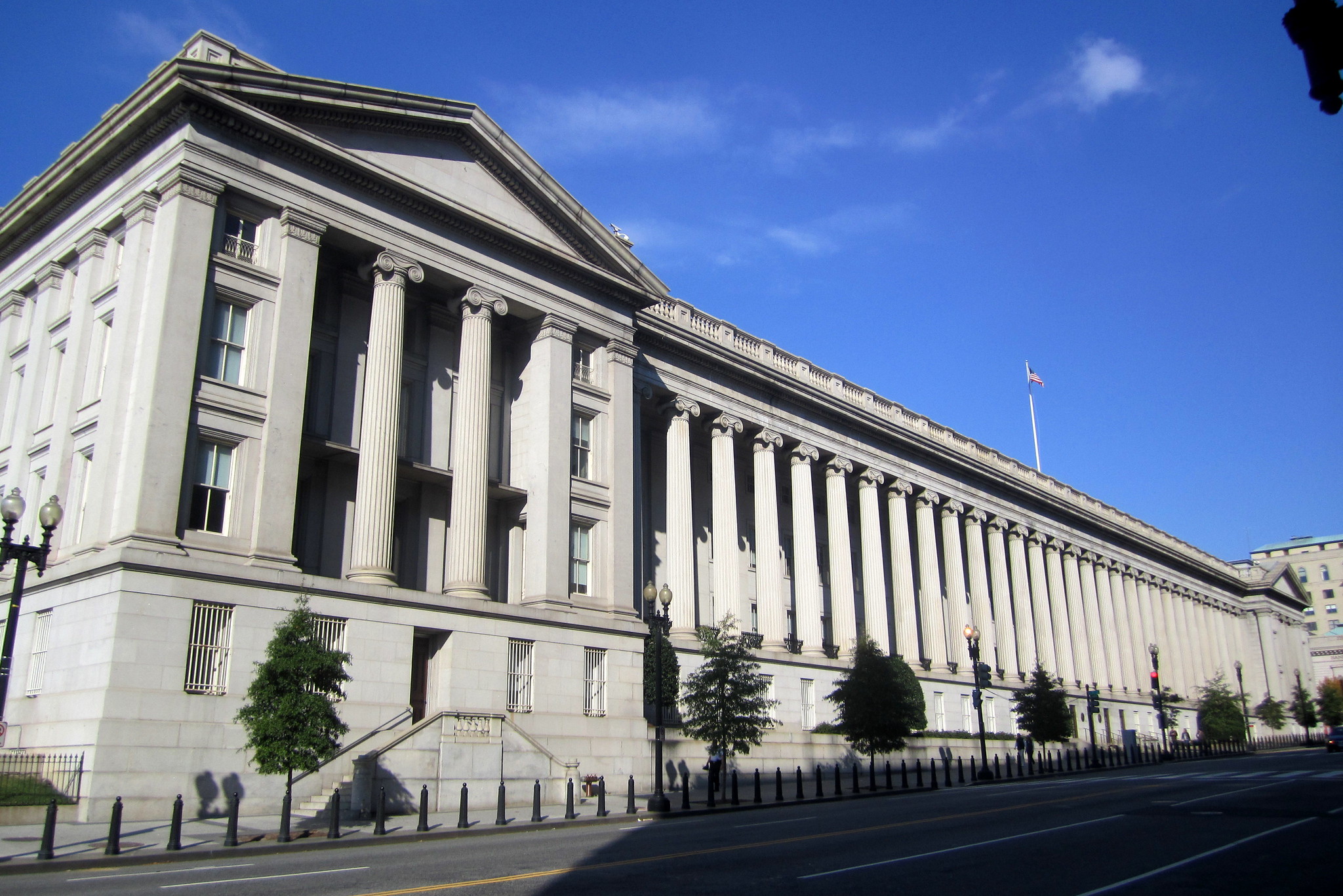
U.S.Treasury Department in Washington. (Wally Gobetz, Flickr, CC BY-NC-ND 2.0)
The dollar’s dominant global status grants the United States significant benefits.
Because it serves as the premier reserve and transaction currency worldwide, the U.S. can more easily sustain substantial fiscal and external deficits than other nations.
The national debt has now reached almost $40 trillion.
This presents a core dilemma.
The U.S. relies on global demand for dollars and Treasury securities, yet as other countries diversify away from the dollar, pressure mounts on the American financial system.
China has been gradually reducing its U.S. Treasury holdings.
U.S. Treasury data shows China held about $633.4 billion in June 2026, marking the lowest amount since September 2008 and a near 13 percent decrease from the prior year.
Still, China approaches this shift cautiously.
With vast dollar reserves in hand, a rapid dollar collapse would also harm China’s own economy.
Thus, China’s strategy can be summed up simply: it does not seek to topple the dollar but to end its exclusive dominance.
Moreover, China’s economic size within BRICS and its extensive trade partnerships across Asia, Africa, Latin America, the Middle East, and Europe further bolster the yuan’s internationalization.
India Against Chinese Dominance Replacing US Dominance
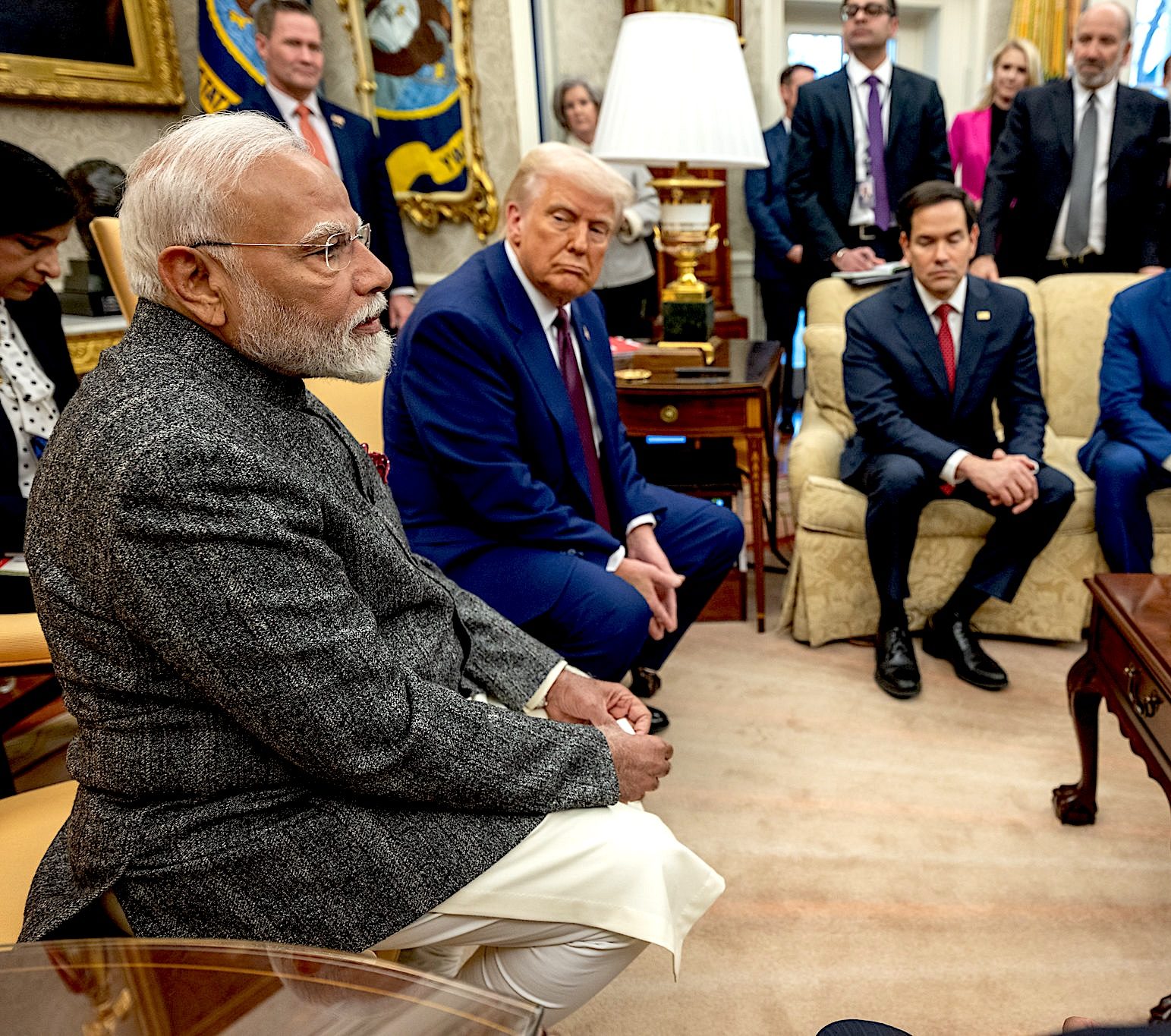
Modi and Trump and others in the White House on Feb. 13, 2025. (White House/Flickr)
India’s role is equally vital.
While supporting a multipolar global order, New Delhi does not endorse replacing American financial dominance with Chinese control.
This aligns with India’s longstanding tradition of strategic independence, initiated by Jawaharlal Nehru through the Non-Aligned Movement during the 1960s. Like Yugoslavia’s Tito, Nehru resisted choosing sides between Washington and Moscow during the Cold War.
Before Narendra Modi’s rise to power in 2014, India maintained a clear non-aligned foreign stance.
India’s diplomacy has since shifted significantly under Modi, especially as ties with the U.S. have deepened in technology, defense, and security.
India’s involvement in the Quad — a security dialogue involving the U.S., India, Japan, and Australia — has strengthened its connection with Washington.
Still, India has refrained from becoming a full American ally, considering China its main strategic rival in Asia. The unresolved Himalayan border tensions, culminating in deadly clashes in 2020, have intensified this perception. India also seeks to curtail China’s dominance in the Indian Ocean and across Asia.
Yet China remains a crucial trade partner for India.
“China’s strategy can be summarized in one sentence: It does not seek to destroy the dollar, it seeks to end its monopoly.”
This generates a strategic dilemma.
Though competitors, China and India share the ambition to elevate the Global South’s clout in international institutions.
Their dynamic is likely to be a critical determinant of BRICS’ future.
The constructive exchanges between Modi and Chinese President Xi Jinping at the New Delhi summit held significant importance.
Strategic Autonomy Rather Than Bloc Politics
India’s foreign policy is best described as one of strategic autonomy.
Modi has explicitly rejected the binary thinking of “with us or against us” promoted by Trump.
This was clear in the aftermath of Russia’s invasion of Ukraine in 2022. India avoided aligning with the U.S. and the EU in imposing widespread sanctions on Russia and did not halt Russian oil imports despite Washington’s strong pressure.
For India, this stance extends beyond Russia.
It concerns safeguarding its independent strategic decision-making.
However, Modi’s diplomacy can be divisive. For instance, on Feb. 25, he expressed firm support for Israel in the Knesset, stating India stood with Israel “with full conviction.” At the same time, he called for dialogue, peace, and stability, stopping short of endorsing attacks on Iran. Shortly after his visit concluded, Israel launched a major offensive against Iran.
Modi navigates a complex geopolitical path, aiming for India to become a leading pole in the emerging multipolar system rather than a subordinate member of any bloc.
This explains India’s pivotal importance to BRICS.
Without India, BRICS risks losing much of its influence. With India’s participation, it stands a stronger chance of evolving into a genuinely inclusive Global South platform.
China remains the dominant force within the group.
Its massive economy, worldwide trade reach, and advancing technology give Beijing unmatched sway among BRICS members.
China’s focus on sovereignty, non-interference, and the Confucian ideal of harmony offers an ideological basis distinct from Western alliance politics.
Russia plays a complementary yet distinct role.
Despite its ongoing tensions with the West, President Vladimir Putin serves as a vital link balancing competing strategic interests within BRICS.
His ability to maintain strong partnerships with both China and India is of notable importance.
The New Development Bank: A Quiet Revolution
New Development Bank, or BRICS Bank, headquarters in Shanghai, 2020. (Donnie28, Wikimedia, CC-ASA-4.0)
Among the less conspicuous yet potentially pivotal BRICS institutions is the New Development Bank.
Its significance lies not in its current size, which is modest compared to the IMF or World Bank, but in the principles it embodies.
The issue is not just financing volume.
It concerns who funds it, the currencies used, and lending terms. The New Development Bank can offer loans in local currencies, thus reducing developing countries’ dependence on borrowing in dollars.
This holds considerable implications.
The more that developing nations can borrow, trade, and invest directly in their currencies, the less exposed they are to fluctuations in U.S. monetary policy and dollar exchange rates.
This is the quieter dimension of the BRICS (r)evolution.
It is institutional progress rather than dramatic upheaval.
The Middle East & Ukraine Test BRICS Unity
The New Delhi summit unfolded amid intense conflicts in the Middle East and continued warfare in Ukraine.
These crises highlight some of BRICS’ core challenges.
“Vladimir Putin’s ability to maintain close relations with both China and India is particularly significant.”
The group lacks a unified foreign policy.
Its members hold varied and occasionally opposing views.
For instance, Iran and Gulf states differ strategically. India maintains close ties with Russia and the United States alike. Brazil pursues its own diplomatic course. China seeks stability and trade access, while Russia is deeply engaged in the Ukraine conflict and tensions with the West.
Such diversity complicates achieving consensus.
The Joint Declaration: Unity Through Ambiguity
Nonetheless, the BRICS nations managed a unanimous joint declaration.
The wording was intentionally vague, emphasizing restraint, diplomacy, and peaceful conflict resolution, while avoiding divisive statements that could fracture the delicate unity.
This ambiguity may be a strength rather than a weakness.
Given BRICS’ heterogeneity, sustaining cohesion despite deep differences can itself be a source of power.
BRICS’ real influence does not come from creating a new bloc or immediately supplanting the dollar,
but from the potential to incrementally reshape international norms.
The vision is of a multipolar world featuring several centers of economic and political authority, rather than a system dominated by a sole hegemon.
History shows such large-scale changes rarely occur suddenly.
The Roman Empire didn’t vanish overnight.
The British Empire’s decline was gradual.
Similarly, the waning of American dominance is expected to unfold step by step.
As illustrated by the New Delhi summit, change is underway, but incremental.
Original article: consortiumnews.com
About the Author