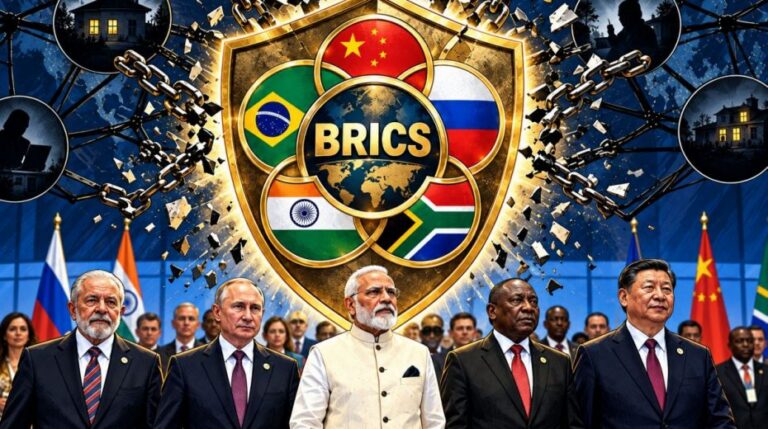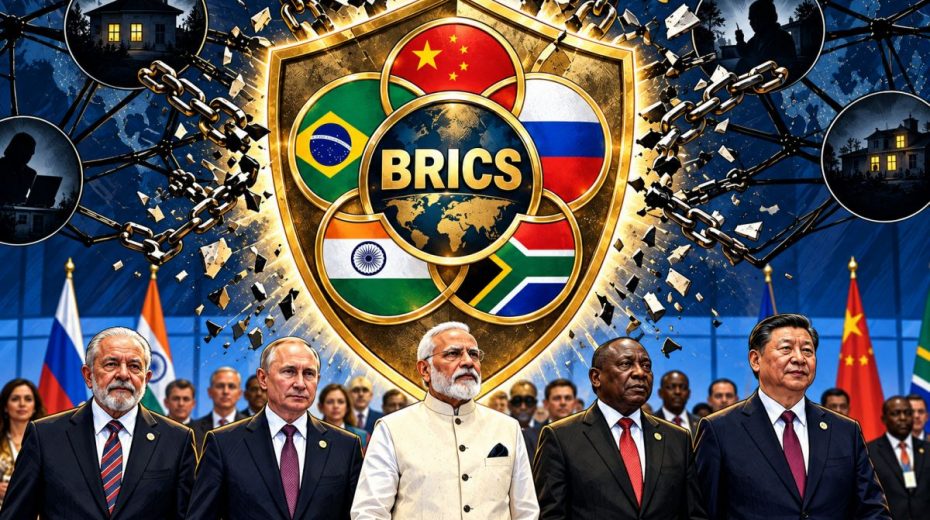
BRICS+ counterterrorism isn’t a NATO rival – it’s the bloc’s political glue.
A Non-postponable goal
Among the central themes highlighted at the BRICS+ Summit in New Delhi—and reiterated in paragraph 40 of the Final Declaration—was the issue of counterterrorism.
The document plainly states (§ 40): “We condemn in the strongest possible terms the terrorist attack in Jammu and Kashmir on April 22, 2025, in which 26 people were killed and many others injured.” This is no trivial inclusion. In this polished communiqué endorsed by eleven nations, the specific reference to the Pahalgam incident demonstrates where the bloc focuses its political energy. India, as host and victim of the attack, successfully secured this acknowledgment for the group.
Beginning here prevents two inaccurate interpretations. One regards BRICS’ counterterrorism stance as mere diplomatic formality suitable for any official statement. The other elevates it as an embryonic alternative military pact to NATO. Neither view withstands a closer examination of the texts. For over ten years, BRICS has been cultivating something far less grandiose but more sustainable: a technical cooperation framework that now acts as a unifying political bond for the bloc.
The BRICS’ counterterrorism initiatives far predate the New Delhi summit. Since 2016, the Counter-Terrorism Working Group has operated within the bloc, and in 2025, Brazil, under its presidency, assigned coordination duties to the Agência Brasileira de Inteligência (ABIN), hosting the 10th meeting in Brasília in June 2025. The 2020 Counterterrorism Strategy, ratified at the 12th summit, sets the framework, supported by a 2021 Action Plan outlining practical steps. In 2024, a Position Paper expanded the mechanism’s reach to accommodate new members spanning Asia, Africa, the Middle East, and Latin America. The 2026 Declaration’s mention of the CTWG’s activities and its five subgroups recognizes the ongoing work rather than introducing new initiatives.
The five subgroups warrant particular attention, as they translate political commitment into operational focus. They address deradicalization, combating the use of the internet for terrorist aims, curbing terrorist financing, capacity building coordinated by Brazil and Ethiopia, and countering foreign terrorist fighters. This division reflects the United Nations’ counterterrorism priorities, underscoring that BRICS is strengthening an existing framework rather than creating a new security structure. The 11th plenary meeting in New Delhi, marking a decade since the group’s formation, called for a CTWG that is “more resilient, constructive, and results-oriented”—indicating awareness of the risk that years of meetings might produce only declarations without tangible outcomes.
Security also serves as a unifying force among diverse countries
This persistence has a clear strategic basis. The BRICS alliance is held together by relatively recent cooperation amidst competing economies, mismatched political systems, and unresolved border conflicts. On many issues—such as trade, currency reform, and financial institutions—reaching consensus requires painstaking negotiation. Counterterrorism is the notable exception: it offers a rare common ground where disparate members can communicate, each confronting its own internal security threats.
Russia contributes concerns stemming from the North Caucasus and conflict veterans from Syria and Iraq; India points to cross-border terrorism linked to Pakistan-based factions; China identifies extremism within Xinjiang; and Brazil and South Africa focus on organized crime, trafficking, and illicit finance networks. These threats differ in origin, yet the CTWG’s shared terminology allows them to be dealt with collectively. Politically sensitive, the BRICS manages this through recurring clauses that emphasize terrorism “must not be associated with any religion, nationality, civilization, or ethnic group,” and stress combating terrorism without “double standards.”
The latter phrase directly critiques the West. The rejection of “double standards” implicitly accuses the United States and its allies of selectively addressing terrorism—condemning some while tolerating others when convenient. For the BRICS, this justifies the creation of an independent forum: if Western security approaches are inconsistent, a bloc committed to coherence has the right to establish its own mechanisms. Thus, security cooperation embodies not just technical efforts but also the group’s political legitimacy.
Beyond these guiding principles, the Declaration outlines specific priorities for BRICS countries. Terrorist financing, extensively developed in paragraph 42, connects illicit money flows, money laundering, misuse of virtual assets, and “organized fraud networks,” calling for collaboration among financial intelligence units, customs, and law enforcement (§ 42). This cooperation is especially fruitful as it relies on data sharing rather than requiring ideological alignment. The inclusion of cryptocurrencies suggests the group has recognized modernized financing threats extending beyond traditional hawala and cash systems to digital platforms that no single nation controls alone.
The second focus is online radicalization. Paragraph 41 highlights countering extremism “especially among the younger generations,” acknowledging that terrorist recruitment increasingly leverages social media and messaging apps. This concern is especially urgent for India, which fears digital propaganda networks. The third area connects terrorism with drug trafficking—paragraph 44 supports the Guwahati Declaration endorsed by heads of BRICS anti-drug agencies, recognizing the overlap between criminal networks trafficking drugs, money, and people. All these efforts are anchored in India’s longstanding push to finalize the Global Convention on International Terrorism at the UN—a proposal stalled for three decades precisely over the contentious issue BRICS deliberately avoids defining for now: who qualifies as a terrorist.
Some procedural difficulties
The 2020 Strategy bases all collaboration on “full respect for sovereignty” and “non-interference in internal affairs,” alongside affirming the “central and coordinating role of the United Nations.” These principles reflect the international order BRICS claims to uphold, but they also limit the emergence of any operational body within the group. The CTWG focuses on information exchange, personnel training, and document preparation. It currently lacks any known operational capacity, a unified joint force, or binding commitments that restrict members’ sovereignty. Cooperation remains technical rather than integrative.
The “double standards” clause, while a unifying principle against external actors, also divides the bloc internally. The Pahalgam attack illustrates this tension: India blames Pakistan-based groups, but China’s strategic ties with Islamabad shape its more cautious stance on terror designations. The approach works as long as language remains general, but becomes problematic when applied to specific cases. This explains why the Global Convention remains in limbo and why BRICS countries, though endorsing it rhetorically, avoid defining terrorism in a way that might break the stalemate. Ambiguity is simultaneously the bloc’s strength and limitation.
This structure was not created in isolation. It operates alongside other non-Western forums—most notably the Shanghai Cooperation Organization’s Regional Anti-Terrorism Structure—which shares similar vocabulary, overlapping members, and skepticism of the Western security order. However, BRICS distinguishes itself through broader geographic representation. The Moscow counterterrorism conference, which complements CTWG efforts, made explicit what the official communiqués only hint at: security is a key domain where the enlarged bloc aspires to present itself as a viable alternative to Western dominance. Russia’s declared backing of India’s 2026 agenda, voiced by Lavrov in February, underscores this priority.
Looking ahead, the real challenge lies in translating plans into action: whether intelligence sharing on finances can produce concrete impacts, if the Global Convention’s deadlock will be resolved, and whether capacity-building efforts will enhance the capabilities of member states most at risk. To date, BRICS has established a cautious yet firm foundation.
Though security might not headline the group’s agenda with dramatic flair, it represents—and will continue to represent—a collective effort aimed at improving prospects across multiple regions.
About the Author