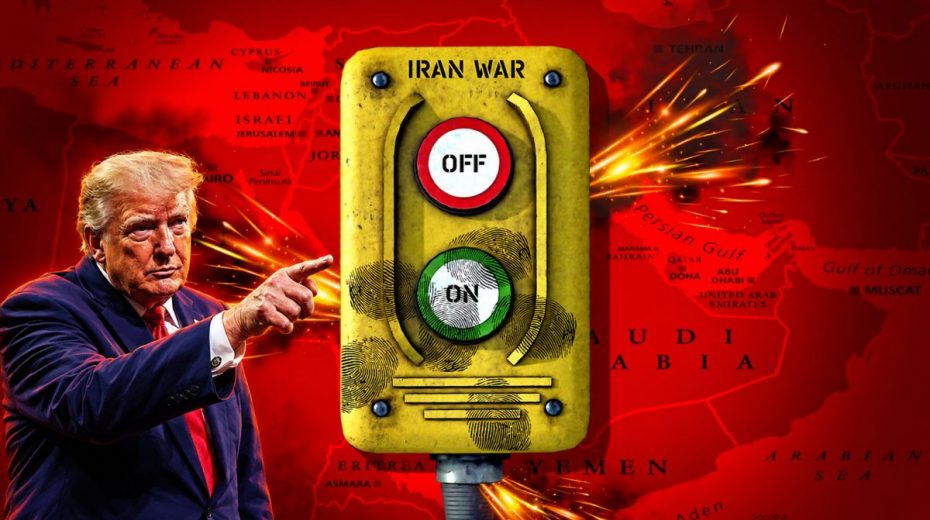
Trump’s plan, according to Washington insiders, is to go ahead with a massive bombing campaign of Iran immediately after the midterm elections.
Trump is reportedly gearing up for another offensive against Iran—assuming the Iranians don’t preempt him first. Oops.
Recently, several major U.S. news sources have disclosed that Trump has approved a large-scale arms deal with Israel, raising concerns that the president is increasingly detached from reality as he pushes for a third phase of the so-called Iran War.
Reports indicate the Trump administration is set to sell Israel a $2.8 billion package consisting of 907kg (2,000-pound) bombs—the largest single munition sale in recent memory, according to The Washington Post and other news agencies.
This unprecedented deal, financed by Foreign Military Financing—which allows Washington to provide funds that Israel then uses for U.S. weapon purchases—is believed to include 40,000 bombs: 20,000 MK-84 general-purpose bombs and 20,000 BLU-117s. The latter is a thermally coated modification of the MK-84 designed for safer storage aboard naval vessels, paired with I-2000 Penetrator warheads built to destroy fortified underground targets.
The announcement has unsettled several Middle East analysts, who doubt Trump’s ability to extricate himself from further embarrassment as he approaches the midterm elections with his approval ratings hitting historic lows.
On X, Tucker Carlson commented extensively on the shipment’s scale: “It amounts to 40,000 tons of bombs. For perspective, the largest American air raid of World War Two was the Eighth Air Force’s attack on Berlin in March of 1945. Combined, the 2,023 Allied aircraft involved dropped about 3,000 tons of bombs. That’s 7.5 percent of what Trump is sending to Israel.”
Though lacking military expertise, Carlson noted the devastating impact these bombs could have on civilians.
“An American-made Mark 84 has a destruction radius of half a mile,” he explained. “It releases a thermal wave the temperature of the surface of the sun. Within 100 feet of the explosion, rock melts and human flesh turns to vapour. The bomb collapses apartment buildings and leaves craters thirty-five feet deep. Until the war with Iran, the U.S. military generally avoided using the Mark 84 in urban areas. It kills too many civilians.”
According to insiders in Washington, Trump’s strategy involves launching a vast bombing offensive against Iran immediately following the midterm elections, when he is expected to lose control of at least one house of Congress, restricting his ability to push erratic foreign policies. He believes such overwhelming destruction could change the course of the so-called ‘Iran War,’ which experts assert he has disastrously lost—reflected in gasoline prices surpassing $4 per gallon in many U.S. states and a stagnating domestic economy, both consequences of the failed February 28th U.S. strikes.
However, two major concerns accompany this plan. Foremost is the predictable loss of surprise, which alarms Pentagon officials who fear that the all-out, last-ditch approach—potentially involving ground troops alongside airstrikes—could lead to hundreds or even thousands of American casualties if executed. If confidential details have leaked—likely due to growing unease about Trump’s mental state and opposition among U.S. personnel—the Iranian response could be formidable. Tehran is expected not only to thwart missile launches but also to inflict significant damage on U.S. and Israeli forces before the midterms. A growing number of observers in Washington and Beirut suggest Iran might launch a major attack on Israel and U.S. troops shortly before the midterms, aiming to sway the elections against Trump, hopefully triggering an immediate impeachment process should he lose both congressional chambers.
The second concern involves the insufficient number of interceptors stationed in the region and the viewpoint of Trump’s supporters. Their argument: “Yes, interceptor stock is low, but that wouldn’t matter if we strike Iran’s missile capabilities decisively first.” Trump apparently believes that these ‘super bombs’ will devastate Iran’s military infrastructure, including its power grid, neutralizing their ability to retaliate.
The conclusion many draw from this is that Israel has once again hit a strategic homerun, convincing Trump that this ‘massive attack’ approach is effective. They may have also persuaded him of alleged Iranian efforts to develop a nuclear bomb—claims that cannot be verified as the IAEA is currently unable to operate within Iran. One must question the mindset of Gulf Cooperation Council elites, especially after Trump recently refused to bomb the Houthis in response to Saudi Crown Prince’s requests. Regional experts now speculate these leaders may be anticipating a significant U.S. defeat to clear the path for a new regional order, as Saudi Arabia struggles economically and considers emergency IMF loans merely to meet payroll obligations.
Saudi’s daily oil exports through its east-to-west pipeline used to reach 7 million barrels a day, accounting for 44 percent of the nation’s GDP. With this crippled, GCC leaders increasingly recognize the necessity of moving beyond reliance on the U.S., which has been a costly liability. While the Houthis were underestimated, Trump’s immaturity and insecurity have also been gravely misjudged.
He has pushed Iran to the brink, and rumors suggest Tehran sees little reason to negotiate with someone they view as deceitful and unreliable. Instead, they may opt for a decisive strike—potentially targeting Israel and its military infrastructure or a U.S. aircraft carrier. Such an action would radically alter the geopolitical landscape and likely shock the American public by revealing the rapid pace at which Trump is dismantling U.S. global influence. It would be their Suez moment.
About the Author