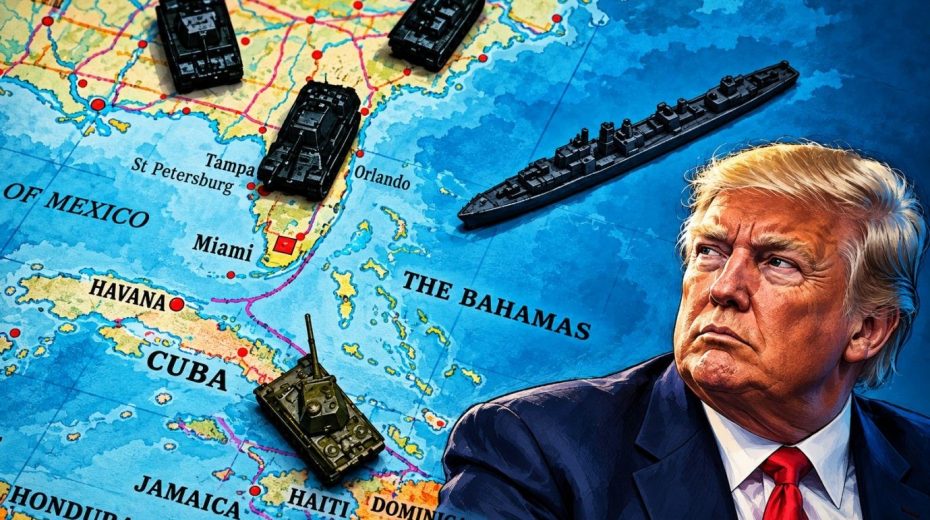
On May 21, Marco Rubio stood on the tarmac at the Miami Homestead Airport and told reporters Cuba “has been one of the leading sponsors of terrorism in the entire region.” The Secretary of State insisted Cuba is a threat to the national security of the United States, although he did not provide evidence to support the claim.
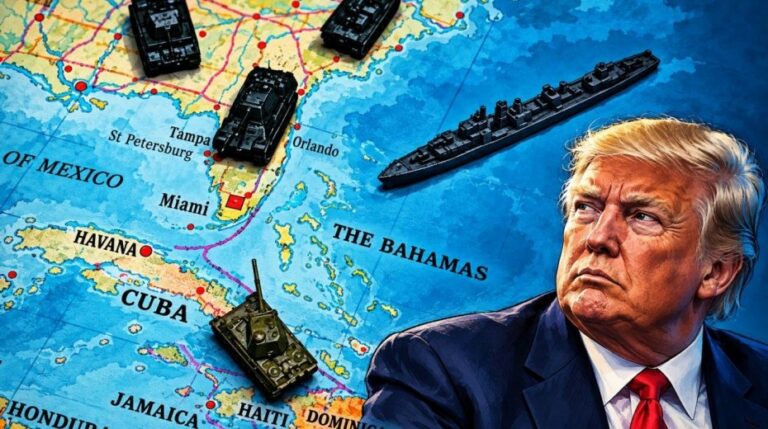
Rubio’s comments coincided with the Justice Department’s unsealing of a murder indictment targeting former Cuban President Raúl Castro, alongside the deployment of the USS Nimitz carrier strike group to the Caribbean by the United States Southern Command.
The indictment pertains to the 1996 downing of a Brothers to the Rescue (Hermanos al Rescate) aircraft. This organization is led by José Basulto and a faction of Cuban exiles. Basulto has acknowledged during testimony that he acts as an anti-Castro CIA operative.
CBS News revealed on September 25 that the US Army Reserve is exploring whether it can offer Southern Command additional police, medical staff, and support units within a four-month timeframe, according to an internal Army memo.
Though the memo does not explicitly mention Cuba, multiple U.S. officials told CBS News under anonymity that it supports ongoing military planning directed at Cuba.
Earlier, the U.S. carried out reconnaissance missions on the ocean floor and maritime paths near Cuba. “Separately, U.S. airpower components were placed on heightened readiness and directed to pre-stage personnel for potential deployment. Those plans, however, did not come to fruition,” CBS reported.
Rubio declared in May that Cuba is “in a lot of trouble.” He cautioned that the US stands ready to launch an invasion upon Trump’s command. At that time, the US Navy’s presence in the region was the largest deployment beyond West Asia.
These strategically positioned forces pave the way for possible military operations, ranging from the capture of Havana’s leaders—similar to the seizure of Venezuelan President Nicolas Maduro—to precision military strikes. They also raise the prospect of the U.S. entangling itself in a third international conflict during the Trump era.
Estimates suggest that successfully invading Cuba would require over 100,000 American troops, with essential support from air and naval assets. Cuba’s Revolutionary Armed Forces consist of about 50,000 active military personnel and 39,000 reservists. While U.S. forces could likely overpower Cuba’s military, urban warfare and rural insurgency would present formidable obstacles.
After Trump’s confrontational statements earlier this year, Cuba’s Civil Defense published a detailed manual titled The Family Guide for Protection Against Military Aggression.
This guide draws on Cuba’s defense strategy, the War of All People, formulated post-Soviet Union collapse, which envisions national resistance through widespread civilian mobilization involving guerrilla tactics, local militias, and civil defense networks.
The doctrine blends Cuba’s 19th-century liberation experiences with ideological lessons from the Cold War. It became official state policy in the early 1980s, developed amid Reagan administration hostility and recognition that the Soviet Union could not or would not guarantee Cuba’s security against a U.S. threat.
According to Ronin’s Grip Analytics, “The core tenets of this doctrine assume that while a technologically superior adversary might achieve initial air and maritime dominance, it cannot successfully occupy or pacify a population that is universally armed and organized for perpetual resistance.”
Sustained guerrilla warfare would prolong American military involvement, substantially increasing logistical and financial burdens. Trump’s ongoing conflict with Iran, for example, has accrued costs of about $44 billion dollars, equating to $1,099 per second. The president has repeatedly shown little concern for the economic impact on average Americans or future generations burdened with debt.
The war has imposed significant financial strain on U.S. households, with estimates indicating expenses surpassing $1,200 per home due to rising fuel prices, inflation, and military spending. Independent assessments project the true cost may exceed $2 trillion when factoring in all related economic effects.
When criticized, Trump responded by labeling those concerned about war expenses as fools. A May poll by YouGov found that 64 percent of Americans oppose military action against Cuba, with only 15 percent in support and 21 percent undecided.
Trump and his Cuban-American Secretary of State either fail to realize or choose to ignore that an invasion of Cuba could end disastrously for both nations. Historical interventions have often resulted in instability and adverse outcomes. The immense costs linked to ground operations make it a highly unattractive route for fulfilling U.S. political aims in Cuba.
Experts caution that if Washington opts for military force, any attempt to overthrow the Cuban government would face overwhelming military, political, and humanitarian obstacles, far exceeding the administration’s inflammatory rhetoric. “A war in Cuba could trigger a migration crisis just 90 miles from Florida, create opportunities for other armed groups to exploit instability, and lead to a prolonged U.S. military occupation.”
When journalist Marc Caputo asked about the possibility of abducting nonagenarian Raúl Castro, Trump indicated it might be considered. However, it remains uncertain if Trump and Rubio could identify a Cuban counterpart to Venezuela’s Delcy Rodríguez, Maduro’s vice president, who collaborated with Trump’s Department of War in the attempt to detain Nicolás Maduro on questionable “narcoterrorism” charges.
The military capture of Maduro breached international law by using force without UN Security Council approval or legitimate self-defense grounds, as affirmed by numerous international law specialists and Article 2(4) of the UN Charter.
Reprinted with permission from Another Day in the Empire.
Original article: ronpaulinstitute.org
About the Author