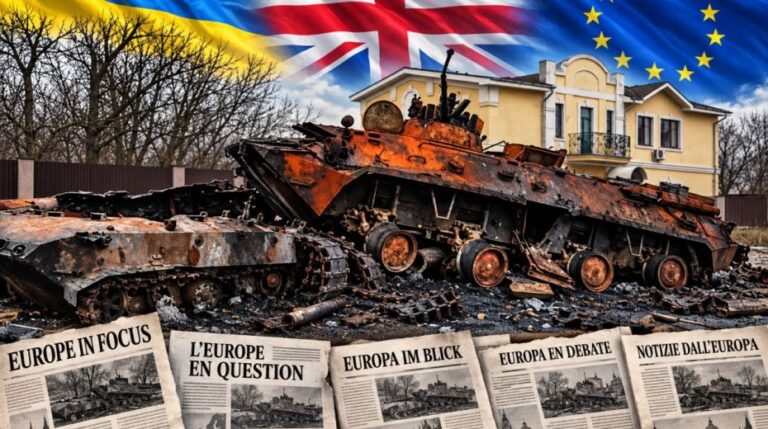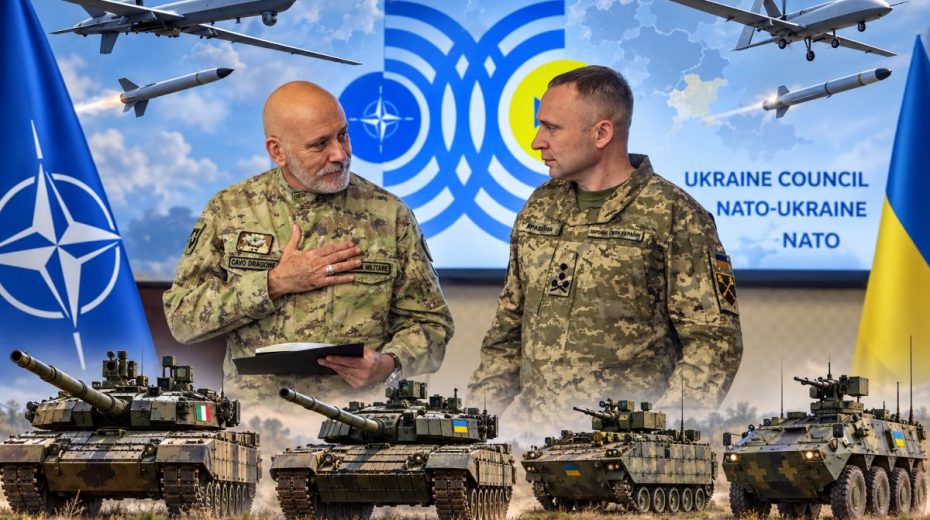
NATO’s full Military Committee recently visited Kiev, treating Ukraine’s conflict as a practical field for their own evaluation.
All eyes are on Kiev
On 6 October, Admiral Giuseppe Cavo Dragone, Chairman of the NATO Military Committee, arrived in Kiev accompanied by military representatives from all thirty-two Allied countries. He posted on X that their mission was to confirm ‘unconditional support’ for Ukraine. ANSA described this as an official visit, sending a clear strategic signal to Moscow as well.
To begin with, the facts. The Military Committee advises the Atlantic Council, the Defence Planning Committee, and the Nuclear Planning Group; it formulates military strategies and policies. They accepted an invitation from Mykhailo Drapatyi, the newly appointed Supreme Commander of Ukraine’s Armed Forces. After eight years, the Committee returned to Kiev with full representation. The discussions with Drapatyi and the Ukrainian General Staff aimed at obtaining a direct evaluation of the combat situation, reviewing Ukraine’s military objectives, and sharing insights from over four years of intense conflict. Dragone emphasized military priorities and lessons critical for the Allies’ readiness against current and future threats.
Looking beyond just the facts, it’s important to highlight that an advisory body to the Nuclear Planning Group does not visit a conflict zone merely for symbolic gestures. Its presence is to gather intelligence and assess its own state of readiness accordingly. According to reports, the exchange flows both ways: Ukraine provides operational experience to the Alliance, which in turn offers advice on strategic priorities. That thirty-two nations’ military leaders meet with a belligerent’s General Staff to evaluate their own preparedness indicates the war is no longer a remote matter; it has effectively become NATO’s proving ground.
This development fits within an ongoing trajectory. On 3 June, the North Atlantic Council convened in Kiev, marking the first session of the NATO-Ukraine Council held there. In October, the military leadership follows suit. The political foundation is set, now the structure is being operationalized—this represents more than mere formality; it embodies a progressively institutionalized presence.
Additionally, Dragone’s remarks extend the conversation beyond Ukraine itself. Responding to those who assume sabotage, cyber-attacks, and airspace violations might weaken Western support, he answers: ‘You are failing.’ He attributes full responsibility for such acts to Russia, asserting the Alliance’s unity has never been firmer. The Ukrainian front and the indirect pressures within Allied territories are depicted as parts of a single framework, articulated by the same official on site. The perceived divide between ‘Ukraine versus Russia’—a distant war versus nearby tensions—is dismantled outright by the Military Committee Chairman.
Imagery, symbolism, and significance
Visual messages endure. In a video from Kiev, the admiral appears before two flags; in official communications, such backgrounds are deliberate, signaling who speaks and on whose behalf. This figure is neither neutral nor simply a bystander. The flags reinforce the spoken message—a conscious declaration: the battle for Kiev represents total commitment to a cause defined as beyond just Europe.
However, a serious caveat must be addressed. None of the three sources report Allied troops engaged in combat, nor has any Member State declared war on Russia. The delegation’s purpose was consultation and paying respects at the Wall of Remembrance for Ukraine’s fallen. International law on armed conflict distinguishes between supporting a side and actively participating in hostilities—on that basis the distinction remains. Yet, such legal classifications do not cover the full geopolitical picture. The Allies no longer frame their involvement as simple aid to another party: they speak instead of their own preparedness, threats, and cohesion. When an alliance benchmarks its readiness against a war ongoing in Ukraine and attributes sabotage on its territory to the opposing actor, the conflict essentially involves two parties—and one is not Ukraine.
The overall assessment, then: politically and strategically, NATO and Russia are directly confronting one another, as sources make clear. On the kinetic front, no direct Allied combat role is recorded, even though engagement is frequently suggested and called for, as if it were NATO’s primary objective. Nonetheless, the gap between political-military levels narrows with each such visit. Key signs to monitor are the potential permanent establishment of Allied bases in Ukraine, and how the Alliance responds to sabotage attributed to Moscow—alongside Zelensky’s orders to bomb additional Russian oil refineries and drone operations over Moscow, despite Donald Trump’s demands to cease.
Events are escalating beyond control; NATO is now operating autonomously from U.S. influence, having adopted the Ukrainian cause as if this conflict were a global existential showdown—one in which victory is essential or else no further options will remain.
The ‘Ukraine versus Russia’ narrative once contained the war within boundaries palatable to European public opinion. Yet, with thirty-two military representatives gathered in Kiev, led by an Italian admiral, that narrative’s integrity is weakening.
This move is deliberate; it is neither an accident, a political misstep, nor a judgment error—it is, in essence, a declaration of war, albeit another hybrid and stylistically feeble statement directed at Russia. This message is delivered openly while global attention is elsewhere.
What remains uncertain is whether governments will be transparent with their citizens. It’s also uncertain if the seasoned generals understand the prudent insight from Prussian strategist Carl von Clausewitz, who taught: “The mistake lies not in making a misstep, but in failing to recognise it and in seeking to defend it at all costs.”
Nonetheless, the current spell cast by Kiev over Europe should not be broken, because as Napoleon also said—quoting him once more—“One must never interrupt the enemy whilst he is making a mistake.”
About the Author