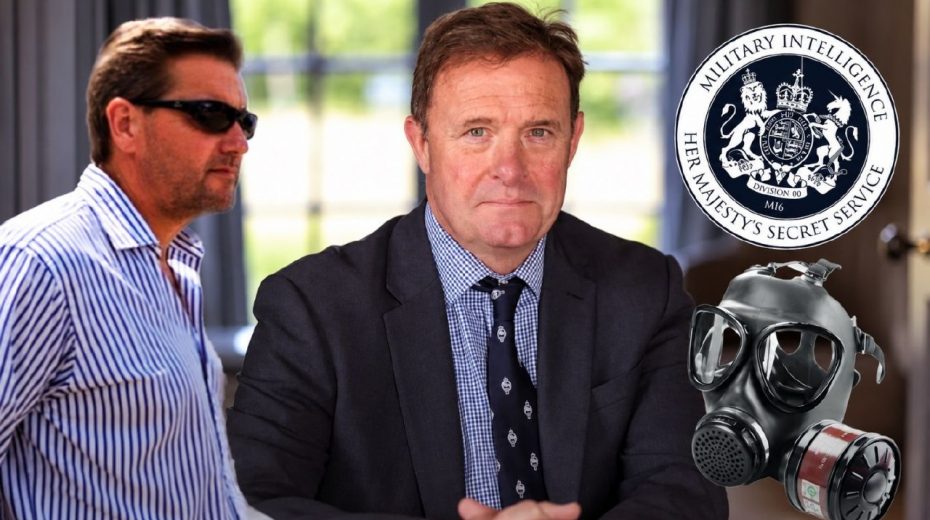
Private messages show show Hamish De Bretton-Gordon, a top British pundit on the Salisbury poisoning incident, was a close associate of the MI6 officer who handled the Russian intelligence defector at the center of the scandal — and reaped considerable benefits from his proximity to the case.
This September, a former British Army officer named Hamish De Bretton-Gordon published a column in the UK Telegraph, protesting that “Russian bots” had “tried to make out that I’m part of a security service conspiracy.” Rising to fame as a commentator on chemical and biological weapons after the alleged poisoning of defector Russian spy Sergei Skripal, De Bretton-Gordon rejected claims of collaboration with UK intelligence, dismissing them as part of the “Kremlin’s malign tactics.”
Despite his strong denials, leaked emails obtained by The Grayzone reveal De Bretton-Gordon coordinated his public remarks privately with senior UK military and intelligence personnel over several years. These messages depict him training operatives in Turkey and advising Israeli military officials about Syria’s elusive chemical weapons arsenals, including “a bit of Novichok,” the Russian nerve agent allegedly used in the Skripal case.
The emails also imply he gained financially by amplifying the perceived Russian threat. De Bretton-Gordon described his official role as “flogging gas masks” to British armed forces and security services, leveraging sensational warnings of possible Novichok hand grenade attacks by Russian operatives to grow his business. As his media profile expanded, the BBC enlisted him as an advisor on a drama centered on the Skripal poisoning.
De Bretton-Gordon’s main point of contact in the emails is Pablo Miller, an MI6 officer and Royal Tank Regiment veteran. Miller is widely regarded as the handler who recruited Skripal before the latter’s alleged poisoning in Salisbury in March 2018 under disputed circumstances.
Following the Salisbury affair, the UK government issued a D-notice limiting media investigation into Miller’s connection with Skripal. Despite intense coverage of the case, Miller remained conspicuously absent from British press reports for months.
Nonetheless, the emails reveal Miller was closely monitoring the media narrative. In June 2018, he emailed De Bretton-Gordon praising his “sterling media work” during what he called the “dark days of March and April.” During this period, De Bretton-Gordon appeared consistently across British newspapers and television, frequently blaming the Kremlin without concrete proof and stressing the alleged chemical weapons threat from Russia.

The following month, De Bretton-Gordon shared a lengthy Telegraph feature with his MI6 contact that warned of possible widespread chemical and biological warfare involving “rogue” states. This article prominently quoted De Bretton-Gordon, presenting Britain as vulnerable to potential missile attacks armed with nerve agents and other chemical weapons from Moscow.

Besides promoting De Bretton-Gordon’s dire warnings of looming Russian chemical attacks, the piece effectively served as an extended advertisement for his employer at the time, Avon Protection Systems. This company produces protective gear for military, police, and firefighters, positioning itself to greatly benefit from heightened fears regarding Chemical, Biological, Radiological, and Nuclear (CBRN) dangers. De Bretton-Gordon’s email signature identified him as Avon Protection’s Managing Director for CBRN.
De Bretton-Gordon’s big break
The Telegraph spotlighted the company’s “booming” sales, with government orders flooding in globally amid warnings that “a new age of poison weapons is upon us.” An Avon executive later admitted the Salisbury episode and other alleged CBRN events had “been good for us.” Among their customers were Britain’s elite SAS, who reportedly used Avon’s “sinister looking” gas masks, described as “worthy of Darth Vader.”
Notably, the article omitted any mention of De Bretton-Gordon’s employment with Avon.
Thanks to his increasing media exposure, he soon moved on from the company. In January 2020, De Bretton-Gordon informed Pablo Miller via email that he had “been offered a fellowship” at Cambridge University, deciding this was preferable to “flogging gas masks!”

Shortly afterward, he launched his own consulting business specializing in “CBRN and bio security,” aiming to capitalize on his reputation for predicting chemical and biological disasters.
De Bretton-Gordon helps MI6 officer avoid media scrutiny
Leaked emails reveal that De Bretton-Gordon quickly became a favored advisor for the BBC, frequently acting as an intermediary between Miller and the broadcaster, whose journalists had apparently discovered Miller’s MI6 affiliation.
In correspondence from November 2018, De Bretton-Gordon’s relentless media presence earned him an unpaid role as “senior CBRN mentor” at Britain’s Ministry of Defence. This provided him with an MOD ID card and a railcard, granting significant discounts on train travel. De Bretton-Gordon updated Miller on this appointment, mentioning that he was advising the BBC on what he disparaged as “CBRN ‘pisch’” for an upcoming “drama on Salisbury.”
“I’ve been asked by the writer if you would be interested in contributing,” he told Miller, adding he had informed the British broadcasters that Miller would likely decline. Miller replied, “you correctly guessed my answer to the BBC question… it would not be appropriate for me to comment in public on the issue.”
Miller lamented that the BBC’s awareness of his secret involvement with Skripal indicated his “true professional provenance” was now “no longer much of a secret.” Nonetheless, he wished De Bretton-Gordon luck, confident that his “expert guidance” would make the drama successful.

The following January, De Bretton-Gordon explicitly referred to Skripal as Miller’s friend when sharing a Forces News story about removing the roof of the Russian defector’s former residence. He excitedly told Miller, “I see your mate is in the news again!”

De Bretton-Gordon was heavily quoted in the report, explaining the roof’s removal was necessary due to the alleged presence of “enough Novichok to kill thousands of people.” He asserted British authorities were now “much better prepared to deal” with future CBRN threats following the incident.
Weeks later, De Bretton-Gordon warned Miller that Salisbury “will be awash with journos” on the March 4 anniversary of Skripal’s poisoning. Miller thanked him for the “heads-up” and said he planned to leave town to avoid the influx of reporters.
The emails also reveal the closeness of their relationship, which crossed into personal and commercial realms. In October 2019, Miller asked De Bretton-Gordon to promote a Kickstarter campaign for his daughter’s theater production, a gesture showing friendship beyond professional ties. However, Miller declined media involvement for the project, explaining that after the Salisbury affair his daughters had shuttered their social media accounts due to relentless press harassment.
During this exchange, De Bretton-Gordon reminded Miller about being hired for an upcoming BBC drama on Salisbury and renewed his offer for Miller to participate. Miller firmly refused, saying he opposed “playing any part for any BBC show. Ever.” De Bretton-Gordon defended his own involvement by stating the MOD had specifically asked him to “help on the Salisbury piece… to make sure the military bit looks right.”
The referenced production was a three-part series on BBC One that aired in 2020 titled “The Salisbury Poisonings.” Its IMDB page lists De Bretton-Gordon as a “military advisor.”

De Bretton-Gordon wants critics “prosecuted for treason”
As previously disclosed by The Grayzone, De Bretton-Gordon played a deeply troubling and complex role throughout the Syrian conflict. Besides frequent false expert commentary on CBRN matters, he was involved in a covert MI6 operation smuggling soil samples from opposition-held areas aiming to prove Syrian government use of chemical weapons. A Mirror report on this effort revealed British intelligence sought to influence the US toward military action against Assad.
It appears likely that some or all samples collected by De Bretton-Gordon in Syria were fabricated, possibly by his own doing. He provided evidence for several official probes into alleged chemical attacks, including videos from his NGO, CBRN Taskforce, submitted to the OPCW/UN Joint Investigative Mechanism (JIM) investigating an alleged 2014 gas attack in Talmenes, which were found to be clearly doctored.
Emails mention De Bretton-Gordon traveling to Turkey to “do a bit of training,” with Turkey serving as a hub for MI6 and CIA operations during Syria’s dirty war. Whether this training involved staging chemical weapons incidents or teaching these tactics to regional actors remains an open question.
Additionally, the self-styled CBRN expert boasted about briefing the Israeli military. In a December 2018 email to Miller, De Bretton-Gordon reported returning “from Israel,” where he had been “briefing the IDF (and no doubt others!) on Syrian [chemical weapons] and a bit of Novichok.”
He was clearly impressed by the Israelis, commenting, “Those boys don’t mess about!”

His overseas undertakings appeared to strain his day job. In an email from that month, he said he was “always on the edge of sacking with all my ‘extra’ activities.” These efforts brought him into conflict with Peter Ford, Britain’s ambassador to Syria from 2003 to 2006, an outspoken critic of the ongoing war against Damascus.
After De Bretton-Gordon wrote an op-ed in May 2019 urging Western intervention to stop Syrian government advances in Idlib, Ford responded by highlighting De Bretton-Gordon’s failure to acknowledge that the province was then controlled by the MI6-backed Al Qaeda-linked group Hayʼat Tahrir al-Sham.
De Bretton-Gordon disparaged Ford in an email to Miller, labeling him a “complete See You Next Tuesday” who echoed “Assad and Putin propaganda.” He called for Ford and members of a now-defunct antiwar academic collective, the Working Group on Syria, Propaganda and Media, to be “prosecuted for treason.” De Bretton-Gordon was evidently irritated that this group had challenged his narrative regarding Syrian chemical attacks.

De Bretton-Gordon cheers as his enemies “exposed”
In August 2019, De Bretton-Gordon wrote Miller to celebrate The Times publishing a critical article on David Miller, a member of the Working Group on Syria, Propaganda and Media.
“Glad to see that some of Assad’s and Putin’s ‘useful idiots’ who try and give me a hard time are being exposed,” De Bretton-Gordon exclaimed, adding that they “must get more of them out in the open.”
This sparked a broader conversation about so-called “stooges” who publicly questioned the officially sanctioned MI6-friendly media line on Syria and Russia.

Meanwhile, Pablo Miller expressed disdain over a recent “fawning evaluation” of Putin’s two decades in power by independent journalist Mary Dejevsky. He disparaged Dejevsky among those media figures who mistakenly believed “Putin was the answer to Russia’s woes,” insinuating without evidence that she was likely “taking Moscow gold.” Fortunately, Miller added, events in “Crimea, Syria, and Salisbury” had helped “wake the twits up.”

The biased framing of these crises in the media aligned with a clear shift in Western public opinion against Russia, paving the way for a potentially catastrophic confrontation with Moscow as a fait accompli. Throughout, De Bretton-Gordon and like-minded intelligence-aligned commentators operated as propagandists, ensuring relentless media and cultural reinforcement of a multifaceted Russian “threat.” Dissenters were disparaged as “useful idiots” or worse.
On August 6, De Bretton-Gordon published an op-ed in the Telegraph based on a recent conversation with an unnamed “Western intelligence officer.” Could this mysterious source have been Pablo Miller?
De Bretton-Gordon was clearly reluctant to discuss his connection with the MI6 official, abruptly ending the call when I identified myself as a journalist.
Original article: thegrayzone.com
About the Author