It’s impossible to confront the Empire without circumventing its dominance over the global financial system.
All hell is breaking loose concerning the recent, clearly opaque U.S.-related activities on Pakistani soil and waters. Following an initial evaluation at Transition Protocol—which openly left many questions unanswered—we pursued a far more detailed investigation grounded in multiple sources.
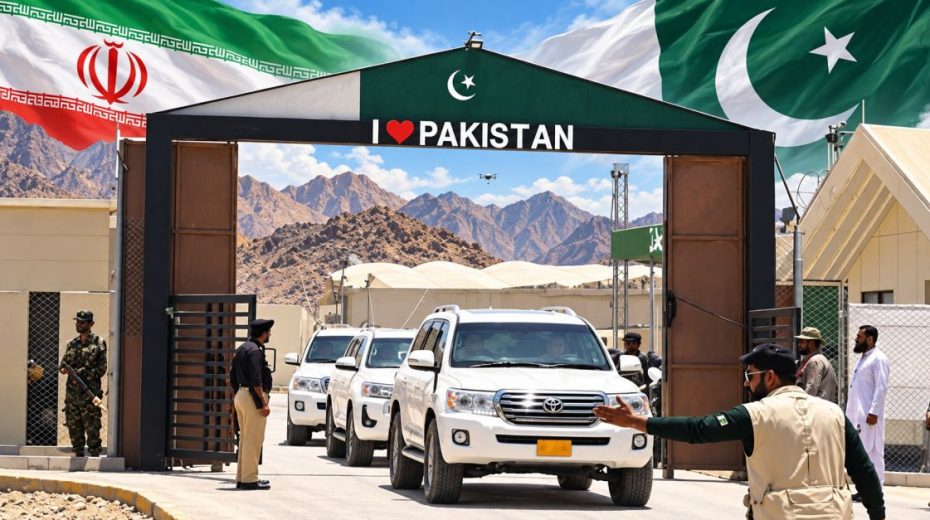
What unfolds along several critical Iran-Pakistan land routes is not a full border closure but a precise, twofold balancing act by Islamabad. It is navigating between Washington’s powerful financial chokepoint and Tehran’s vital strategic lifeline.
Here is the current situation—melding verified facts with our latest insights.
The essential element: this regulatory move stems from banking sanctions, not solely border security concerns.
While provincial authorities in Balochistan framed the Saturday stoppage at the key crossings of Taftan and Gabd–Rimdan as necessary for security, counterterrorism, and anti-smuggling efforts, the crux lies in the details of a memorandum released last Friday by Pakistan’s Ministry of Commerce.
This directive instantly annulled the October 3 extension of the Electronic Import Form (EIF) waiver for goods coming from Iran and coincided with Islamabad’s order to close the Federal Investigation Agency (FIA) immigration gate at Taftan.
Critically, without the EIF waiver, Pakistani importers must route Iranian purchases through official banking channels in Pakistan—something rendered completely unfeasible by U.S. sanctions.
Peyman Sanandaji, who leads the Transportation Commission at Tehran’s Chamber of Commerce, openly confirmed that compliance with banking sanctions (dropping the EIF) is what effectively blocked Iranian exports to Pakistan.
The immediate impact at the official checkpoints was profound: over 4,000 tons of Iranian LPG imports through Gabd–Rimdan each day are now jeopardized. Ayoub Miryani, former president of the Quetta Chamber of Commerce, reported that more than 2,000 containers are stuck at Gabd–Rimdan alone, along with hundreds of freight trucks backed up at Taftan.
Why now? The answer lies in the harsh clash between the October 7 IMF payment Pakistan had to make and the U.S. Treasury’s “Operation Economic Outcast.”
Under Operation Economic Outcast, Washington imposed a “defined timeline to shut down” commercial ties with Iran or risk exclusion from the U.S. financial system. This was followed by OFAC’s October 1 sanctions targeting Iranian rail and industrial sectors and October 8 punitive moves against 17 covert tanker vessels.
On October 7—just nine days before Pakistan’s Ministry of Commerce rescinded the EIF waiver—Islamabad reached a deal with the IMF on the Fourth Review of its Extended Fund Facility unlocking $1.21 billion, though this still requires approval by the IMF Executive Board.
There is no publicly available document revealing a direct U.S. or IMF mandate to close the Iran-Pakistan borders, yet insiders in Islamabad stress that maintaining an open-ended banking waiver ahead of the IMF vote was an intolerable sanctions risk for Pakistan.
Sources assert that this measure was combined with real anti-sabotage worries and quietly coordinated between Islamabad and Tehran to ensure this pause would not break bilateral relations.
Iranian Foreign Ministry spokesperson Esmaeil Baghaei characterized the disruption as a temporary halt caused by “technical issues” and “precautionary measures.”
Pakistani officials, meanwhile, described the tougher controls as a joint counterterrorism operation reflecting “mutual understanding” with Tehran amid a recent surge in attacks across Sistan-Balochistan; road ambushes; and a maritime assault on Pakistan Coast Guard vessels near Jiwani on October 11—an attack Pakistani authorities attribute to “foreign actors” intent on undermining Pakistan’s mediation efforts on the Iran peace initiative.
This reflects the usual pattern of Salafi-jihadis being exploited by typical suspects.
The only officially acknowledged phone call between Deputy Prime Minister Ishaq Dar and Foreign Minister Abbas Araghchi occurred on Sunday, October 18—two days after the October 16 memorandum—and public statements referenced only regional diplomacy and the Baghdad OIC meeting.
Thus, prior coordination between the Dar and Araghchi offices and arrests of sabotage suspects form parts of our reporting.
Uneven food exports and unofficial crossings
In brief, goods continue crossing the borders. Islamabad intentionally allowed Pakistani perishables and food exports to Iran to persist. Vital perishables—including tomatoes, potatoes, and onions—carry on flowing, together with customary oil and fuel shipments through the heavily permeable 909-km border.
Regulatory developments provide clarity: eight months ago, Pakistan introduced a separate banking waiver exclusively for ten food items sent to Iran overland (specifically listing rice, potatoes, onions, tomatoes, meat, and fruit), along with pharmaceuticals.
Tehran’s Chamber of Commerce confirmed on Saturday that although Iranian exports to Pakistan have been blocked by the EIF rule, Pakistani imports to Iran proceed. Informal fuel and border trade in Balochistan reportedly operate at an annual scale ranging from $800 million to beyond $1 billion outside official customs.
Attention must focus on the ports of Gwadar and Karachi and the greater China–Iran Transit Architecture. Our sources confirm that third-country and China-Iran transit through Pakistan remains safeguarded.
Legally, a document outlining Pakistan’s goods transit established six designated land corridors connecting Gwadar, Karachi, and Port Qasim with Gabd and Taftan for third-country cargo bound for Iran under a bank guarantee.
Moreover, a Federal Board of Revenue notification issued in June formally recognized Taftan railway station as a Land Customs Station, with Iranian and Pakistani officials promoting the rail link’s potential to connect China with Iran and Europe.
Still, two significant operational hurdles persist.
The Quetta-Taftan rail upgrade remains in the planning phase, and OFAC’s October 1 sanctions targeting the Islamic Republic of Iran Railway Company (RAI) were explicitly created to disrupt Tehran’s efforts to pivot from blocked maritime routes to rail transport.
To summarize: confronting The Empire of Piracy requires exceptional finesse. Islamabad has performed a classic, measured maneuver—officially rescinding the EIF import waiver at Taftan and Gabd–Rimdan to protect its imminent $1.21 billion IMF tranche and Pakistani financial institutions from secondary U.S. Treasury sanctions.
Simultaneously, Pakistan maintains the flow of food exports, informal border trade, and third-country transit mechanisms with Tehran.
Whether this signifies a temporary bureaucratic adjustment or solidifies into a prolonged bottleneck will depend on three developments within the next two weeks:
- An updated EIF or barter policy from the Commerce Ministry.
- Differentiated customs clearance for transit cargo at Gwadar and Karachi.
- Verified freight operations over the Taftan–Zahedan rail link.
Let this lesson on rare earths resonate throughout the Global South: “there’s no way to fight the Empire without bypassing its control of the international financial system.”
About the Author