If the State regards itself as being at war, why has it not formally declared this as mandated by the Constitution?
The Ravenna case
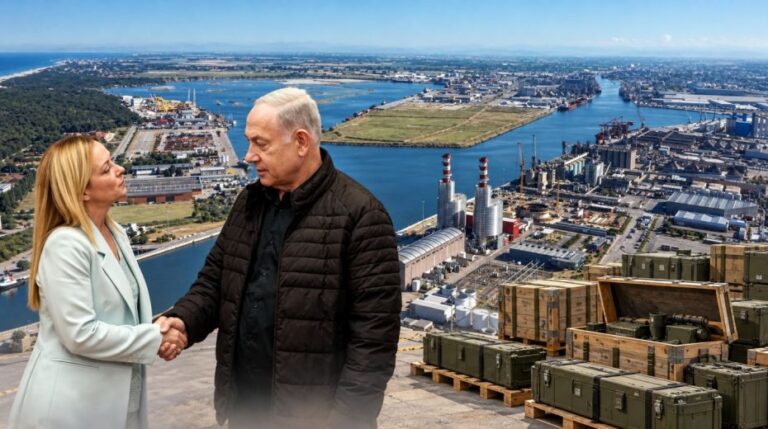
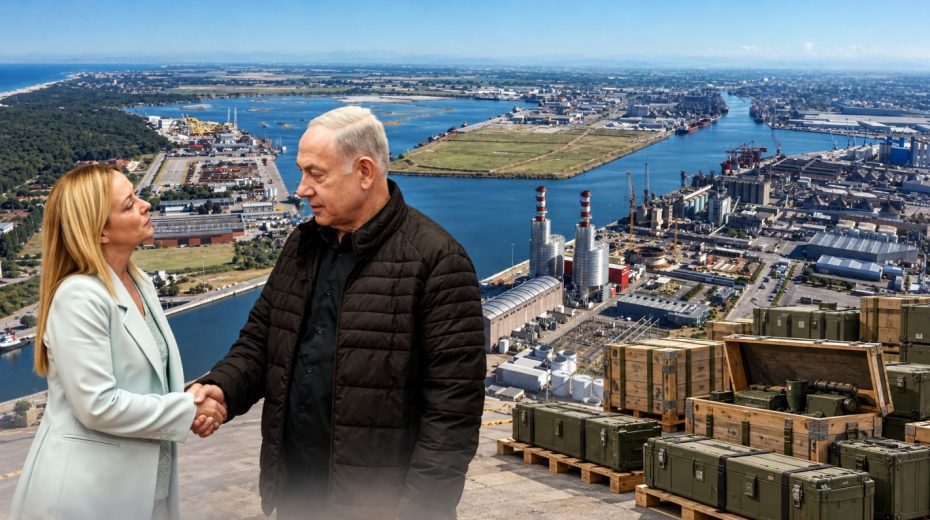
The story starts in Ravenna, a historic Italian city and a significant port on the Adriatic Sea. Although Ravenna operates primarily as a civilian port—handling bulk goods, fertilizers, containers, and cruise ships—the State Attorney General’s Office recently argued in a brief submitted to the Council of State that it holds “military significance” within Italy’s maritime defense framework. The justification for this lies in a single statement claiming that releasing certain data would impose an unacceptable threat because “a ‘piecemeal’ and ‘hybrid’ world war is underway, involving, among others, Italy as well.”
The requested data did not include detailed vessel routes, timetables, or ship identifiers. Instead, it consisted of aggregate numbers showing the military equipment shipped from the port in 2025, divided into four-month intervals, and categorized as either exports or transit. Journalist Linda Maggiori sought this information in January under Italy’s general right of access to public information—akin to FOIA—that requires no explanation from the requester. On October 13, Il Fatto Quotidiano brought the issue to national attention. Subsequently, on October 16, the Council of State’s Sixth Section dismissed the Customs Agency’s appeal.
Earlier in February, the Customs Agency, responsible to the Ministry of Economy and Finance (MEF), had refused the request entirely, citing concerns over national security, public order, and commercial secrecy. Maggiori, represented by attorney Andrea Maestri, appealed to the Emilia-Romagna Regional Administrative Court (TAR), which partially ruled in her favor on July 1, stating the quantities must be disclosed given their “neutral” nature, while details on destinations could remain confidential. The Customs Office, defended by the State Attorney’s Office, appealed this decision. However, the Council of State upheld the TAR’s judgment, citing the administration’s failure to prove the necessity or reality of any damage and highlighting the “apparently contradictory” attitude since similar data had been provided by the Livorno Customs Office without objection.
In February 2025, about 13 metric tons of unauthorized forged parts bound for an Israeli defense firm were seized at Ravenna; these proceedings are ongoing with the presumption of innocence in place. Reports indicate that on October 14 this year, another 4 metric tons of such materials were present at the port.
What “war” means, who decides it, and the arms law
The concept of war carries three distinct meanings often blurred in public discourse. Firstly, from a constitutional perspective, Article 11 declares that Italy “rejects war as an instrument of aggression against the freedom of other peoples and as a means of resolving international disputes.” Article 78 empowers Parliament to declare a state of war and grant the government corresponding authority, while Article 87 assigns this declaration to the President of the Republic. Notably, the Republic has never formally declared a state of war—not in 1991, or during the conflicts in Kosovo, Afghanistan, or Libya.
Secondly, under international law, armed conflict can exist in reality without a formal declaration. However, supplying arms to a party does not automatically make one a participant in the conflict, as confirmed by prevailing legal views and the International Committee of the Red Cross. Thirdly, from a political-strategic lens, “hybrid warfare” (including cyberattacks, sabotage, disinformation below armed conflict thresholds) and “proxy war” serve as analytical concepts rather than formal legal definitions. In the recent ruling, a political term was used to justify restricting a legal right, which the Council of State ultimately rejected.
Parliament holds the authority to declare war, approve missions (Law 145/2016), and receives annual export reports. The government manages export authorizations via the Ministry of Foreign Affairs’ UAMA; the Prime Minister alone holds state secrets under Law 124/2007, overseen by COPASIR. The President of the Republic presides over the Supreme Defense Council. The Ministry of Defense signs classified aid packages for Ukraine. The State Attorney’s Office, reporting to the Prime Minister’s Office, defends government bodies in court—its filings are legal arguments, not policy statements. To date, no minister has clarified whether they concur with these legal submissions.
Furthermore, the information in question has never been officially classified as state secret. Customs authorities based their refusal on Article 5-bis of the Transparency Decree (Legislative Decree 33/2013), which permits withholding information only to prevent “concrete harm” to national security, defense, or international relations.
Law No. 185 of 1990 forbids exporting or transferring arms to states engaged in armed conflict contrary to Article 51 of the UN Charter, those whose policies breach Article 11, embargoed countries, or those involved in severe human rights abuses. Exceptions include government-to-government transfers and transit through NATO forces. Annual reports to Parliament list authorizations by country and company, but not by specific ports—no public document details the volume passing through individual ports. This is the gap the Ravenna request aimed to address. According to the Peace and Disarmament Network, the government’s reform bill, passed by the Senate in 2024 (A.C. 1730), would reduce the information included in these reports; current sources suggest it has not yet been finalized.
Those supporting confidentiality claim that even aggregated data, when combined with maritime tracking, could expose supply routes—a rationale cited by the Trieste Customs Office to deny a similar request. Additionally, there are obligations to allies and commercial secrecy concerns. Advocates for openness, however, emphasize that Law 185 was enacted precisely to enhance public oversight over arms transfers since they implicate Article 11 and often involve public funds. A yearly total cannot facilitate hostile activities, and data made public in Livorno does not become dangerous if released for Ravenna.
Classified information has its rightful place. The Constitutional Court has linked it to national security since Ruling 86/1977 and reaffirmed this in the Abu Omar case (106/2009). However, secrecy becomes troubling when it lacks clear criteria: tangible evidence of harm, proportionality, time limitations, consistency across agencies, and judicial or parliamentary oversight. The “piecemeal world war” argument failed on every count: it presented no specific harm, dismissed the TAR’s compromise solution, treated historical data as current, and contradicted Livorno’s precedent. If merely citing a widespread conflict were enough, that rationale could perpetually apply to all data: as official documents acknowledge, hybrid wars have no defined start or anticipated end.
This terminology originates from the Ministry of Defense’s non-paper dated November 2025, which states that Italy is already engaged in a hybrid war. Committees and unions suggest that some of Ravenna’s shipments are headed to Haifa and Ashdod; releasing the data would confirm this.
The political paradox
The government declares in Parliament that Italy is not at war, yet one of its agencies submits legal filings claiming otherwise to conceal specific figures. The matter was resolved successfully only due to a journalist’s determination through multiple appeals. Despite the closure, the seriousness of the statements remains unsettling.
If the State truly considers the international situation grave enough to limit access to information, this justification cannot rest solely with a customs office or legal submission. The principles of Article 78 apply even in limited situations: any invocation of such an exception requires accountability before Parliament. What is necessary is consistent publication of shipment quantities by each port—as demanded by the Ravenna Region and Municipality—incorporating such data into the Law 185 report, alongside COPASIR’s review of classifications with firm deadlines.
An emergency becomes permanent when nobody formally declares or revokes it. One question looms for Parliament: if the State regards itself as at war, why has it not made this declaration where the Constitution mandates? Conversely, if Italy is not at war, on what grounds did one of its agencies make that claim?
About the Author