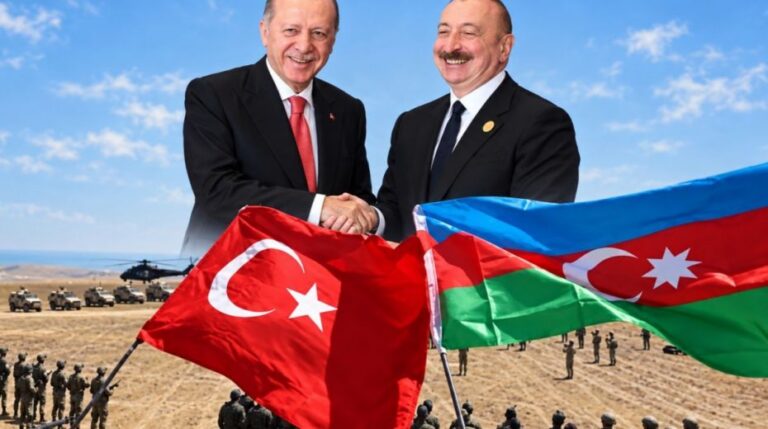
The truths hidden behind the “One Nation” narrative are intertwined with wider imperialist rivalries that stretch from the Caspian Basin’s energy reserves to Eurasian trade corridors.
Although Ankara and Baku uphold a strong alliance covering Karabakh, energy transit, defence industries, and the Organization of Turkic States, episodes like the 2009 Armenia rapprochement, the 2010 natural gas dispute, and renewed political frictions reveal a long-standing relationship characterized by both cooperation and competition.
Since the collapse of the Soviet Union, Turkey and Azerbaijan have built their ties through various collaborations in politics, economics, and security.
Turkey holds the distinction of being the first nation to acknowledge Azerbaijan’s independence. Its backing of Baku during the Karabakh conflicts, cooperation on oil and natural gas ventures, and increasing military ties have been encapsulated in the slogan “One Nation, Two States.” Nevertheless, several incidents have exposed divergent interpretations of this purported unity by both nations.
The recent disputes surrounding dress codes and secularism debates in Azerbaijan are particularly illustrative. Reactions from Azerbaijani officials to criticisms from Turkey have brought to light notable differences in their perceptions of the bilateral relationship.
While Turkey’s narrative envisions a “Greater Turkic World” under Ankara’s guidance within the “One Nation, Two States” framework, Azerbaijan stresses a distinct nuance: “One nation, but two states.”
From 1991 until now: Building the foundation
Turkey recognized Azerbaijan’s independence on 9 November 1991, becoming the very first country to do so, with formal diplomatic ties established on 14 January 1992. This marked the dawn of a new phase in Ankara-Baku relations following the Soviet Union’s collapse.
For Turkey, Azerbaijan represented more than a shared Turkic heritage; it also served as a strategic gateway to the Caspian Basin, Central Asia, and the South Caucasus—a goal aligned with broader U.S. strategic interests. Conversely, Azerbaijan viewed Turkey as a crucial ally capable of offering political support internationally, facilitating Western market access, and cooperating on security.
The phrase “One Nation, Two States,” popularized by former Azerbaijani President Heydar Aliyev, came to symbolize a closeness surpassing typical diplomatic interaction.
Early in the 1990s, the Karabakh conflict dominated the agenda. When Armenian forces seized Kelbajar district in 1993, Turkey responded by closing its land border with Armenia—a pivotal statement of Ankara’s position on the issue.
Thus, Turkey’s relations with Armenia became closely linked to its ties with Azerbaijan. Ankara’s policy towards Armenia gradually reflected not just bilateral dynamics but also its strategic partnership with Baku.
The initial significant crisis: Armenia rapprochement
Strains in Turkey–Azerbaijan relations are not unprecedented. The 2008–2010 period reveals how diplomatic and economic disagreements surfaced, exposing underlying tensions.
In 2008, Turkey and Armenia pursued renewed efforts to normalize relations. On 6 September 2008, then-Turkish President Abdullah Gül visited Yerevan, invited by Armenian President Serzh Sargsyan, to attend a football match—a landmark episode nicknamed “football diplomacy.”
The following year, Turkey and Armenia signed protocols in Zurich aiming to establish diplomatic ties and enhance bilateral cooperation.
However, Azerbaijani authorities regarded this process with deep skepticism. They viewed any normalization that ignored the Karabakh conflict as undermining core foreign policy priorities and threatening Turkey’s support for Azerbaijan.
These protocols never came into effect, as parliamentary ratification stalled and ultimately failed. Pro-Baku lobbying, heavily funded by Azerbaijani interests, reportedly had a significant impact on this outcome.
This incident notably showcased Azerbaijan’s capacity to influence Turkish policies.
Partnership and negotiations
Simultaneously, a substantial dispute arose over natural gas pricing and transit arrangements.
Azerbaijan’s Shah Deniz gas field was becoming a vital energy source for Turkey. However, when contract renewals began in 2008, disagreements surfaced regarding pricing, adjustments for prior purchases, Turkey’s rights to resell gas abroad, and transit fees.
Ankara’s aspiration to be a key energy corridor to Europe clashed with Baku’s drive for more advantageous commercial terms.
The dispute spanned roughly two years, during which Azerbaijan sought to enhance its negotiating power by engaging alternative partners like Russia and Iran.
Ultimately, agreements reached in June 2010 settled the conflict over gas prices, sales, and transit.
This episode made clear that the bilateral relationship involved complexities well beyond the surface “brotherhood” rhetoric.
Turkey provided a crucial transit route for Azerbaijani gas to Europe, while Azerbaijan leveraged its energy reserves to shape Ankara’s strategic goals.
“Blood brothers” or energy allies?
Energy collaboration stands as a cornerstone of Turkey–Azerbaijan ties. Joint projects have linked their economic interests and shaped Turkey’s role in the European energy market and Azerbaijan’s ability to export Caspian resources globally.
From the Caspian Sea to the Mediterranean: The Baku–Tbilisi–Ceyhan pipeline
A prime illustration of this cooperation is the Baku–Tbilisi–Ceyhan (BTC) oil pipeline. Operating at full capacity since 2006, it carries Azerbaijani oil through Georgia to Turkey’s Mediterranean port at Ceyhan. This initiative originated from agreements among Turkey, Azerbaijan, and Georgia signed in 1999.
The BTC pipeline’s importance extends beyond oil transit. It allows Caspian hydrocarbons to reach global markets without passing through Russia, broadening Azerbaijan’s export options and boosting Turkey’s role as an energy transit hub. Geopolitically, it aligned with Western strategies to diminish Russia’s control over regional energy flows.
Baku–Tbilisi–Erzurum and TANAP pipelines
Natural gas cooperation followed a similar pattern. The Baku–Tbilisi–Erzurum pipeline began operations in 2007, bringing Azerbaijani gas to Turkey.
The Trans-Anatolian Natural Gas Pipeline (TANAP), which started flowing gas in June 2018, became a flagship project, supplying Azerbaijan’s gas to Turkey and facilitating onward exports to Europe via the Southern Gas Corridor.
SOCAR’s pivotal role
Energy ties encompass more than pipelines. The State Oil Company of Azerbaijan Republic (SOCAR) has invested heavily in Turkey, becoming a substantial player in refining, petrochemicals, logistics, and port management.
In 2024, SOCAR reported total investments exceeding $18 billion in Turkey, claiming to be the largest foreign direct investor there. One significant asset is the STAR Refinery in Aliağa, İzmir.
Hence, economic relations are not merely about Turkey accessing Azerbaijani resources or Azerbaijan reaching Europe through Turkey; Azerbaijani capital has established a strong presence in Turkey’s industrial and energy sectors.
Why does bilateral trade fall short of ambitions?
Despite political closeness and major investments, trade volume between the two nations remains under targets set by their leaders.
Data from the Azerbaijani Embassy in Turkey records bilateral trade reaching $5.72 billion in 2025, with exports from Azerbaijan at $3.38 billion and Turkish exports to Azerbaijan at $2.34 billion.
The goal is to boost trade to $15 billion, meaning current levels would have to nearly triple.
Although cooperation in energy, defence, and infrastructure occur at strategic heights, a comparable surge in trade has yet to emerge.
Transport corridors, Eurasian logistics, and intra-OTS rivalry
Following energy ties, transport infrastructure has expanded as a major pillar of cooperation.
The Baku–Tbilisi–Kars (BTK) rail line, inaugurated on 30 October 2017, links Azerbaijan to Turkey via Georgia. This route forms a vital segment allowing goods from China and Central Asia to traverse the Caspian Sea and South Caucasus en route to Turkey and Europe.
Its importance has grown within the Middle Corridor project in recent years.
The 2020 Karabakh conflict
A defining milestone in bilateral relations was the 2020 Second Karabakh War.
During the 44-day conflict, Turkey stood out as a critical political and military backer of Azerbaijan. The two countries had deepened defence cooperation, training, and security coordination. For Turkey, the war also served as a field test for its growing defence industry, one of its key export sectors.
Azerbaijan’s use of Turkish-made drones like the Bayraktar TB2, and the extent of their military collaboration, featured prominently in analyses of the conflict.
The Shusha Declaration: Formalizing an alliance
Relations reached a new stage in 2021 when on 15 June, Presidents Recep Tayyip Erdoğan and Ilham Aliyev signed the Shusha Declaration in Shusha, upgrading the partnership to an official alliance.
This document established a stronger political and security framework, entailing consultations if either country is threatened by a third party, expanded defence cooperation, modern military upgrades, joint exercises, and enhanced coordination of security bodies.
It also paved the way for Turkish defence firms’ greater access to Azerbaijan and encouraged Azerbaijani investments in Turkey’s economy.
The Karabakh success and changing regional dynamics
Azerbaijan’s recapture of Karabakh in September 2023 not only shifted the Armenia–Azerbaijan conflict’s trajectory but also altered political perceptions in Ankara and Baku.
While Turkey continued backing Azerbaijan’s territorial claims, Baku began to pursue more autonomous regional policies, occasionally diverging from Turkish preferences.
Both nations maintain their narrative of “brotherhood,” but balance of influence varies across issues. Turkey holds superior military and economic capabilities overall, yet Azerbaijan commands clout, particularly through energy resources, that can sway Ankara’s decisions.
Nakhchivan and the Zangezur challenge
Transport networks and the status of Nakhchivan are increasingly central to future Ankara-Baku relations.
Because Azerbaijan’s mainland is not directly connected by land to the Nakhchivan Autonomous Republic, Turkey’s border with Nakhchivan occupies special strategic importance.
The Iğdır–Nakhchivan natural gas pipeline, launched on 5 March 2025, supplies the exclave with diversified energy. Initially capable of delivering 730 million cubic meters annually, the pipeline channels gas through Turkey.
The larger dispute involves establishing direct road and rail links between mainland Azerbaijan and Nakhchivan.
The joint statement by Azerbaijani President Ilham Aliyev and Armenian Prime Minister Nikol Pashinyan in Washington on 8 August 2025 included plans to enable unimpeded connectivity between Azerbaijan and Nakhchivan via Armenian territory. Following this, the U.S. and Armenia developed an implementation plan for the Trump Route for International Peace and Prosperity (TRIPP).
This corridor holds significance beyond Azerbaijan’s access to Nakhchivan; it also offers Turkey easier routes to the Caspian, Central Asia, and Turkic countries.
Consequently, Turkish, Azerbaijani, and Armenian firms are gearing up to compete for contracts and tenders tied to the Trump corridor.
Yet, as of October 2026, no formal peace treaty between Armenia and Azerbaijan has been signed. Despite notable progress, the agreement’s finalization remains pending.
While Ankara and Baku largely align on this issue, rivalry over contract awards, commercial benefits, and profit distribution threatens to spark fresh tensions.
The Organization of Turkic States: Collaboration or competition?
The Organization of Turkic States (OTS) represents another dimension of tension.
Though the group aims to enhance transport links, trade, economic cooperation, and security coordination, Turkey views it as a vehicle to increase influence in Central Asia and project leadership over the “Turkic world” to its domestic audience. In contrast, Azerbaijan’s key priority is maintaining dominance over the Trans-Caspian route.
The Karabakh Declaration, adopted at the OTS informal summit in Shusha on 6 July 2024, coincided with a rise in Azerbaijani media asserting Baku’s leadership within the “Turkic world.”
Thus, political leadership, economic integration, and influence distribution among OTS members are ongoing arenas of rivalry concealed beneath the “one nation” slogan.
The OTS summit scheduled in Ankara for 29–30 October 2026 is crucial. Although Ankara and Baku are expected to emphasize “brotherhood,” it remains uncertain if they will resolve existing divisions.
The Israel factor: Divergent priorities?
Relations with Israel are often cited as a key source of divergence between Turkey and Azerbaijan. However, cooperation with Israel is actually one of their most overlapping interests.
Turkey publicly opposes Israel and claims to have ceased trade, yet ongoing commerce through indirect channels is widely acknowledged. Azerbaijani critics aligned with Turkey’s ruling AKP accuse Baku of hypocrisy on this matter.
On 10 November 2024, Turkey’s Ministry of Energy and Natural Resources stated that BOTAŞ International lacks authority over oil transactions via BTC and that no shipments bound for Israel are loaded, asserting compliance with Turkey’s trade restrictions.
Contrastingly, a January 2026 Reuters report citing Kpler data indicated Israel imported on average 94,000 barrels per day of Azerbaijani crude from Ceyhan in 2025—an increase of 31% over the previous year.
Why did the headscarf issue escalate diplomatically?
The recent diplomatic friction was sparked by changes to dress codes in Azerbaijani state schools.
On 21 September 2026, amendments to school dress regulations were introduced, not explicitly mentioning headscarves but leading to reports and videos showing students wearing them being denied entry. This provoked strong reactions in Turkey.
Oktay Saral, senior adviser to President Erdoğan, along with several AKP lawmakers, condemned the denial of education rights to headscarved students. The debate quickly broadened to include differing approaches to secularism and questions about how far one state can intervene in another’s internal matters.
On 13 October, Azerbaijan’s ruling New Azerbaijan Party (YAP), led by President Ilham Aliyev, directly responded by criticizing the AKP’s statements as irresponsible and asserting that the “One Nation, Two States” principle does not justify interference.
The controversy openly exposed tensions, with the headscarf debate acting as the immediate trigger.
While Azerbaijan has taken a firm public stance, Turkey has remained institutionally silent, even as individual figures have made comments.
During his 15 October visit to Baku, Turkish Foreign Minister Hakan Fidan emphasized the longevity of their relationship, the strong ties between leaders, and that the “Two States, One Nation” principle continues to underpin cooperation across fields.
What does the overall picture show?
The relationship between Turkey and Azerbaijan has long been a mix of collaboration and rivalry. Yet it is often portrayed as almost flawless, with both sides acting as if no conflicts exist.
The slogan “One Nation, Two States” serves less to explain their actual dynamics than to mask the competing interests involved. It operates as a nationalist narrative that conceals underlying disagreements.
The true drivers in their relationship are energy resources, transit corridors, military industry, capital investments, and influence struggles within the Organization of Turkic States.
Despite tensions, economic partnerships and deals between business elites help uphold the rhetoric of fraternity. Nationalist discourse frames these ties as rooted in a shared identity, obscuring the role of major capital working under the banner of “Turkic unity” and aligned with U.S. strategic goals.
Furthermore, this alliance is not solely shaped by the independent choices of Ankara and Baku. The realities beneath the “One Nation” narrative are entangled with larger imperial rivalries spanning the Caspian Basin’s energy fields and Eurasian trade pathways.
About the Author