Global Crossing. Does that name ring a bell?
It was one of the shining stars of the dotcom era.
Established in March 1997, somewhat late in the game, the company quickly rose to prominence. It went public just 18 months later—an incredibly rapid IPO timeline.
Investors eagerly sought a stake. The company’s mission was compelling: to deliver high-speed internet worldwide through an extensive fiber-optic cable network.
The marketing pitch was irresistible: we’re building the telecom infrastructure of the future.
Many saw Global Crossing as a key gateway on the internet.
Its fiber network eventually stretched across 27 nations and over 200 cities, truly linking the globe and upgrading users from dial-up to broadband.
In 2001, Global Crossing secured an additional $1 billion in funding, announcing its network was “fully funded.”
A mere 221 days later, the company filed for bankruptcy.
The fiber infrastructure they created lived on and continues to be utilized today.
Founder Gary Winnick managed to sell $700 million worth of shares before the downfall.
Meanwhile, late investors were left with nothing.
The Breakthrough That Broke Fiber
When Global Crossing launched, a single fiber-optic strand could carry roughly 2.5 gigabits per second (gps).
By 2000, the advent of DWDM (dense wavelength-division multiplexing) boosted each cable’s capacity to 100 gps.
This represents a 40-fold jump in transmission capability. Despite the internet’s rapid expansion, the industry had overbuilt telecom infrastructure. The market was flooded with excess fiber.
The DWDM technological leap was a significant factor in the dotcom crash.
Could a similar event unfold in the present day? Absolutely.
In fact, I expect major innovations that will greatly improve and reduce the cost of AI. At this moment, approximately 100,000 top engineers worldwide are intensively working to optimize the efficiency and performance of hundreds of AI models.
Given such concentrated talent, AI’s high costs likely won’t persist for long. We’re already observing this trend with recent Chinese open-source AI models, which deliver about 95% of the capabilities of leading American ones but at only a tenth of the expense.
Depending on how developments unfold, such breakthroughs could severely impact infrastructure companies in a manner similar to how DWDM disrupted fiber players.
Of course, other factors exist that could also threaten the rapid growth of AI.
Data Center Stocks Crack
AI-related equities stumbled again today, with data center stocks bearing the brunt.
Coreweave (CRWV) dropped 9.84% near midday. IREN fell 8.8%, Nebius (NBIS) shed 7.8%, and Oracle (ORCL) declined roughly 4%.
Investors are encountering familiar worries reminiscent of the dotcom days.
Excessive debt paired with insufficient revenue.
Just a week ago, Jim Rickards alerted readers about risks in data center stocks through the Paradigm Press App (available for Android and iPhone).
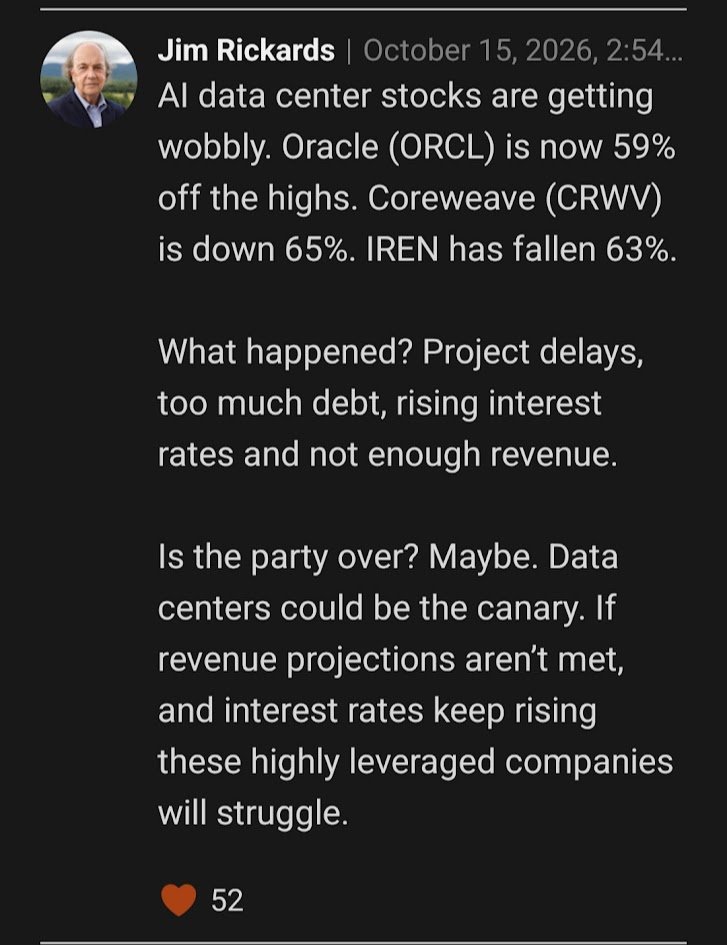
Source: Paradigm Press App
Coreweave might be the canary in the coal mine here. It carries the heaviest debt and leverage among the “neocloud” data center companies. Its model involves purchasing Nvidia GPUs and leasing them out—a popular approach that will face stiff competition soon as new facilities launch across the country.
The final concern Jim highlighted—rising interest rates—is crucial.
This echoes another parallel between the dotcom era and today’s AI boom. From June 1999 to May 2000, the Fed under Greenspan raised interest rates six times, from 4.75% to 6.5%, aiming to cool the bubble, which ultimately crashed.
Now, rising rates and yields are once more pressing upon markets, creating a potentially volatile environment given the extensive debt fueling this bubble.
Leveraged to the Hilt
The AI surge is heavily driven by borrowed money.
Morgan Stanley reports that in 2026 alone, companies have issued $466 billion in debt dedicated to AI expansion.
Moreover, there are commitments totaling at least $1.4 trillion in future expenditures (such as guaranteed rent for five years following data center construction).
Leverage permeates every layer—from hyperscalers like Amazon to neocloud providers like Coreweave, and even infrastructure landlords.
When setbacks occur, debt amplifies their severity. Key risks include:
- Continued increases in interest rates
- A significant efficiency breakthrough drastically reducing AI costs
- An oversupply of data centers depressing prices and undermining profitability
- Ongoing advancement and adoption of Chinese open-source AI models
It’s possible the bubble has at least another year before bursting. Timing such events is notoriously difficult, and markets often defy rational expectations for longer than anticipated.
Nonetheless, “neoclouds” and AI-focused data center stocks currently present substantial risks. With towering debt and locked-in future obligations, these industries may fail unless conditions remain ideal.
Higher interest rates, limited electricity supply, and surging inflation suggest a rough path ahead for these heavily leveraged players.
Meanwhile, comparisons to the dotcom period become increasingly unavoidable as we continue hunting for investments that can endure and prosper through the upcoming shakeout and beyond.
About the Author