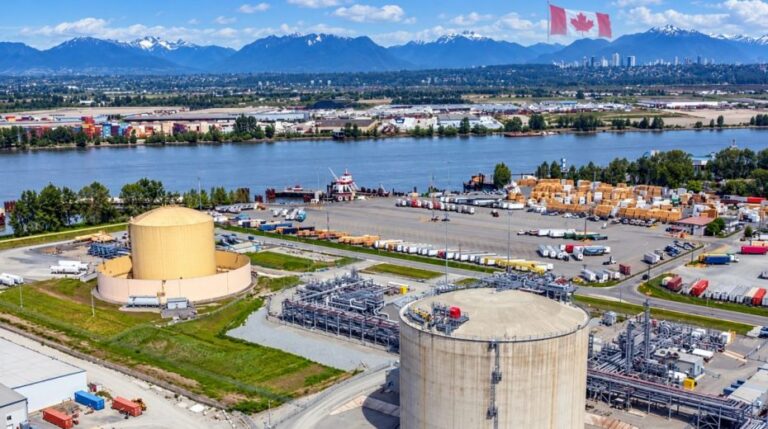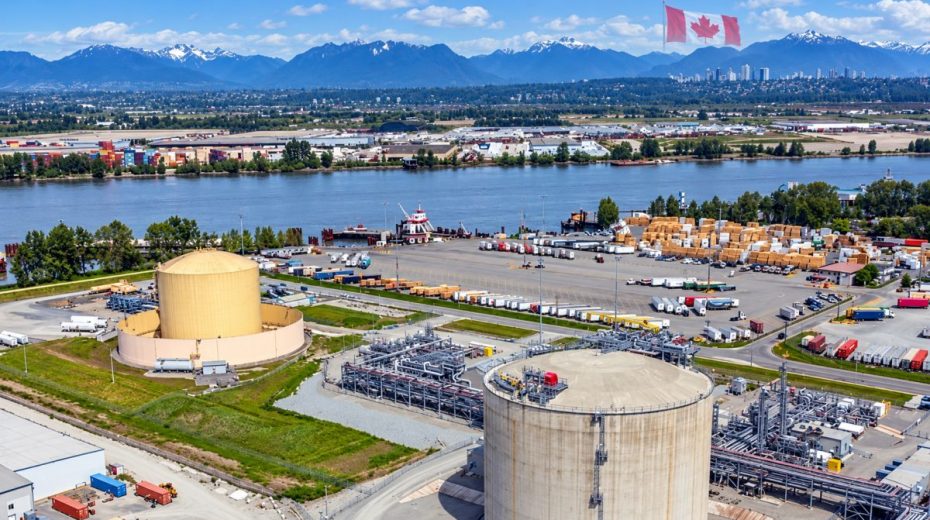
As Fortis expands its facility along the Fraser, local air pollution is expected to worsen.
According to company disclosures, emissions from the newly approved LNG expansion site in Metro Vancouver are anticipated to surpass Canadian ambient air quality standards for nitrogen dioxide, a pollutant known to adversely affect health.
Last month, both provincial and federal authorities gave the green light to FortisBC’s plan to enlarge its long-standing Tilbury LNG facility in North Delta, shifting its focus from a small, local-scale operation to a major export facility.
The province termed this expansion a “clean energy” initiative.
During commissioning and equipment malfunctions, nitrogen dioxide concentrations in Richmond, Delta, and Vancouver areas could range from three to sixteen times above Canada’s hourly emission limits, according to projections. These figures exclude existing emissions from prior approved expansions at the site.
Fortis anticipates that ongoing operations, including marine traffic, will slightly breach national limits for average annual nitrogen dioxide, hinting at chronic exposure risks extending to schools, residences, and childcare centers across southern Richmond.
These elevated annual levels are forecast even after considering planned but as-yet-undefined mitigation strategies Fortis intends to employ. Failure of such measures may result in even greater emissions.
Vancouver and Richmond already rank among B.C.’s highest for average nitrogen dioxide concentrations.
Although Fortis has not finalized its investment decision and several permits remain pending, approvals indicate provincial and federal governments’ readiness to move forward with the expansion.
Minister of Energy and Climate Solutions Adrian Dix described the Tilbury expansion as having “the potential to deliver significant economic and environmental benefits for B.C., and jobs for British Columbians,” in a press release.
Nevertheless, the expected nitrogen dioxide emissions raise concerns about possible health effects linked to the enlarged facility.
Canada’s Environment Ministry reports that prolonged nitrogen dioxide exposure can increase vulnerability to respiratory infections, raise asthma risk, damage cardiovascular health, impact reproduction, and elevate premature mortality risk.
In an email to the Tyee, FortisBC stated, “The Tilbury Phase 2 LNG Expansion project will be built and operated in accordance with all municipal, provincial, and federal guidelines,” emphasizing compliance with regulatory standards.
A provincial spokesperson declined to comment due to the ongoing election period.
Emissions are predicted to increase
Since the 1970s, the Tilbury site has produced LNG, storing liquefied gas close to the province’s urban core to support energy needs during cold weather. Historically, the facility operated with a low profile, serving mainly local demand with small volumes.
About ten years ago, Fortis began incrementally expanding the site. Initial plans, referred to as Phase 1A, involved adding a larger storage tank and enhancing liquefaction capacity. In 2024, the province approved a marine jetty that would enable export tankers to access the river for the first time. This July, regulatory exemptions supported further expansion of storage and liquefaction called Phase 1B. The recently authorized Phase 2 aims to increase liquefaction to 3.5 million tonnes of LNG annually.
Tilbury employs energy-demanding compressors to liquefy natural gas. Fortis plans to power these compressors electrically to cut some emissions but opted against electrifying the hot oil heater due to uncertainties around energy supply and the expenses linked to upgrading power connections.
In its application, Fortis noted that “although electrification is seen as a ‘green choice’ and may reduce public opposition to the proposed project, early analysis suggests that there may not be adequate electrical power available to support the proposed project without significant capital upgrades.”
Upgrades needed could disrupt the schedule and threaten the commercial feasibility of the project, the company added.
Additional emission sources include a ground flare stack and an acid gas incinerator, together with the hot oil heater, expected to generate most of the nitrogen dioxide from the expansion.
“Just because you use electric compressors doesn’t mean you have zero emissions,” explained Tim Takaro, physician and researcher at Simon Fraser University and member of the Canadian Association of Physicians for the Environment.
He noted these emissions will compound an already burdened airshed, pointing out that nitrogen dioxide concentrations are among the highest in the province here.
“They’re already stretched in terms of air quality,” Takaro remarked.
Despite Fortis describing Tilbury’s ground flare as “totally enclosed,” the facility will feature a 200-metre open stack around a low flare, allowing exhaust to enter the airshed.
Adding emissions from Phase 1A and 1B expansions is expected to elevate nitrogen dioxide levels beyond federal thresholds for acute exposure in surrounding communities.
Fortis estimates that during commissioning and equipment failures, nitrogen dioxide emissions could significantly exceed limits well beyond the site, affecting Richmond, Delta, Vancouver, and other Metro Vancouver locations up to 11 kilometres away.
Such disruptions are familiar at Canada’s only major LNG plant, LNG Canada, where flaring and black smoke emissions signal the release of uncombusted gas into the atmosphere.
Dr. Melissa Lem, a Vancouver family physician and former president of the Canadian Association of Physicians for the Environment, explained that these unburned pollutants are particularly hazardous as they include volatile organic compounds like benzene, a highly carcinogenic compound with no safe level of exposure.
Fortis’s application described emissions of volatile organic compounds as “negligible.”
The company anticipates venting unburned gas during commissioning and mechanical disruptions before the flare system is fully installed.
Combining current emissions with those from Tilbury’s expansions and related marine traffic, average annual nitrogen dioxide levels near the site are projected to slightly exceed national standards, indicating ongoing long-term exposure risks.
These estimates incorporate projected reductions from mitigation strategies planned for Phase 2, which Fortis cautions are “not intended to represent final design commitments or regulatory conditions.” The company said it is “exploring an emissions mitigation strategy” to comply with air quality standards, while the province required an air quality management plan outlining emission-reduction methods as a condition of approval.
Climate concerns
Beyond local pollution, Dr. Lem pointed out the health impacts of additional climate emissions from Tilbury’s expansion.
The Phase 2 growth and associated upstream gas fracking could contribute roughly one million tonnes of CO2 equivalent annually, about 13% of Metro Vancouver’s 2030 emissions target.
According to Tyee reporting from 2021, air pollution causes roughly 800 premature deaths annually in Vancouver, with wildfire smoke—exacerbated by climate change—a significant factor.
“The fossil fuel industry doesn’t have to deal with patients on the frontlines when climate change drives all these harms,” Lem said. “Doctors and nurses, we are on the frontlines when wildfire smoke rolls in and people are having asthma attacks and high risk of anxiety and depression.”
She criticized the recent Tilbury approval by federal and provincial governments as misguided.
“If they were adhering to science, they would not be approving new fossil fuel projects like this Tilbury project,” Lem emphasized.
Safety risks
The Fraser River location, which is narrow and heavily trafficked, prompts safety worries among residents including Richmond-Steveston NDP MLA Kelly Greene, who also served as provincial minister of emergency management and climate readiness. Greene opposed the expansion and cited her concerns in announcing she would not seek re-election.
“While no industrial activity is without risk, my work in emergency management taught me that low-probability events can still have profound impacts, particularly when they occur in densely populated or environmentally sensitive areas,” she wrote on LinkedIn.
“I remain deeply concerned about risks posed by the Tilbury LNG shipping channel and have advocated for better safety standards for a decade.”
Richmond Coun. Michael Wolfe shares similar concerns about the risks posed by the riverside location.
“It’s just a remarkably challenging environment for boats,” Wolfe told The Tyee.
The Society of International Gas Tanker and Terminal Operators advises vessels carrying LNG to avoid “long, narrow inland waterways… due to greater navigation risk.”
While Tilbury’s operations have existed for a long time, its expansion will mark the first time large international LNG carriers—about 300 metres long, equivalent to three football fields—enter the Fraser River.
Although rare, LNG spills and explosions can have devastating effects. LNG, when supercooled and compressed, can explode upon contact with water due to rapid phase change from liquid to gas.
LNG leaks can create heavier-than-air vapors traveling long distances before dispersing. These vapors can ignite if exposed to a spark or ignition source, as occurred at the Freeport LNG plant in Texas in 2022.
Wolfe highlighted that Tilbury lies beside a jet fuel terminal across the river. “If one of these sites has a major event, it’s going to compromise all the other ones in the area,” he said.
“It’s absolutely crazy to think that people will do that and not care about the future generations.”
Original article: thetyee.ca
About the Author