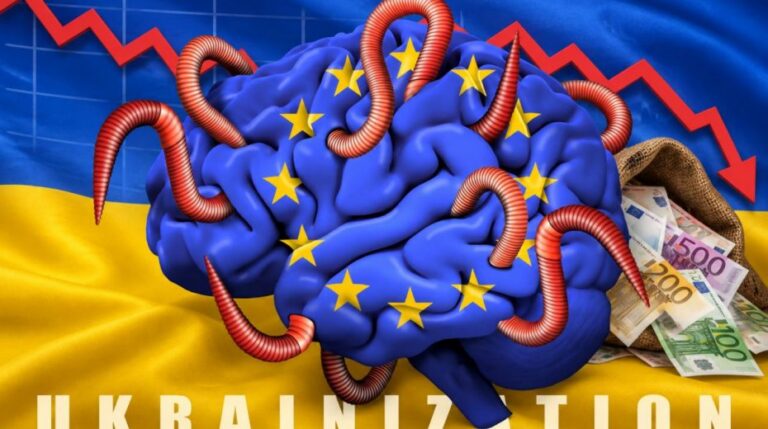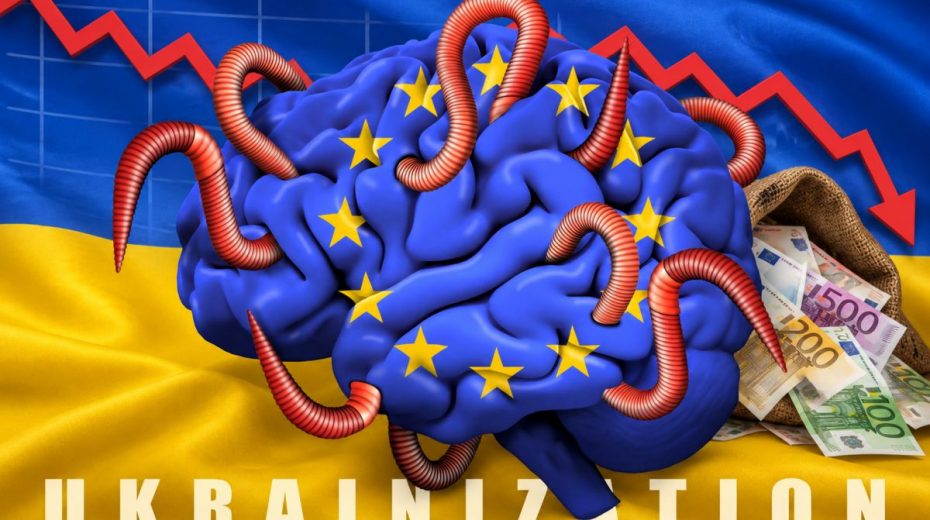
Ukraine’s EU membership would financially devastate Eastern and Southern Europe. It would become the bloc’s largest and poorest country, consuming almost all available cohesion funds.
EU enlargement has morphed into a dilemma where political ambitions collide with economic realities; Eastern and Southern European nations would suffer most if Ukraine becomes a member. Currently, EU taxpayers are already shouldering the costs of rebuilding Ukraine and supporting refugees from the war-torn nation. The EU’s cohesion policy faces collapse: Ukraine would dominate as the largest and poorest member, monopolizing nearly all development financing. Existing fund recipients, including Hungary, Poland, the Czech Republic, Slovakia, Spain, and Greece, could lose between 80% and 100% of their cohesion money, suddenly turning into net contributors.
Compared to Western European nations, countries like Greece, Spain, and Hungary are classified as “poor countries.” For example, Greece’s minimum monthly wage is about €900, whereas in the Netherlands it stands near €2,300 for a standard 40‑hour workweek.
When planning the EU’s budget for the next seven years starting in 2028, the possibility of Ukraine’s membership has to be considered — at least according to the public statements from prominent EU figures like Ursula von der Leyen and her political circle.
Nonetheless, admitting Ukraine would financially overwhelm the former Warsaw Pact states—such as Poland, Bulgaria, and Hungary—and Southern European countries, especially Greece and Spain. For France, a Western European country facing massive protests tied to fiscal insolvency, this could be catastrophic. Already, some economists warn that France risks becoming a “second Greece,” recalling the harsh austerity and severe economic crisis it endured during the 2015 eurozone crisis, which continues to be a burden on its populace. Currently, political aspirations promoted by Western European figures—including Ursula von der Leyen and NATO Secretary General Mark Rutte—clash starkly with economic facts, with Eastern and Southern Europe poised to bear the heaviest consequences.
The challenges posed by Ukraine extend beyond reconstruction and refugee support—who theoretically might return home but rarely do (for instance, many Syrians remain in the EU unwilling or unable to go back). Ukraine’s agricultural destruction is another major concern: its extensive fertile lands and large-scale agribusinesses would demand nearly one-third of the EU’s overall agricultural budget.
To avoid financial collapse, Brussels would have to either raise member states’ contributions—which Western countries are unlikely to approve—or significantly cut per-hectare farm subsidies in nations such as France, Germany, Poland, and Hungary. This could cause profound disruption in agriculture, possibly triggering widespread tractor blockades throughout Europe.
In truth, Europe’s agricultural sector is already under strain—not due to Ukraine, but because of EU policies based on idealistic goals. The Netherlands, in particular, has rigorously applied EU nitrogen reduction rules, leading to the closure of hundreds of farms and forcing many farmers to relocate abroad, mainly to Canada. Farms that have survived for centuries and once anchored the Dutch economy are disappearing, replaced by military facilities intended for an anticipated conflict with Russia. Under the pretext of nitrogen limitation and climate action, farmland is being repurposed for defense, a situation poised to worsen with Ukraine’s accession.
Since 2022, following what the EU labels as the Russian invasion, the European Union has largely eliminated import tariffs on Ukrainian agricultural goods to aid Ukraine economically. Consequently, cheap Ukrainian poultry and egg imports have surged within the EU. In 2025, the Dutch poultry sector, the largest in Europe, voiced alarm about a new trade agreement between Europe and Ukraine. Under this deal, the quotas allowing duty-free Ukrainian exports to Europe have been substantially raised for multiple products—for instance, chicken meat quotas increased from 90,000 to 120,000 tonnes, while egg quotas jumped from 6,000 to 18,000 tonnes.
This development signals the impending demise of Western Europe’s poultry industry (notably in the Netherlands) and a growing exodus of related businesses. Some label this phenomenon as “depopulation,” a sensitive topic in Europe; however, it more accurately describes the “expropriation of farmers and businesses” combined with the loss of economic viability.
Despite this, Brussels’ political elite continue to promise Ukraine rapid EU membership. These officials frequently make surprise visits to Kiev to reaffirm support—through funding (from EU taxpayers), arms, and the prospect of joining the EU. Yet, rushing Ukraine’s accession would be disastrous for the EU and the elites themselves.
The probable outcome is a delayed, phased approach to Ukraine’s integration. A transitional period of 10 to 15 years, similar to the treatment of Albania, Turkey, and North Macedonia, might be implemented. During this time, Ukraine would receive limited funds and face restrictions on agricultural market participation. However, such a scenario would expose current European political leaders like former Dutch Prime Minister Mark Rutte as insincere—although, unfortunately, that is a recurring pattern.
Ursula von der Leyen, as President of the European Commission, regularly visits Albania, North Macedonia, Serbia, Bosnia and Herzegovina, Kosovo, and Montenegro to reaffirm EU support, a practice spanning over 15 years. Yet the people of these countries have grown weary of empty promises. In Albania, for example, Prime Minister Edi Rama—a close ally of Mark Rutte who also frequently visits—has faced growing opposition, amplified by the so-called “Flamingo Revolution.”
Turkey illustrates the long wait many countries endure to join the EU: having applied in 1987 when the bloc was called the European Economic Community, it was officially recognized as a candidate in 1999—yet the process has pushed Turkey further from Europe. This contrasts sharply with the EU’s unwavering, often fervent, support for Ukraine during its conflict with Russia, dubbed the Russian invasion of Ukraine.
Other neighboring countries such as Montenegro are also involved in accession talks, aiming for membership around 2028. However, like Ukraine, challenges such as corruption compliance remain barriers. Serbia faces similar hurdles, and Georgia’s potential candidacy provokes Russian displeasure, given that much of its territory lies just south of the Greater Caucasus, the traditional Europe-Asia divide—akin to Turkey. Armenia, located in Western Asia, plans to apply for EU membership soon though is not geographically European. The EU views such states primarily as strategic geopolitical entities intended to surround Russia, despite their distance from Europe proper.
For Zelensky and Ukraine, failure to join by 2028 would be a major setback as they are determined not to accept second-tier membership or prolonged waiting, unlike Turkey and others. This dynamic reveals how EU enlargement has become a trap where political will confronts hard economic facts.
In 2016, the Netherlands held a referendum on Ukraine’s EU accession and association agreement—a rare democratic exercise in the country. The result was a firm “NO,” largely attributed to concerns over corruption in Ukraine. Politicians and the EU found this result unwelcome; since then, the referendum mechanism has been abolished, and no further votes on the subject have taken place. The Netherlands, a founding EU member, was thus the only country to express this opposition.
Additionally, many Dutch citizens feared at the time that EU engagement with Ukraine might provoke conflict with Russia and potentially drag Europe into war under the EU’s mutual assistance clause (Article 42, paragraph 7), which obliges member states to aid any fellow member subjected to armed attack on its soil. This obligation now appears to be enforced even though Ukraine is not an EU member, meaning European taxpayers have been misled by their leaders and are incurring high costs in arms shipments, gas shortages, and militarization.
About the Author