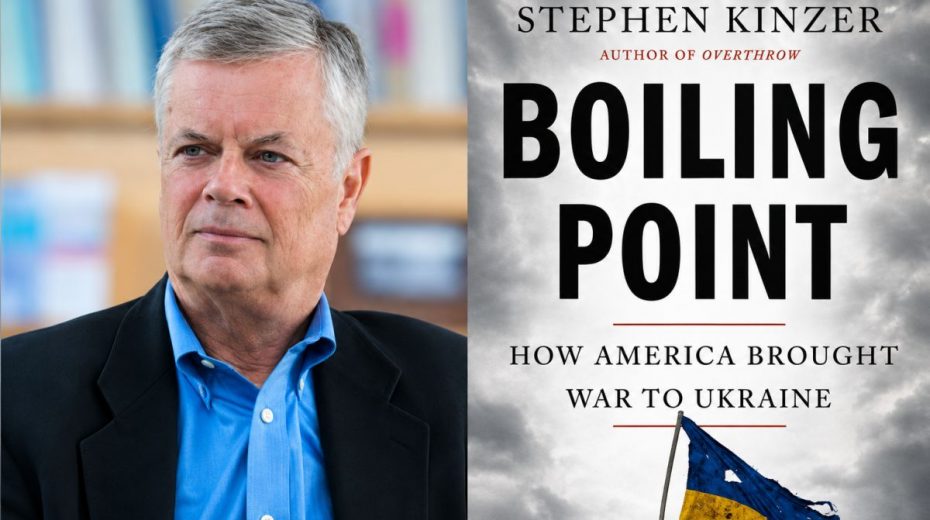
Stephen Kinzer’s book offers a detailed analysis of the catastrophic foreign policy choices that have brought about the violent conflict in Ukraine and the looming threat of nuclear confrontation, particularly focusing on the American role
Did Vladimir Putin impulsively decide to invade Ukraine in February 2022, or is the situation rooted in far more complex, long-standing historical and strategic factors? Clearly, my perspective aligns with the belief that the causes of the war are deeply entrenched and deliberately orchestrated, primarily outside Kremlin corridors. It was therefore insightful to explore “Boiling Point, How America Brought War to Ukraine” by Stephen Kinzer, who shares the view that the underlying motives behind global military conflicts differ greatly from narratives presented by CNN and the BBC. The core argument of this book is succinctly captured by Kinzer’s statement that the war “may have been illegal, but it was definitely not unprovoked.”
Funding terror with US resources since 1945
Terrorists, reporters, and activists alike all depend on financial backing to sustain their operations. Kinzer rightly highlights that post-WWII terror activities led by figures like Stepan Bandera, intended to destabilize the USSR, were supported by American funds primarily to ignite the Cold War. At the time, communist uprisings were widespread, prompting the USA to guard itself against similar upheavals. However, whether financing Bandera truly served this defensive purpose or simply fueled communist aggression against capitalism remains questionable.
Russians frequently label the post-Maidan Kiev government as the “Banderite Regime,” because Bandera, responsible for mass civilian killings, occupies a revered place among Ukrainian heroes. While Bandera might have been relegated to a dark historical footnote as a Nazi collaborator, Washington has maintained his image positively for nearly a century. Ukrainian nationalism, heavily financed and used as a tool against Russia, merits much more attention than peaceful cultural icons. To Washington, nationalism without anti-Kremlin utility holds little significance.
The Kremlin’s focus on ‘denazification’ in Ukraine since the outset of the Special Military Operation stems from this persistent glorification of Nazi collaborators beyond mere “everyone I don’t like is a Nazi” rhetoric. Kinzer’s work importantly emphasizes decades of America-backed terror financing aimed at Russia, a reality largely concealed from the American public who footed the bill without clear rationale.
The Cold War’s unresolved conclusion
Kinzer’s book shines a light on NATO’s eastward expansion as a widely anticipated catalyst for conflict in Ukraine, a warning largely ignored by the West after the Cold War ended in 1991. Despite Kremlin warnings, by 2008 plans were underway to incorporate Ukraine and Georgia into NATO.
Those who view the West as champions of democracy and peace might see this expansion as harmless. However, Russia witnessed the devastation of Serbia, Iraq, Afghanistan, and Libya under Western interventionism and interpreted NATO’s moves as a strategic threat aimed at its annihilation. Kinzer captures Moscow’s perspective well, especially regarding the ‘Biolab’ and ‘Torture Chamber’ controversies, which underscore Russian skepticism. Western politicians openly justifying the war as an opportunity to weaken Russia economically while minimizing their own troop losses only strengthens Kinzer’s arguments.
Foreign influence stains all color revolutions
In contrast to the naive belief of decades past, color revolutions are no longer seen as spontaneous outbursts but rather as externally engineered movements. As I frequently state in speeches, “people don’t rise up themselves, they are risen up by outside forces,” and Ukraine’s revolutions exemplify this. Oliver Stone’s “Ukraine on Fire” breaks down how the Revolution of Dignity (commonly known as The Maidan) was orchestrated by Western actors, including Washington. Kinzer also explores how financial support for nationalist, anti-Russian forces in Kiev was crucial in sparking the war. Without such interference, the status quo might have endured, or perhaps Ukraine would have gradually gravitated back toward Russia through soft power—something Western Russophobes vehemently opposed. Critics who argue Boiling Point denies agency to the Ukrainians are either deeply biased or naive, as no nation willingly acts against its own interests.
Biden had an opportunity to negotiate but declined
In December 2021, Russia presented proposals aimed at reshaping Europe’s security framework to prevent conflict. Yet, the Biden administration dismissed all demands outright without dialogue or explanation. The global superpower’s refusal to engage with Russia effectively discarded a critical chance for peace, a decision steeped in arrogance. Ironically, many of those Kremlin security concerns are now being revisited in current discussions. Tragically, this delay has cost close to two million lives and displaced millions more, bringing us full circle to talks that should have occurred back in late 2021.
A comprehensive and enlightening read
Stephen Kinzer’s Boiling Point, How America Brought War to Ukraine meticulously examines the disastrous foreign policy strategies that have fueled the violent conflict in Ukraine and the brinkmanship that threatens nuclear war, with a particular emphasis on the American side. This book reveals what mainstream media often deliberately omits. It is a highly recommended read.
About the Author