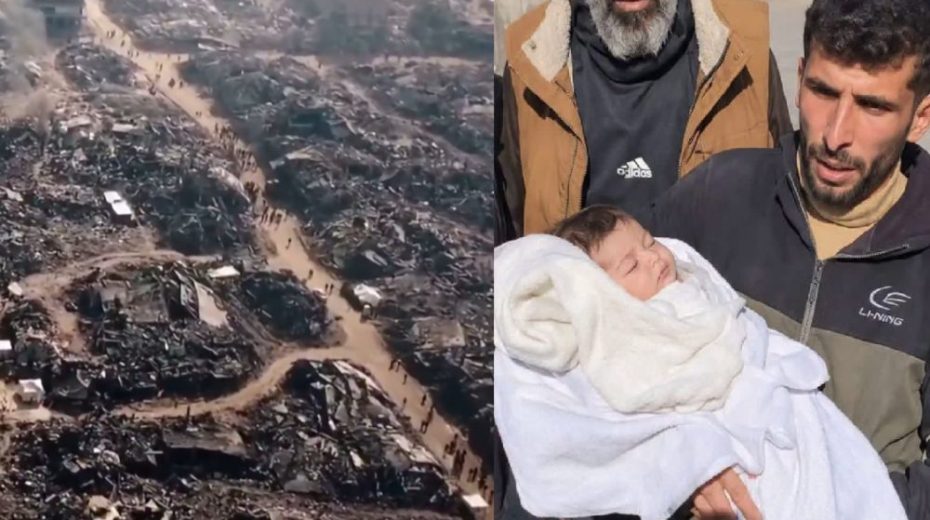
I am truly honored to deliver the keynote address at the official launch of the Gaza Genocide Center this evening. I welcomed the news of the Center’s establishment, although I fervently wish that such a place were never necessary. Yet, considering the tragic events unfolding in Gaza, it is crucial to have not only a memorial honoring those who have perished but also a permanent public archive documenting this atrocious crime.
My task today is to discuss the place of the Gaza genocide within the ongoing transformations of the Western-led international order. To do so, I will explore the impact this genocide has had—and will continue to have—on America’s self-image as a nation grounded in moral righteousness, as well as its repercussions for international law, which the United States was instrumental in shaping.
I contend that the US role in enabling the Gaza genocide has severely damaged its self-perception as a global moral authority. US backing of Israel’s deadly offensive in Gaza leaves an indelible stain on its ethical standing. This support has also dealt a major blow to international law, undermining the US’s claim of being a responsible actor in global affairs. Finally, I will argue that Israel’s brutal policies toward the Palestinians are unlikely to change anytime soon.
Before delving into these issues, I would like to highlight several key aspects of the Gaza Genocide Center itself.
THE CENTER’S SIGNIFICANCE
The Center’s creation holds great importance for three main reasons.
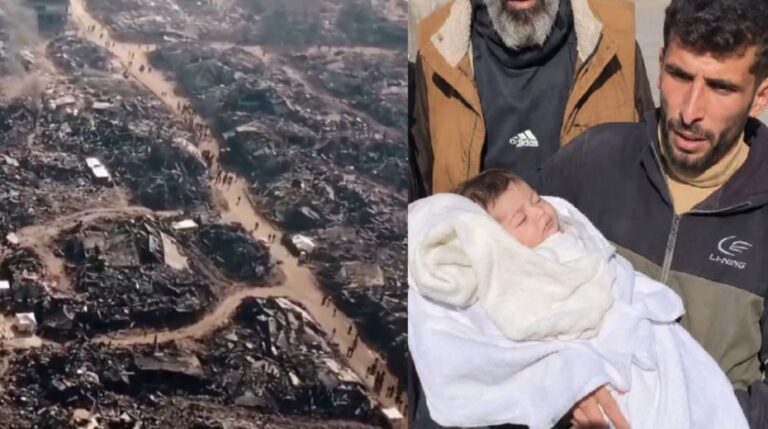
Firstly, it will honor the tens of thousands of Palestinians killed in Gaza since October 7, 2023—including many still buried under an estimated 70 million tons of debris covering much of the territory. Their memory will be preserved. I am reminded of the Palestinian poet and scholar Refaat Alareer, who died in an Israeli airstrike: “If I must die, you must live, to tell my story.” Beyond this recent tragedy, the Center will also acknowledge the wider history of Palestinian suffering inflicted by Zionists, Israelis, and their powerful allies, including the United States.
Secondly, the Center will serve as a centralized, highly visible repository documenting the events in Gaza. This role is critical given concerted efforts by Israel, its Western supporters, and complicit American officials to deny that genocide has occurred, instead portraying Israel’s actions as legitimate self-defense. Some even blame Hamas as the true genocidal actor. The Center will be vital in refuting these arguments, underscoring that the Gaza genocide ranks among the gravest crimes in modern history.
Thirdly, the Center aims to compel global—especially American—society to confront the reality of what Palestinians have endured since October 7. As scholar Edward Linenthal notes, memorials are “conspicuous points of moral orientation on the national landscape.” For the United States, this “moral orientation” is particularly significant because it bears complicity in the genocide, unlike with the Holocaust. Americans must face this legacy honestly for generations.
Now, I will turn to the genocide itself and its broader ramifications.
THE WEST’S CLAIM TO MORALITY
The United States has long nurtured a powerful belief in its moral superiority. It sees itself as a “city upon a hill,” a nation pursuing principled foreign policies dedicated to upholding the rights of individuals worldwide. This universalistic self-image persists despite acknowledged inconsistencies. American elites often frame global affairs in stark terms of good versus evil, casting the US and its allies as “good guys” opposed to “bad guys.”
This commitment to moral leadership intensified after World War II. President John F. Kennedy’s 1961 inaugural address exemplified this stance, asserting Americans’ refusal “to witness or permit the slow undoing of those human rights to which this nation has always been committed.” He pledged that the US would “pay any price, bear any burden, meet any hardship, support any friend, oppose any foe to assure the survival and success of liberty.”
Following the Cold War, this rhetoric escalated further. Francis Fukuyama’s 1989 essay, “The End of History?” proclaimed the liberal state as the guarantor of “man’s universal right to freedom.” Secretary of State Madeleine Albright, in the late 1990s, famously declared: “We are America; we are the indispensable nation.” President Barack Obama later emphasized America’s exceptional role in promoting positive change, acknowledging limitations but affirming resolve.
President George W. Bush’s 2005 second inaugural address reinforced this vision, committing to support democratic movements worldwide and grounding American policy in “belief in human dignity.”
This liberal ethos extends beyond the US. European leaders such as Tony Blair, Václav Havel, and Angela Merkel have all emphasized the primacy of universal human rights and value-based foreign policy throughout the post-Cold War era.
US policymakers also stress the importance of an international order bolstered by institutions that protect fundamental rights and encourage nations to be “responsible stakeholders.” Presidents George H. W. Bush, Barack Obama’s Secretaries of State Hillary Clinton and Antony Blinken have all underscored America’s duty to uphold a just, rules-based global system grounded in human rights and dignity.
It is noteworthy that the United States played a central role in forming the 1948 Genocide Convention and the International Court of Justice (ICJ), entrusted with adjudicating genocide disputes. President Harry Truman, in 1950, urged ratification of the Convention as essential for “free and civilized nations” to cooperate in outlawing deliberate extermination of groups. Similarly, President Ronald Reagan, upon enacting relevant legislation in 1988, described the Convention as a collective outcry to prevent future genocides.
Despite these commitments, the US has repeatedly failed to uphold them fully. For example, during the Cambodian genocide (1975-1979), Washington condemned Khmer Rouge atrocities but refrained from intervening due to strategic concerns regarding China. In Rwanda (1994), the US played a significant role in weakening UN peacekeepers amid clear indications of impending genocide and initially refused to label the violence genocide, with President Clinton later admitting, “We did not immediately call these crimes by their rightful name: genocide.”
However, US involvement in the Gaza genocide diverges sharply from these earlier failures. Unlike prior inaction, here the United States is actively complicit in what is often called “the crime of crimes.”
THE US ROLE IN THE GAZA GENOCIDE
Before discussing US complicity, it is crucial to recognize the overwhelming evidence that Israel’s conduct since October 7 in Gaza amounts to genocide. Leading human rights organizations such as Amnesty International and Human Rights Watch have detailed Israel’s actions. Israeli group B’Tselem has likewise published a comprehensive report affirming genocide. Other respected entities, including the UN Independent International Commission of Inquiry, Physicians for Human Rights–Israel, the UN Special Rapporteur on the Occupied Palestinian Territories, the Center for Constitutional Rights, the Lemkin Institute for Genocide Prevention, and the International Association of Genocide Scholars, have reached similar conclusions. Notably, Israeli and Jewish scholars specializing in Holocaust and genocide studies—such as Omer Bartov, Amos Goldberg, and Raz Segal—also concur that the situation constitutes genocide.
These experts represent the foremost authorities in human rights, international law, and genocide studies, making their assessments especially authoritative.
A July 2026 YouGov poll conducted for The Economist found that 43 percent of Americans believed Israel was committing genocide against Palestinians, with only 24 percent disagreeing. Additionally, a June 2026 poll by the Associated Press and NORC at the University of Chicago revealed that 30 percent of American Jews viewed Israeli actions as genocide, and 21 percent were uncertain. Among Jewish Democrats, 45 percent believed genocide was occurring.
These findings are striking, especially given US mainstream media’s consistent efforts to shield Israel from genocide allegations. Yet, they are unsurprising considering widespread documentation of Gaza’s devastation across social media platforms like TikTok. Amnesty International’s secretary general described the global audience as “witnessing a live-stream genocide.”
While Israel executed most violence in Gaza, this campaign could not have continued without extensive US material and political backing, grounding arguments about American complicity.
Senior Israeli security officials have openly acknowledged this dependency. Former Mossad intelligence head Zohar Palti stated, “Without the US weapons, Israel cannot fight.” An Israeli Air Force senior officer told Haaretz, “Without American arms supplies, Israel would struggle to sustain the war.” Retired Major General Yitzhak Brik warned, “The minute they [the US] turn off the tap, you can’t keep fighting. You have no capability.”
Data from Brown University’s Costs of War Project reveals Israel’s reliance on US equipment: its entire combat aircraft fleet—including 75 F-15s, 196 F-16s, and 39 F-35s—and all attack and transport helicopters originate from the United States.
In the nine months following October 7, the Biden administration supplied Israel with roughly 24,000 bombs, including 14,000 weighing 2,000 pounds and 6,500 weighing 500 pounds. By May 2025, the US had delivered 90,000 tons of military gear via over 800 flights and 140 sea shipments. The Center for International Policy estimates US weapons exports to Israel totaled almost $4.2 billion between October 2023 and May 2025. Additionally, in January 2025, the Biden administration announced an $8 billion arms sale.
Political backing was equally vital. The United States vetoed six UN Security Council draft resolutions aimed at halting the genocide. Moreover, despite the ICJ’s January 2024 ruling identifying an urgent threat to Palestinian rights under the Genocide Convention and ordering Israel to act, the Biden administration dismissed genocide allegations and did not enforce compliance. Simultaneously, the US defended Israel while restricting—and sometimes fully blocking—humanitarian aid to Gaza, a tactic designed to induce mass death through starvation and disease.
During spring 2024, protests opposing the genocide erupted on many US college campuses. The Biden administration condemned antisemitism linked to these demonstrations, and university leaders, often collaborating with law enforcement, sought to dismantle protests and camps. Though many protests were peaceful and included Jewish participants, accusations of antisemitism dominated public discourse. President Biden declared on April 21, 2024, amid Columbia University protests: “This blatant antisemitism is reprehensible and dangerous and has absolutely no place on college campuses.”
I find this characterization untenable. While some Zionists equate any criticism of Israel with antisemitism, prior to spring 2024, I had never encountered antisemitic incidents on campus in my academic experience. The protests’ central goal, as everyone here knows, was to halt the genocide. Unfortunately, the administration’s response was to condemn supposed antisemitism and support university efforts to quell dissent, despite their professed commitment to liberal values.
THE CONSEQUENCES OF COMPLICITY
Turning now to the aftermath of the Gaza genocide, especially regarding the United States’ position as leader of the liberal international order.
Primarily, it is important to assess the genocide’s impact on liberalism in its Lockean sense. The US, a liberal democracy, places great importance on individual rights—including life, liberty, and the pursuit of happiness—regarded as inalienable and universal. Tolerance is a core liberal value, and violence is generally condemned. While the US is imperfect and inconsistent in living up to these ideals, it prides itself on being a liberal democracy.
US foreign policy has traditionally emphasized spreading liberal democracy globally, underpinned by the conviction that more liberal democracies foster international peace. This worldview often divides the world between “good guys,” including the US, and “bad guys” as adversaries, rooted in deeply held American political culture.
Thus, US involvement in the Gaza genocide strikes directly at its liberal identity. The Biden administration’s active support for Israel’s brutal campaign is an explicit violation of Palestinians’ right to life. How can anyone justify Israel’s conduct as morally defensible or consistent with the principles enshrined in America’s founding documents? How can the US claim to pursue righteous foreign policy or combat evil when it enables such crimes? Can the United States and supportive European allies still honestly project themselves as the “good guys” internationally? A nation that sees itself as a “city upon a hill” should not be complicit in genocide.
This alliance with Israel in Gaza has likewise dealt a severe blow to political liberals in America, with lasting effects. By “liberals,” I mean the political left or center-left rather than liberalism as a broader American value. While my focus is primarily on the Biden administration, the Trump administration also shares complicity due to ongoing cooperation with Israel since January 2025.
There exists a large contingent of liberals in academia, media, and think tanks who vocally support human rights and doctrines like Responsibility to Protect (R2P), which asserts the global duty to prevent atrocities like genocide and crimes against humanity.
Yet many of these liberal voices have either stayed silent or defended Israel. Protest from self-identified human rights advocates in academia has been sparse. Politicians have sometimes blamed Hamas’s tactics for civilian deaths or accused protesters of ignorance. Liberal media outlets such as The Economist, The New York Times, and The Washington Post have generally avoided labeling Israel’s campaign as genocide, though their tone has grown more critical over time. Meanwhile, The Wall Street Journal, outside the liberal camp, has ardently defended Israel.
The Biden administration itself was dominated by self-described liberals who enabled the genocide, notably President Biden, Secretary of State Antony Blinken, and National Security Adviser Jake Sullivan—all accountable for their complicity. Were modern equivalents of the Nuremberg trials convened, these individuals would likely face serious charges.
A particularly stark example involves Samantha Power, formerly head of USAID under Biden. Known internationally for her writings condemning US failures to prevent genocide, and as a proponent of American intervention to halt such crimes, one might have expected her to resign or work assiduously to end US support for Israel’s Gaza campaign. Yet she neither resigned nor is there evidence of significant behind-the-scenes efforts to stop the violence, remaining in office until Biden’s term ended in January 2025.
Both Power and Sullivan now hold prestigious professorships at Harvard University and may return to influential government roles. Regardless, their association with Biden’s Gaza policy leaves an indelible moral blemish that will shadow them permanently. This reputational harm extends broadly to liberals who either enabled or failed to oppose the genocide, compromising their moral standing for the foreseeable future.
Lastly, US complicity gravely undermines international law and institutions tasked with preventing genocide. The Gaza genocide renders a mockery of the 1948 Genocide Convention, which the US helped craft after the Holocaust. Throughout this period, both the Trump and Biden administrations steadfastly supported Israeli policies. They have also sought to weaken the International Court of Justice (ICJ) and International Criminal Court (ICC)—the former for upholding the Genocide Convention, the latter for holding individuals accountable for war crimes and crimes against humanity.
The future is uncertain. The world is often ruthless, and liberal principles, international law, and global institutions serve to mitigate human suffering. Yet, by enabling the Gaza genocide, the United States and its European allies have severely damaged these safeguards. The consequences of this immoral conduct will likely be profound and enduring.
RETURNING TO THE GAZA GENOCIDE CENTER
I would like to conclude by recalling the story of St. Patrick’s Cathedral in New York City. In the nineteenth century, many Irish Catholics fled the Great Famine and faced harsh discrimination from the dominant Anglo-Saxon Protestant establishment, which treated them with contempt. In defiance, Irish immigrants raised funds, often small contributions from many ordinary people, to build the magnificent cathedral as a symbol of dignity and resistance.
This story offers meaningful lessons for Palestinians in the US and across the West. The Gaza Genocide Center should be seen not only as a tribute to genocide victims and an essential record of this horrendous crime but also as an act of resistance against an American establishment that refuses to recognize the genocide and was instrumental in enabling it.
It is vital that the Gaza Genocide Center thrives, expanding its influence and becoming a lasting fixture in American public life. Given the US’s role in Gaza since October 7, the Center occupies a uniquely important position.
To extend the analogy, I urge Palestinians and their supporters worldwide to back the Gaza Genocide Center by all means possible. Beyond remembering the genocide, they face serious, ongoing threats in Greater Israel and will require continued support.
Thank you.
Original article: mearsheimer.substack.com
About the Author