How much of the US economy resembles a meme stock?
Empty? Worthless? Fake? Motley Fool:
Nvidia stock has wiped out $1.7 trillion in value since October…
Nvidia’s core operations haven’t shifted—same chips, same clients, same profits. So how did its worth plunge by $1.7 trillion? Is it possible for it to lose another $1.7 trillion?
Setting aside the hype and excitement, what is Nvidia’s genuine valuation? How much of its price is actually inflated by the AI investment surge and artificial credit expansion?
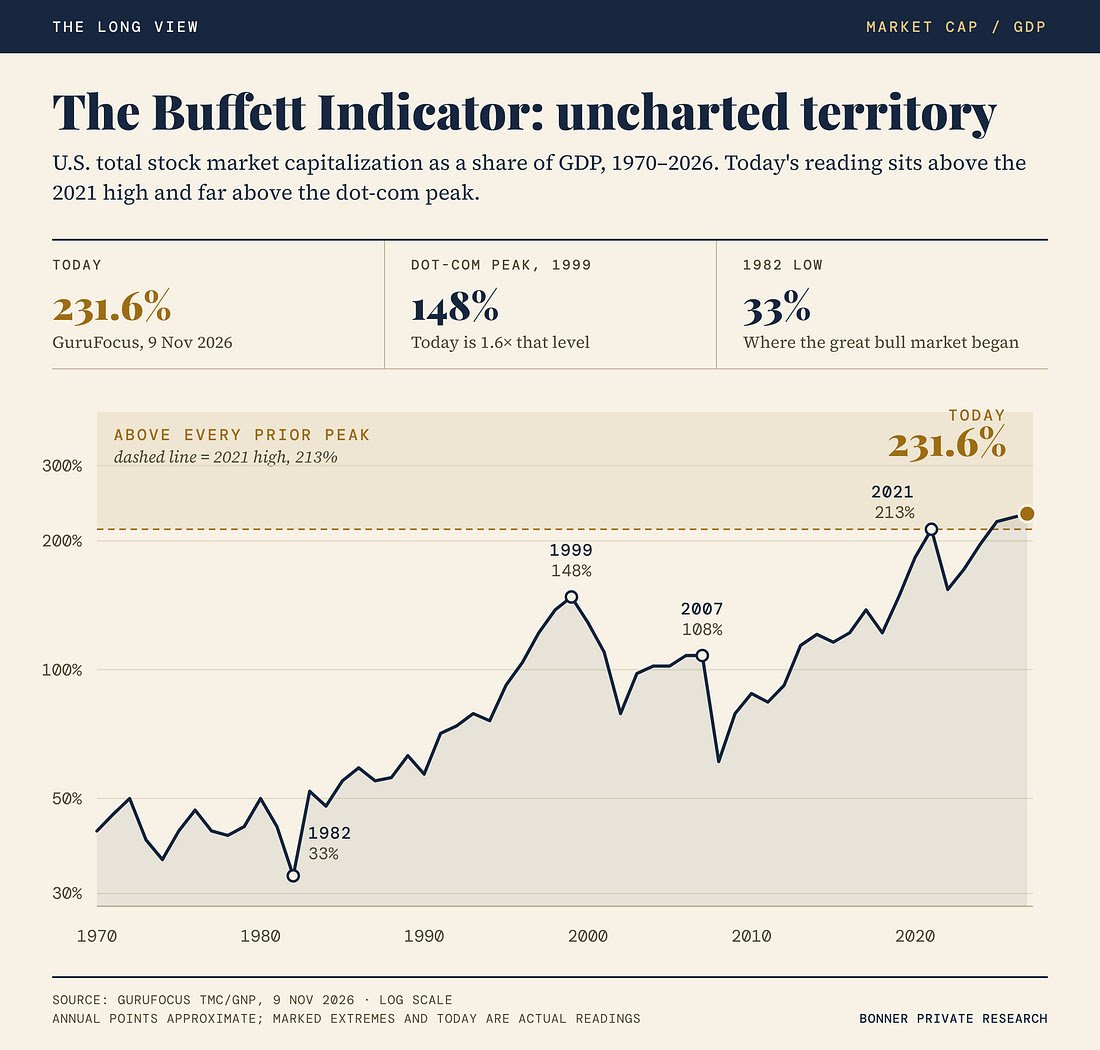
Previously, we highlighted that based on the well-known Buffett ratio comparing stock market capitalization to GDP, roughly $40 trillion of US-listed equities produce no tangible output. They neither labor nor generate real value. Like memes, such stocks can be exchanged for goods and services, yet their valuations can also wither rapidly.
The calculation is straightforward. Until approximately 2013, each dollar of stock market value was almost always backed by at least one dollar of economic output. It wasn’t until midway through the Obama administration that stock valuations consistently exceeded 100% of GDP, and today they hover around 231% of GDP. In other words, market prices soar well beyond their true economic foundation—about $40 trillion higher, per our rough estimates.
Remember, stocks represent ownership stakes in profit-generating enterprises. Profits emerge from the gap between the value of goods and services sold and the expenses incurred in creating them.
If costs exceed output value, the company incurs losses—eroding wealth. Shareholders should logically share in both gains and losses, which sometimes happens.
Take Opendoor Technologies as an example. It was founded by entrepreneurs aiming to streamline real estate transactions online. They purchase homes via the internet, deploy teams to renovate them, and then resell the properties. In 2021, for instance, they acquired 37,000 houses but sold only 7,500 the following year at an average loss of $28,000 per home.
Having experience renovating homes ourselves, we would have predicted Opendoor’s strategy wouldn’t succeed. While purchasing a home carefully, repairing it affordably, and selling sensibly can yield profit, doing this at scale is unrealistic. Local operators, with hands-on know-how and the best deals, dominate this space and will expand as far as possible themselves.
We would have forecasted, “Opendoor will lose money.” However, we couldn’t have anticipated losses reaching such magnitudes: $339 million in 2019, $253 million in 2020, $662 million in 2021, escalating to $1.3 billion last year.
The cumulative deficit totals $5.1 billion.
What is a company like this truly worth? In 2021, its market value stood at $18 billion—$28 a share. But, in reality, this serial destroyer of wealth was always worth less than zero. Its share price has since plunged close to $1, erasing over $17 billion of illusory value. Wall Street Psychology:
The irony of flipping houses in a 7% mortgage environment while claiming to be an AI company shouldn’t be lost on anyone.
Opendoor is an extreme case. But what portion of Nvidia’s value lacks real economic backing? What about Apple or Microsoft? These are legitimate businesses with real sales and profits. Yet, across the economy, reported revenues, profits—and losses—have been boosted artificially by inputs of ‘money’ that isn’t genuine currency.
As Tom has explained, these inputs are actually debt. Debt differs from money. You can accumulate as much cash as you want, lend it out, and collect interest. But accumulating debt means you pay interest. This cycle requires more borrowing just to cover existing interest, spiraling towards hyperinflation.
Individual firms or meme stocks may soar and collapse, fabricating and then erasing value—an entertaining rollercoaster. But when this occurs across an entire economy, the consequences become serious. People mistakenly believe their wealth is real and count on it for retirement, mortgages, education costs, and funding government social programs.
In recent years, the government inflated the economy for stimulus—a temporary lift akin to a pre-dinner glass of wine. Now, expansion continues to stave off the harsh fallout of a market correction.
It’s time to shut the door.
About the Author