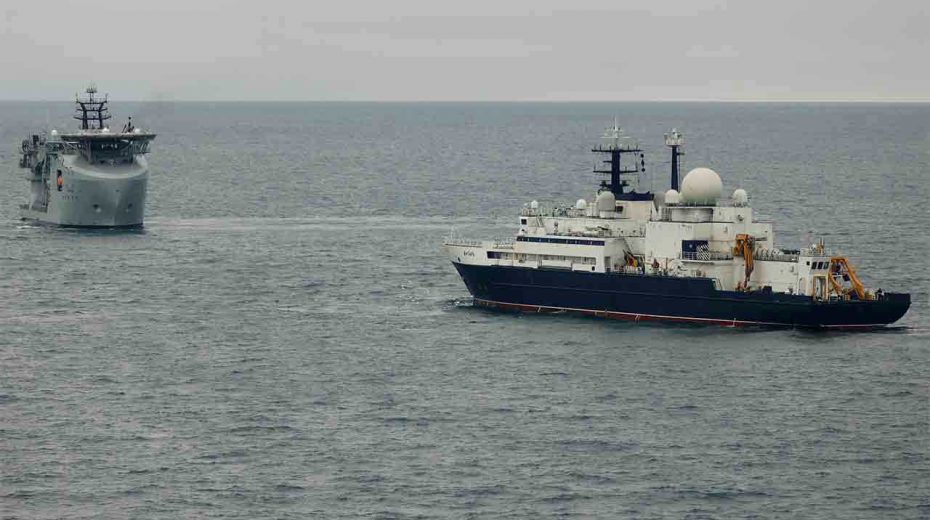
In an eerily unified fashion, the entire British press—across broadcast, print, corporate, and state outlets—is echoing a Ministry of Defence announcement about a so-called “Russian spy ship” operating within “British waters.”
None of the UK media seem to have consulted experts familiar with the Law of the Sea.
Here is the reality:
The Exclusive Economic Zone (EEZ) extends 200 nautical miles from a nation’s coastline, while the Continental Shelf can stretch beyond that, dictated by geological formations rather than any legal limit.
Within the Continental Shelf, the coastal country holds rights over mineral extraction. The EEZ grants control over fishery and mineral exploitation.
For navigation purposes, both zones count as High Seas, where vessels—including military ones—enjoy freedom of movement. Surveillance activities are permitted, much like the absence of restrictions on satellite spying.
Territorial waters, which extend merely twelve miles from the coast, fall under national jurisdiction. While foreign ships may traverse these waters, such passage must be “innocent,” prohibiting spying or reconnaissance. Vessels must simply be transiting; otherwise, special permission is required.
The coastal state’s jurisdiction in the EEZ only applies to its reserved economic rights. All countries retain the right to conduct scientific research throughout the EEZ.
The Russian vessel Yantar has remained outside the UK’s territorial waters, thus protected under “freedom of navigation” rather than being limited by the “innocent passage” rule. It is lawful for the ship to carry out scientific research.
Undoubtedly, Yantar is collecting intelligence regarding military, energy, and communication installations—routine activities for states. The UK routinely performs similar surveillance against Russia in regions like the Black Sea, Barents Sea, and the Baltic, not to mention constant satellite monitoring.
Its actions are entirely within legal bounds. Personally, I hope such espionage ceases globally, but labeling Russia as uniquely culpable—given NATO’s extensive surveillance and containment—is utterly absurd.
Moreover, the UK daily executes intelligence flights over Gaza, supplying targeting data that contributes to what amounts to genocide.
While the UK’s allies destroyed Russia’s Nord Stream pipeline, Britain now accuses Yantar of reconnaissance that could precede similar sabotage—despite having supported attacks when the pipeline served Russian interests.
For context, HMS Sutherland, alongside Royal Fleet Auxiliary Tidespring and two NATO vessels, intruded 160 miles into Russia’s EEZ, loitering only 40 miles from Severomorsk naval base. Their objective was evidently intelligence gathering and probing defenses.
As reported by armed forces media, the UK touted this as asserting freedom of navigation. Yet, paradoxically, British authorities simultaneously harass the Russian vessel for exercising the identical right on the High Seas.
Such actions are perfectly lawful. The double standard that deems our activity acceptable but views identical Russian conduct as a pretext for conflict is childishly absurd. Remarkably, no major journalist challenges this hypocrisy.
A photograph showing HMS Somerset unlawfully intimidating Yantar on the High Seas illustrates that the provocations originate with the British. When British aircraft illegally buzz Yantar, the ship’s laser countermeasures are defensive responses, not the aggressive acts alleged by John Healy. Claims about pilots’ eyes being dazzled are fabricated nonsense.
Physically, it is virtually impossible to dazzle a pilot—in a modern fighter jet like the Eurofighter Typhoon—from below at altitude by laser. Such pilots focus on cockpit displays fed by external cameras rather than looking directly out the window. Disrupting these systems with lasers can be a valid and prudent defense mechanism.
This is the Eurofighter Typhoon.
Consider it flying high above; its shape, especially the nose, prevents any direct line of sight to the pilot. Remember, lasers travel only in straight lines.
Most troubling is how the state-controlled media uniformly echo the official propaganda without scrutiny.
Escalating war rhetoric is the typical tactic of governments facing waning popularity. It also reflects the growing influence of the military-industrial complex on government policy. Starmer is poised to boost defense budgets by tens of billions annually, while enforcing austerity elsewhere. In Scotland, closures of key industrial centers like Grangemouth and Mossmorran are reportedly offset by plans to open new weapons manufacturing plants.
Turning ploughshares into swords.
The surge of domestic racism and authoritarianism coincides with heightened militarism and a narrative that paints Russia and China as enemy powers poised for conflict. The media willingly disseminates even the thinnest propaganda to support this stance, without critical examination.
Western democracy has already collapsed. Many have yet to realize it.
Original article: craigmurray
About the Author