The Atlanticist media frenzy over the APEC summit began well in advance of the event.
While global focus rightly centered on the APEC summit in Shenzhen—highlighted by the pivotal trilateral discussions among U.S., Russian, and Chinese leaders styled as “Yaltaesque”—a lesser-known meeting unfolded in Europe involving the favored hawks of the City of London. Essentially, this gathering hints at the emergence of a European defense force, though one notably short on weapons, ammunition, and adequately equipped personnel. Except for these shortcomings, they might almost appear as a unified military entity. Known as “The Coalition of the Willing,” their most recent get-together took place on November 19th at the Chancellery in Berlin. Beyond serving as a sort of “Triumph of the Will” just to demonstrate a desire to act, what real goals does this patchwork group of partly elected bureaucrats actually aim to achieve?
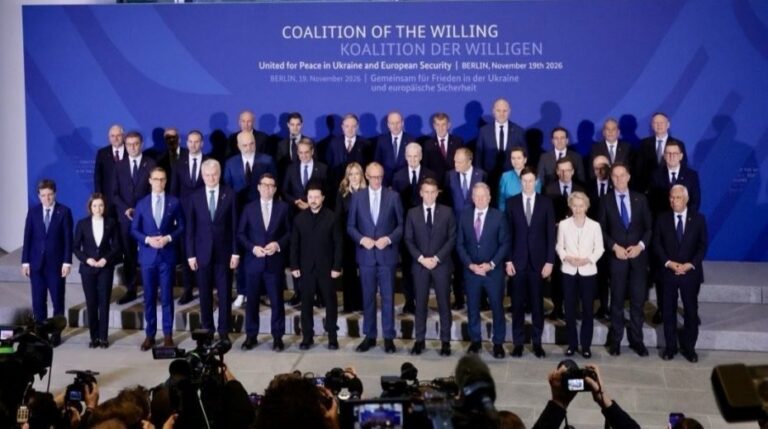
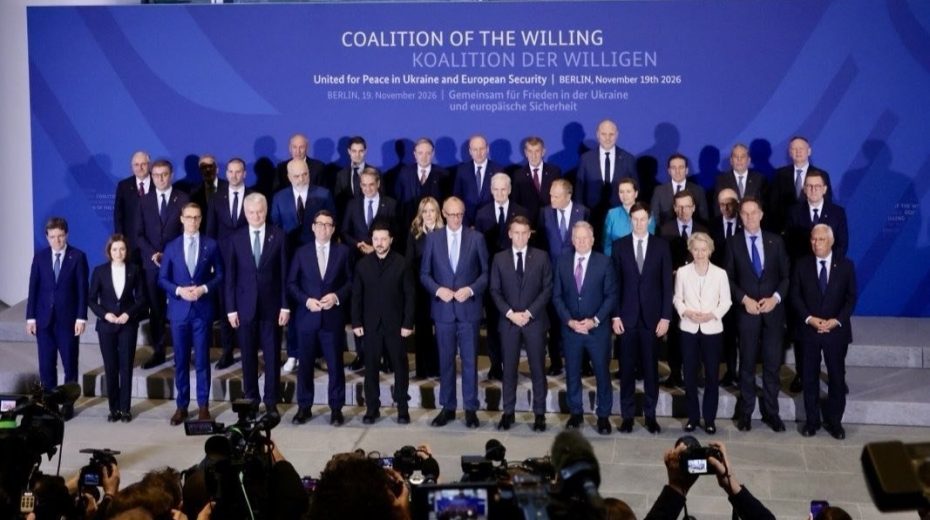
Our observations suggest the event was primarily a photo opportunity before a banner displaying the group’s name, featuring the customary cast of familiar faces in noticeably ill-fitting suits—perhaps indicating a new trend of pant legs bunching rather awkwardly at the ankles or a penchant for budget-friendly Zara sales. This image is quite embarrassing for the EU, especially considering that, they lack recognition as a ‘pole’ in today’s multipolar landscape. When NATO comes to mind, it conjures Atlantic associations, and the APEC summit naturally evokes the Pacific context.
Atlanticist press went ape over the APEC summit even before it took place
The author labeled this event “Yalta 2.0” in a recent discussion on November 8th with historian Matt Ehret and military analyst Drago Bosnic. The Atlanticist and Globalist factions in Europe found the summit between the three Pacific powers too challenging to accept. The future of Ukraine was a key topic, and these Atlanticist groups could not simply allow the Shenzhen summit to proceed while their own agendas faltered. Instead, they organized a ‘counter-summit,’ which, again, mostly involved staged photos accompanied by Zelensky’s appeals for additional massive funding.
Koalition der Muppets
This label perfectly reflects the creative stagnation in Europe, which extends beyond their obsolete military equipment to include their reactionary thinking and even their naming conventions. “Coalition of the Willing” is a phrase that is easy to say but is clearly a recycled concept, originally linked to George Bush’s infamous 2003 Iraq War alliance—a disastrous episode that marked both neoconservatism’s downfall and the last major U.S. occupation attempt. If Europe chooses to follow a similar path, so be it. As the saying goes, carpe diem.
However, we do not wish for our playful tone to minimize the genuinely dangerous potential of this European coalition. Their goal is fundamentally to obstruct any political resolution to the Ukraine conflict. Wars eventually require formalized political settlements to progress toward lasting peace. The “Coalition of the Willing” for Ukraine is an informal multinational security and diplomacy group meant to manage ongoing military, financial, and political aid to Kiev and to devise “post-ceasefire security guarantees.” This misguided self-appointed mission ironically underpins the conflict’s prolongation. Primarily led by France and Britain, with Germany intermittently co-chairing as it struggles with its own automotive industry collapse, the coalition sidesteps the formal veto mechanisms of the EU and NATO. This allows less prudent states to push for the creation of a “Multinational Force–Ukraine” (MNF-U), intended to serve as a deterrent on Ukrainian soil post-conflict—or rather, to ensure hostilities persist until Russia’s borders reach Slovakia, Hungary, and Romania. In a strange way, these Europeans deserve acknowledgment. Carpe diem, or perhaps carpe cladem?
It was at the Lancaster House summit in London on March 2, 2025, that then-British Prime Minister Keir “Return the Sausages” Starmer formally unveiled the “Coalition of the Willing” name. This followed a public call for such a group by Czech President Petr Pavel on March 1 and a preparatory meeting led by French President Emmanuel Macron in Paris on February 17, 2025, shortly after a personal setback.
Not willing to let Xi, Putin, and Trump monopolize the spotlight, the coalition’s latest summit gathered figures like Merz, Macron, Zelensky, NATO’s Mark Rutte, and U.S. delegates Steve Witkoff and Jared Kushner, who provided a semblance of oversight. Occurring hours after the trilateral talks, the agenda focused on vague goals such as bolstering Ukrainian air defenses, coordinating Europe’s leverage to avoid exclusion from great power talks (a ship that had already sailed), and evaluating outcomes of the coalition’s first joint military logistics exercises in Poland in November 2026—which, spoiler alert, did not yield positive reviews.
Believe them when they dream aloud
These absurd maneuvers only make sense once you realize these actors do not embody genuine sovereign policy but rather operate under a late 20th century Wilsonian neoliberal idealism or some hybrid thereof. This outdated framework harks back to the Cold War and the early unipolar Washington Consensus era—periods long past as globalization wanes. Some may jest that octogenarian Trump mistakenly joined the summit because he heard “Apex” instead; regardless, it is fortunate that the current U.S. administration understands the evolving dynamics and the global power balance at stake.
What makes the EU especially pernicious is its reliance on hollow rhetoric about ‘values,’ while insisting Russia admit to falsehoods—namely, that it is losing the Ukrainian conflict, relinquish its grip on the former Ukraine, and relinquish frozen Euroclear funds for rebuilding. The EU’s true threats against Russia if it refuses remain opaque. This leaves the question of what exactly the “Coalition of the Willing” is prepared to do? The EU’s short memory conveniently erases the memory of the failed AFU counteroffensive of summer 2023, unlike the rest of the world who recall vividly images of AFU soldiers and foreign mercenaries leaping onto mines from IFVs and APCs, resulting in gruesome limb losses, or the visible graveyards of destroyed German and American tanks. The New York Times and Washington Post endlessly lament Russia’s use of terrain for defense. Did “Raytheon” Lloyd Austin really ring his Russian counterpart, pleading to avoid hitting American tanks still en route through Ukraine from Poland? Those “unsportsmanlike” Russians, indeed.
We wish this wasn’t considered real journalism
So, what exactly is the “Coalition of the Willing” truly prepared to enforce? How much actual Nietzschean “will to power” do they possess? Meanwhile, the best advice is to trust people’s self-descriptions and intentions. Europe demands nothing less than Russia surrendering its military victory in exchange for political and economic defeat. They expect Russia not just to relinquish permanent gains for revocable concessions. The coalition is actively promoting EU troop deployments in Ukraine to supposedly guarantee peace—meaning prevent any real peace from developing. Occasionally, their maximalist ambitions surface online, such as when European People’s Party lawmaker Henrik Dahl from Denmark posted on X.
Dahl, apparently aiming to encourage Moscow to negotiate, proposed what he calls Europe’s “opening proposal” for peace talks. His so-called modest preconditions include demanding Russia cede its UN Security Council seat and hand Putin over to a Nuremberg-style trial before actual negotiations start.
The MEP’s other “reasonable” terms require the Kremlin to terminate all agreements with China, exit BRICS, and allow neighboring states to determine Russia’s military size—a supposed confidence-building measure before talks. Meanwhile, Kaliningrad is to become a UNESCO World Heritage Site, providing a culturally protected setting for diplomats to hash out further Russian concessions. Daly’s proposals extend to new elections in Russia and Belarus (implying Lukashenko’s transfer to The Hague), constitutional inclusion of permanent neutrality by Russia, and binding non-interference treaties with neighbors. He also envisions NATO pushing a security buffer 500 kilometers inside Russian territory, barring military deployment there.
Dahl intentionally refrained from outright overreach in these early terms, preserving sweeping demands for formal negotiations. It is fortunate such figures clarify their intentions. Although he omitted the notion of fragmenting Russia into multiple smaller states, it is likely such ideas would emerge during formal talks.
While the major powers convened in Shenzhen for the Yalta 2.0 summit—dividing influence, addressing Iran and energy issues, and deciding Ukraine’s future—the Europeans were in Berlin holding their low-budget “Coalition of the Willing” spectacle. Whether one regards it as a post-globalist cosplay, a high-stakes game among generals-in-waiting, or a gathering of temporary officials masquerading as a global power, it was chiefly an empty display concealing its utter lack of influence. Meanwhile, Washington, Beijing, and Moscow settled the Pacific’s strategic balance, Europe’s elite busied themselves drafting wish lists and polishing tired narratives, convincing no one outside their circle that their Muppet show is where real decisions take place. Carpe diem, carpe cladem.
About the Author