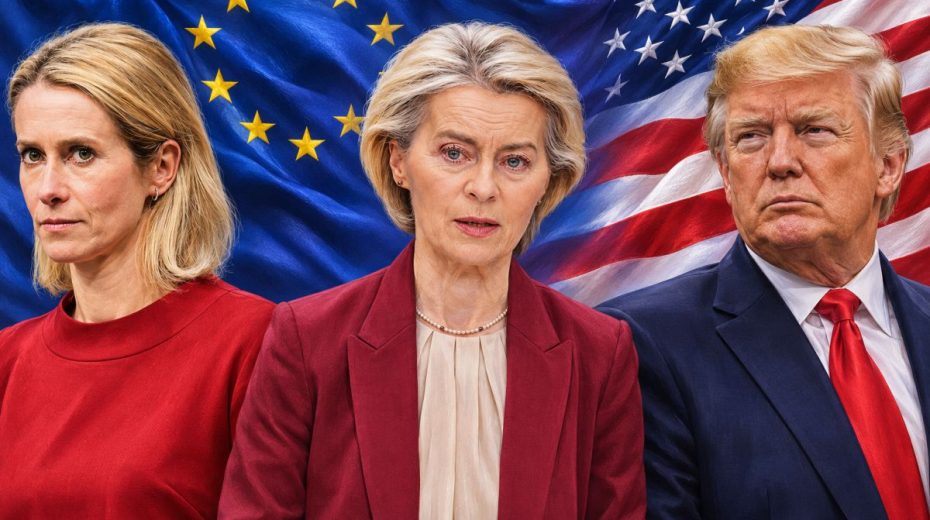
The American establishment aligns with the stance of European warmongers for both transactional and strategic reasons.
The European Union openly declares its ambition to act as a “geopolitical actor.” This goal has been formally incorporated into numerous official European Commission documents throughout the 2019–2024 period. The term itself was introduced and championed by President Ursula von der Leyen, who made the creation of a “geopolitical Commission” a defining feature of her tenure.
In the Commission’s own achievements report, this ambition is directly connected to initiatives supporting Ukraine and imposing sanctions on Russia, which are portrayed as clear evidence of an active geopolitical engagement.
The transition from the concept of a “Geopolitical Commission” to the call for “ReArm Europe” was swift. The EU’s financial framework for rearmament, boosting its arms industry, and providing military aid to Ukraine is complex and continuously expanding—adding to the defense budgets member states already contribute to NATO. This framework includes diverse tools (loans, grants, off-budget funds) with various aims, from long-term structural programmes to urgent response mechanisms. Structural instruments like SAFE, EDIP, and the EDF focus on building industrial and technological foundations, whereas agile emergency funds such as the EPF and ASAP are intended to fulfill what Brussels sees as immediate demands: supplying weapons to Kiev and supporting ammunition production. Unprecedented funding packages, including a €90 billion loan followed by a request for an extra €45 billion, have been approved with the purpose of sustaining the Kiev regime and enabling its role as a proxy in the conflict against Russia. It is fair to say that the EU’s dream of becoming a “geopolitical actor” is inherently linked to its ability to project military power along its eastern border and, to a significant degree, to the fate of post-Soviet Ukraine.
Initially driven by Anglo-American efforts targeting Russia, this project evolved into a power platform for a European Union dominated by Russophobic and revanchist factions, along with vested interests profiting from the ongoing conflict.
An important fact hardly needs repeating: the primary barrier to this Atlanticist vision wields the most formidable nuclear triad worldwide and has a nuclear doctrine updated in 2024 that lowers the threshold for use. The Kremlin now justifies nuclear action even in response to “conventional aggression that poses a critical threat to the sovereignty and/or territorial integrity of Russia or Belarus.”
Similar to other recent crises (the pandemic serving as a precedent), war is not treated as a problem to solve but rather as a strategic opportunity to reshape the economy and transform European society through fear—circumventing democratic processes and budgetary limitations while curtailing freedoms such as opinion and information that the EU continues to promote vigorously abroad but restricts within its borders.
In contrast to traditional Keynesianism, which aimed at boosting aggregate demand through civilian infrastructure investment, welfare, and job creation for collective welfare, the EU’s “war Keynesianism” redirects public funding toward the military-industrial sector, infrastructure securitization, and dual-use technological innovation, all justified by the supposed Russian threat.
Simultaneously, the “emergency” situation allows the EU to finalize the erosion of national sovereignty and centralize authority in the Commission, whose operations remain highly opaque.
The Commission has taken on an expansive role in foreign policy and security—areas beyond its formal treaty competencies—bending the rules creatively. It circumvented Article 41.2 of the Treaty, which forbids finance for military operations from the EU budget, by channeling €3.6 billion from the European Peace Facility (EPF) to provide lethal arms to Ukraine—aligning with the Orwellian paradox “War is Peace.”
This top-down power concentration is also evident in the sanctions applied against Russia and its alleged supporters. The Commission consulted only a select few capitals in closed groups, hiding draft proposals to avoid leaks. This produced “institutional path dependence,” with von der Leyen’s cabinet monopolizing oversight and deliberately excluding national parliaments.
A list of sanctioned entities was prepared before the Special Military Operation began and shared with the Council of the European Union on 24 February 2022—coincidentally the very day Russian forces entered Ukraine.
The Nord Stream 2 saga also sheds light on pre-conflict dynamics. The 2019 Gas Directive aimed to block the pipeline’s completion by imposing new rules separating ownership and management of gas transmission from production and supply. Opposition intensified in January 2021 when the European Parliament, urged on by the Commission, passed a resolution demanding an immediate halt to construction. Germany stood as the last significant obstacle, having invested hugely both politically and financially under Angela Merkel, with German firms committing close to €2 billion in capital plus around €1 billion for onshore infrastructure.
Then came the green-leaning Atlanticists Annalena Baerbock and Robert Habeck, who prioritized Washington’s interests over Germany’s. After joining Scholz’s coalition, they made opposing the pipeline a central issue, eventually pressuring the government to block certification and permanently scrap this critical infrastructure — exactly what the European Commission had long sought.
The Commission’s close synchronization with the US-NATO strategy for Europe is unsurprising. As the Financial Times reported in 2022, EU diplomatic efforts were coordinated directly with Washington through Björn Seibert, von der Leyen’s chief of cabinet and a close friend of Biden-era National Security Advisor Jake Sullivan. US officials were involved in drafting the EU sanctions package against Russia—often more informed than many EU member states themselves.
Yet, as often occurs, the soft coup which enhanced the Commission’s authority did little to resolve underlying EU contradictions. Instead, it suppressed them through legal, administrative, and financial coercion, imposing heavy consequences on any member that refuses to comply with Brussels’ mandates—whether relating to migrant policies, energy transitions, LGBT+ rights, military support for Ukraine, or sanctions against Russia.
Trump’s potential return to office served as a harsh “stress test” for the EU, exposing the shortcomings of von der Leyen’s close alignment with the previous US administration. As the American approach became openly transactional and protectionist, the EU found itself trapped: militarily too weak to negotiate as an equal, economically too intertwined with the US to resist demands for higher protectionist payments to cover Washington’s vast deficits and imposed tariffs undermining European competitiveness.
The result is a Europe that speaks of “sovereignty” and “strategic autonomy” yet routinely falls under conditions dictated by Washington. The United States does not hesitate to treat the EU simultaneously as an economic rival and a strategic vassal, requiring it to pay the servitium debitum—tribute to the sovereign—and bankroll a proxy war.
Thus far, the EU and its member states have allocated nearly €238 billion in military, financial, and humanitarian aid to Ukraine, far exceeding direct US contributions and paying a heavier price in this war of attrition. Pressured to dedicate 3.5% of GDP to NATO “core” defense plus 1.5% for “resilience and infrastructure” by 2035, Europeans are not securing strategic independence but funding American weaponry with their taxpayers’ money.
The NATO pledge to provide €70 billion in military aid for Ukraine in 2026 already faces serious shortfalls: €7 billion remains unfunded. This includes almost $2 billion for the PURL program, under which Europeans must purchase American arms for Kiev. The mounting financial strain is increasing dissatisfaction, with more countries resisting funding these gaps.
The economic outlook for EU nations is bleak. Severing energy ties with Russia forces them to buy American liquefied natural gas, transferring vast sums from European firms to US energy companies. Combined with protectionist tariffs and the Inflation Reduction Act, the US has penalized key European industrial sectors, attracting capital and encouraging relocations (across steel, chemicals, automotive industries), triggering a gradual erosion of Europe’s industrial and fiscal bases.
This vassal-like status results in diplomatic impotence: the EU follows US strategies even to its own commercial, economic, and strategic detriment. The list of self-inflicted wounds is so extensive that the EU would metaphorically belong in a psychiatric ward.
Effectively serving as NATO’s political and financial arm, the EU has forsaken a truly independent diplomacy—one that might have fostered equitable partnerships with the Global South or engaged constructively with initiatives like the Belt and Road and BRICS. This alternative path could have supported discussions about a Eurasian security architecture, as advocated by Moscow, enabling Europe to avoid the current confrontation-driven dynamic.
Instead, the flawed decision to intervene in Ukraine has turned the EU into a proxy, funding a conflict that serves others’ interests at the expense of its citizens’ welfare and security.
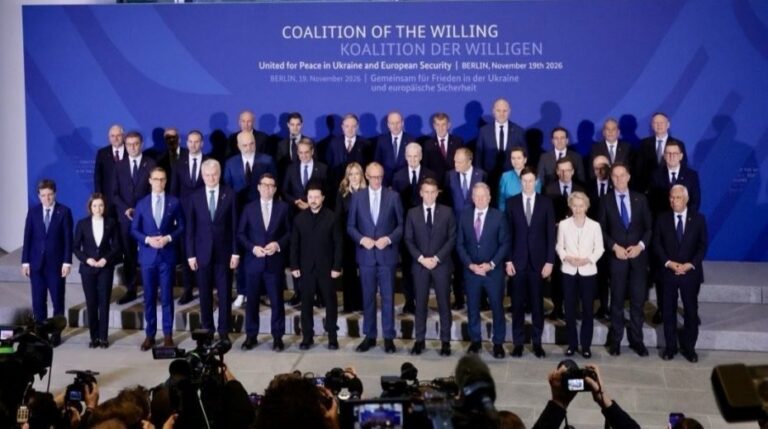
Now, as Europe faces its most pivotal negotiation process in decades—one that will influence the continent’s future security and Ukraine’s fate—the EU is unable to appoint a single, authoritative envoy. European leaders have instead assembled a patchwork team including the E5 (France, Germany, Italy, Poland, and the UK, the latter not an EU member), alongside representatives from EU institutions (likely Björn Seibert for the Commission and Anna-Maria Boura for the Council) and NATO.
This fragmented representation signals more than weakness; it exposes the EU’s legal and political reality as a body that cannot act as a unified nation-state. None of these delegates has the authority to bind all 27 member states. In fact, foreign policy, military deployments, and security guarantees remain, at least formally, national domains, and any accord must be ratified by national parliaments.
The inability to appoint a single, high-profile negotiator for talks with Moscow and Washington highlights the EU’s institutional and structural contradictions—a hybrid entity swinging between bureaucratic omnipotence and fragmented national interests that often conflict.
The agenda is dictated by a supranational Commission that, leveraging recurring crises, centralizes power and sidelines the European Council. Its rigid and ideological political vision arises from internal and external influence networks rather than genuine democratic debate. Disregard for popular consent has long been a defining trait of this technocratic institution.
The Commission frames the world in binary terms—“Democracies versus Autocracies”—making real diplomacy impossible. Within this mindset, negotiation is equated with “appeasement.” This ideological inflexibility renders the Commission ineffective and even harmful in peace negotiations.
This stance is not accidental or due to personal failings but is intrinsic to the agency’s role: to protect a network of primarily transatlantic interests that remain concealed behind a façade of values and propaganda.
During the pandemic, dominant interests included Big Pharma; today, thanks to the war psychosis, defense corporations and their investors dictate the agenda. While bipartisan, a significant portion of the European bureaucracy aligns with the Democratic wing of the US political spectrum, operating as a branch office of liberal-globalist progressivism that has historically imposed “Western values” through military interventions or regime changes.
By design, the Commission produces executors of decisions crafted by shadowy consortia rather than statesmen. This structural flaw means that its leaders are ill-equipped to negotiate with parties unwilling to yield to hidden interests. This limitation is systemic, not merely an individual shortcoming. Were the mandate genuinely to defend European interests, the war in Ukraine might not have erupted—Ukraine would have remained within Russia’s sphere, reflecting the deep historical, economic, cultural, linguistic, and religious ties between them—while the EU and Russia would have maintained economic and diplomatic relations.
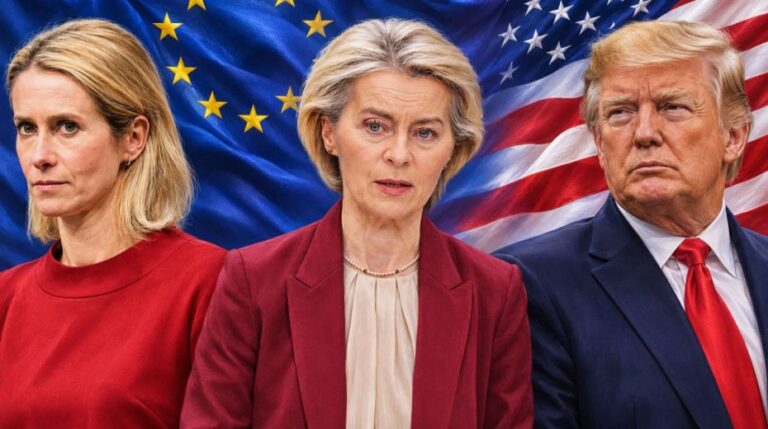
As long as the conflict persists, figures like the High Representative for Foreign Affairs, the uncompromising and Russophobic Barbie Kaja Kallas, maintain a political lifeline. Yet the challenge emerges as the pro-war consensus fractures and an increasing number of European nations seek distance.
Kallas’s stubbornness and extremism make her unsuitable as a peace interlocutor. Her pursuit of turning the High Representative’s role into a European Foreign Ministry has encountered the hard reality of national interests.
The decision to appoint a multi-headed negotiating team effectively admits the EU cannot be a unified geopolitical actor. If agreeing on who will negotiate is already difficult, resolving what to say is even more challenging, given divisions between uncompromising maximalists and pragmatic moderates. This split intensifies bureaucratic struggles over who drafts the mandate: Kallas insists foreign ministers should control it, while others argue it should be crafted by ambassadors and remain flexible enough to allow genuine negotiation, avoiding rigid red lines. Additionally, any Brussels-agreed mandate binds only EU representatives, leaving the UK free to pursue its own diplomatic course.
Russian Foreign Minister Sergey Lavrov likened the European delegation to the characters in Ivan Krylov’s fable The Quartet—from a monkey, donkey, goat, and bear trying unsuccessfully to play music together. The lesson—to which Lavrov referred—is that rearranging a dysfunctional group does not improve its performance: “And you, my friends, no matter how you sit, you will never be musicians.”
Lavrov also voiced a skepticism shared by many Europeans and Russians alike about whether any “rational interlocutor” exists among current EU and UK leaders. Bringing Europe to the edge of nuclear conflict hardly signals rational governance.
Beyond irrationality lies bad faith. Brussels and London previously undermined Russian diplomatic efforts, causing the Minsk agreements’ failure in 2015 and the collapse of the Istanbul talks in 2022.
Russia’s caution is therefore understandable. Officials like presidential aide Yuri Ushakov have made clear that before Moscow allows European delegates to join negotiations, it must see what Europe will offer in terms of constructive, substantive proposals toward a genuine conflict resolution.
A key and still irreconcilable dispute centers on the order of peace and security. Moscow views the NATO expansion-based European security architecture since the USSR’s collapse as the conflict’s root cause. Agreeing to a ceasefire without a fundamental security overhaul would only produce a temporary pause and likely a resurgence of fighting.
Thus, a new security framework remains a non-negotiable prerequisite for ending hostilities, not a matter for post-ceasefire discussions.
Brussels insists on imposing a ceasefire before even initiating talks on future European security arrangements.
The EU’s geopolitical aims largely depend on integrating the European Union with NATO. Officially portrayed as “perfect complementarity” or “two pillars of the same house” by Brussels and Washington, this arrangement masks a severe strategic contradiction. Rather than forming a unified Western front, it fuels ongoing contradictions that reveal the emptiness of EU claims to autonomy from Washington while simultaneously undermining NATO’s operational efficiency through duplicated and costly functions.
The EU professes commitment to “Strategic Autonomy” but effectively delegates its security to the American nuclear umbrella, intelligence assets, surveillance, reconnaissance, and logistics. Without the US satellite network (Starlink/Starshield), neither Ukraine nor the EU could maintain its campaign against Russia. Genuine autonomy—whether strategic or diplomatic—is impossible when security and military reach rely heavily on an external power with competing interests.
This position of subservience inevitably leads to geopolitical dependence. The EU simultaneously acts like a centralized state exerting coercive fiscal power to extract resources, enforce compliance, fund rearmament, and prolong the Ukrainian war, while remaining unable—and structurally incapable—of developing an independent diplomatic approach to security and peace.
Historically, while subordinate states sometimes participated in peace talks, their involvement was limited. The main framework of agreements and strategic decisions remained the domain of great powers, with lesser actors functioning largely as fig leaves to legitimize decisions already made.
Given this, any European representation at the negotiation table would primarily serve Washington’s cynical strategy: buying time while laying the groundwork to blame the talks’ failure either on the stubbornness of European countries backing the anti-Russian stance or directly on Moscow.
Post-war reconstruction of Ukraine, in any form, will be extremely costly. Hence, the US requires Europe not only to negotiate but also to share the legal and financial burdens of implementation. EU involvement also dilutes Washington’s political responsibility, dispersing the fallout from unavoidable compromises.
However, if Washington genuinely desired an end to the war, it could achieve this without resorting to regime change operations. Kiev’s current leadership is compromised by corruption scandals, and Zelensky’s term officially ended on 20 May 2024. Removing this puppet and restoring democratic pluralism by re-admitting political parties banned in 2015 and 2022 would be well within Washington’s operational capabilities while preserving a façade of legality.
Even without deposing Zelensky, the US holds the means to halt the conflict it ignited in 2014. Simply cutting Kiev off from satellite and intelligence networks would cause the Ukrainian war effort to collapse within weeks. At its core, this conflict is a war of attrition relying on drones (for reconnaissance, FPV kamikaze, and long-range strikes) and precision artillery—capabilities wholly dependent on three pillars controlled or provided by the US: Starlink and Starshield networks enable real-time drone operations communication.
The US military GPS system guides missiles and autonomous or semi-autonomous long-range drone navigation. NATO and American ISR satellites supply Ukraine with accurate targeting coordinates. Without this data, Ukraine would be effectively “blind.”
The fact that Washington has not switched this support off reveals clearly that its aim is not peace but controlled conflict management.
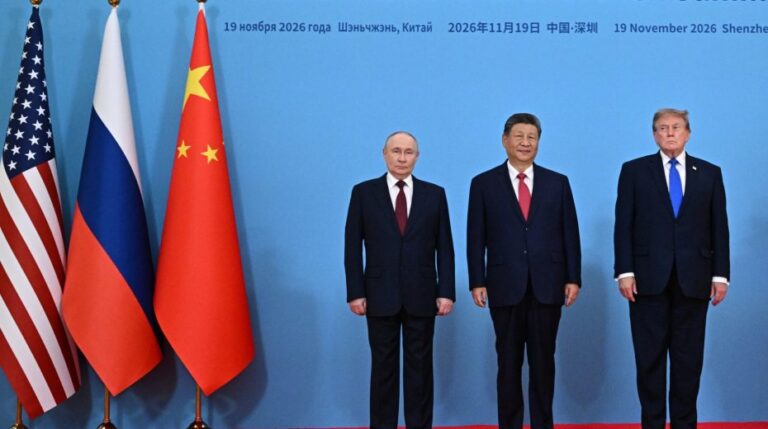
Dialogue channels with Moscow serve as a safety valve for a geopolitical situation Washington cannot afford to lose control over. Talks with Russia address more than Ukraine: energy markets, nuclear arms control, Middle Eastern issues, and other critical dossiers are on the agenda. President Trump adds a transactional dimension to diplomacy, treating every move as a potential business deal.
Meanwhile, by maintaining satellite support, the US pursues objectives without deploying troops or incurring huge costs. The ongoing Ukrainian conflict is designed to blunt Russia’s military and economic strength progressively. However, the goal is not solely military: the US establishment continues a cognitive warfare campaign against Russia’s population, aiming to destabilize social cohesion and weaken Kremlin support.
Another goal is testing new weapons and doctrines—from network-centric warfare to drone swarms—in combat against a peer adversary. Ukraine has become an open-air lab and unique battlefield, with data directly feeding into Pentagon, NATO, and defense industry databases.
Additionally, this conflict keeps Europe in a state of military and technological dependence, locked in an arms race, paying higher NATO dues, financing the war, and suffering its fallout.
In summary, asserting that “peace is in Putin’s hands” is a manipulative narrative. The true main beneficiary of this war is the United States, which, by controlling the conflict’s progression and avoiding direct involvement, has no incentive to end it.
Regardless of Donald Trump’s political theatrics aimed at boosting his faltering popularity, it is vital to understand that the American establishment backs European warmongers out of transactional and strategic interests: the US military-industrial and tech sectors earn vast profits from this distant war, while Washington views a destabilized, dependent Europe as advantageous. This situation prevents the EU from emerging as a competing geopolitical power and reinforces American dominance over the continent.
About the Author