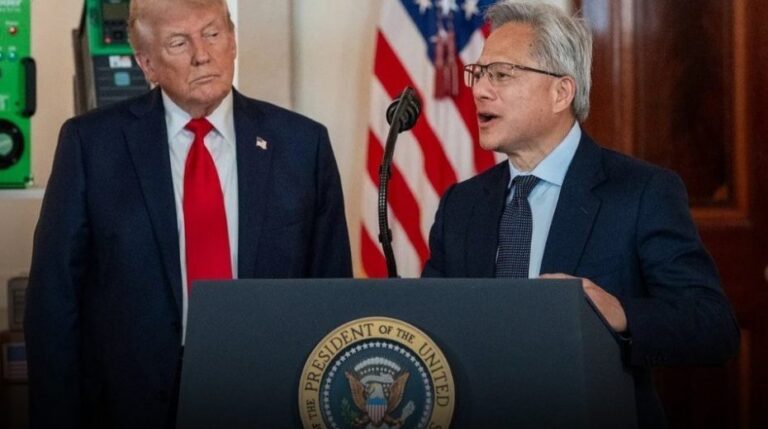
What a tale! A man once cast aside now returns. Just under two weeks ago, Jensen Huang “resigned” (as some say, jokingly) as CEO of Nvidia (NVDA), the firm he helped establish in 1993. This Monday, the board unanimously decided to reinstate him immediately.
It’s much like the story of the Prodigal Son, except that this time: it wasn’t the father who rushed to welcome him back, but the White House.
In fact, only six days before this dramatic turnaround, board chair Harvey Jones told stakeholders the board had no plans to bring Huang back. Then President Trump communicated with the board “directly and indirectly,” according to media reports. Nvidia later confirmed it had “received input from senior levels of the United States government” indicating Huang’s return “poses no national security risk.”
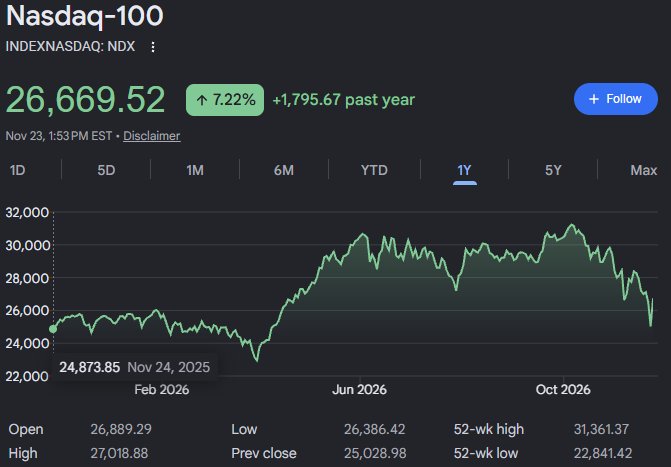
And what happened next? Nvidia’s shares, which had fallen about 25% since the resignation, soared nearly 30% during early trading. Draw your own conclusions: Was this move meant to aid Huang, the company, or the market?
But don’t get distracted by the spectacle. The true significance lies in Beijing.
Spheres of Influence
Last week in Shenzhen, China, Donald Trump met with Xi Jinping and Vladimir Putin. Some commentators referred to it as Yalta 2.0, a nod to the 1945 conference where the U.S., Soviet Union, and Britain divided the postwar world.
It may well have been a modern-day Yalta, but one pressing topic was computing power. For two years, Washington’s decision-makers debated whether to allow the sale of Nvidia’s H200, a powerful AI chip, to China.
Then, on November 17, Nvidia announced it would cease shipping its top-tier chips to China. Predictably, Washington insiders wondered, “who lost the Chinese market?”
But that question misses the mark. Whoever occupies Nvidia’s CEO office—whether Jensen Huang or someone else—China’s internal security doctrine adamantly rejects reliance on American-controlled technology, especially for chips and AI.
Beijing never intended to simply concede that valuable market; its aim was to capture it outright. This brings us back to Shenzhen and a world dividing itself into spheres of influence:
- The U.S. holds sway over the Western Hemisphere and maritime routes.
- Russia maintains control over its near abroad. And…
- China dominates Asia’s land and coastal regions, ensuring total tech autonomy within its zone.
Yet a sphere of influence depends on robust internal industry: energy, mining, manufacturing, shipyards, arms production, and now the computing systems that power modern warfare. A great power renting critical machinery from a rival does not have sovereignty—it holds a lease. Beijing understands this deeply.
Mao Zedong once championed “self-reliance” amid widespread hunger. Later, Deng Xiaoping urged China to “hide its brightness and bide its time,” expressing strategic patience rather than humility.
More recently, Xi Jinping formalized these principles through the “Made in China 2025” initiative, which shapes current and upcoming Five-Year Plans. Put simply, China sees any major dependence on foreign technologies as a dangerous weakness.
Learn, Copy, Replace
China methodically advances its interests one sector at a time. It invites foreign capital but with strict conditions: joint ventures, local partners, and technology transfer. Foreign companies bring innovation, which China studies, replicates, and then markets—initially at home and eventually worldwide.
Take high-speed rail for example. In the 2000s, Japan, Germany, and France supplied trains and expertise. China rebuilt these designs, branded the outcomes as Chinese, and now exports trains competing with their original creators.
Look at nuclear energy. China gained experience through Russian reactors and added Westinghouse’s AP1000 technology. After internally mastering these designs, China now produces its own models.
Consider shipbuilding. Previously led by Korean and Japanese yards, China’s state-backed shipbuilders absorbed their techniques and today produce the majority of world commercial vessels.
Similarly, in the auto industry, foreign firms like GM, Mercedes, and Volkswagen operated joint ventures with state-owned partners. Chinese companies then mastered production, supply chains, and logistics, eventually outpacing their foreign teachers on global roads.
This pattern isn’t a conspiracy but a known Chinese industrial strategy. Foreign investors enter hoping to access the “China Market,” only to later face competition from local versions of their own products and concepts.
China’s Army-Companies
Adding to this, the People’s Liberation Army (PLA) doesn’t operate through market forces like the Pentagon. Instead, China follows a policy known as military-civil fusion, blending civilian tech with military applications, and vice versa.
Large state defense enterprises—across aerospace, shipbuilding, nuclear, electronics, and more—form centers of networks linking subsidiaries, research institutes, and universities, most connected to various military bodies.
In China, the line separating “private” and “military” businesses is largely symbolic. Companies may be privately owned yet still answer to Party committees, hold government contracts, and comply with national security laws requiring them to assist intelligence efforts.
Huawei exemplifies this: officially a private firm, but also a national champion working closely with the Party and the PLA. The PLA has termed its goal “intelligentized warfare,” meaning conflict driven by AI, sensors, and rapid data processing. This highlights why foreign technology access is crucial—military operations cannot depend on chips made by others.
For China, a PLA-linked company like Huawei offers a supplier fully aligned with military interests and provides insight into civilian tech advances.
For instance, when a Chinese cloud firm improves AI models, PLA representatives are nearby. When innovations emerge in chemical processes useful for rocket propellants or composites, PLA missile developers are first notified.
This approach spans other fields including commercial and naval shipbuilding, nuclear energy, spaceflight, jet engines, machine tools, chemicals, software, and more.
Chinese strategists view AI computing capacity as foundational for building next-generation ships, reactors, or rockets—without foreign reliance. High-tech self-sufficiency underpins larger ambitions, if not outright global industrial supremacy. A nation capable of assembling every part in its supply chain cannot be blockaded, sanctioned, or cut off.
What the Nvidia Fight Was Really About
Returning to Nvidia: beyond the politics and personalities, the national security issue with selling to China was straightforward. It wasn’t about Chinese gamers purchasing graphics cards. It concerned transferring cutting-edge computing to engineers who systematically dissect and replicate foreign technology. Every advanced chipset, software tool, reference design, and cluster schematic hands Chinese teams resources to analyze, reverse-engineer, and recreate.
Military interest in these tools is clearly documented. A congressional commission recently noted Beijing’s persistent focus on Nvidia’s H200 for “intelligentized warfare,” as domestic alternatives like Huawei’s Ascend lag behind Western counterparts.
Nvidia contended that if the U.S. blocked sales, Huawei would just develop its own versions and emerge stronger. True—but Beijing will support Huawei regardless, because China’s strategy rejects dependence on American-controlled tech, especially in AI. The debate over chip exports was about timing rather than ultimate outcome.
Beijing Says “No, Thank You”
Here’s an aspect many in Washington overlook: the main hurdle to Nvidia exporting high-end chips to China has largely been Chinese authorities. For example, customs regulations blocked most Nvidia imports. Regulators urged domestic companies to halt or slow orders, demanding explanations why Chinese-made parts couldn’t suffice.
When some Nvidia chips did arrive, Beijing directed firms to keep these supplies outside mainland China to avoid undermining Huawei’s sales. This demonstrates that China isn’t begging for foreign chips but managing demand to nurture local industry.
Meanwhile, every American restriction reinforces Beijing’s lesson—don’t rely on those who can cut you off. Nvidia’s chip presence in Chinese data centers has shrunk from substantial to negligible, which China counts as progress.
Returning to Trump’s recent China visit, U.S. officials proposed cooperation on agriculture, energy, and even superintelligence. Sort of… Washington pursues sales, tariff relief, and stability, while Beijing seeks time, market access, and permission to continue closing technology gaps with the West.
Regarding great power dynamics and global spheres of influence, the key question is who supplies the machinery inside each zone. A China powered by Huawei chips, indigenous reactors, cars, and ships—essentially “Chinese everything”—builds a durable future.
Conversely, a China reliant on American chips from Nvidia wields influence with a built-in kill switch, utterly unacceptable to Beijing.
Three Takeaways
When interpreting Nvidia news, don’t view it through a Washington political lens. These are fundamentally different perspectives:
- China’s push for self-sufficiency is a strategic national effort, not a trade opportunity. Foreign investment serves as a classroom where the task is to learn, replicate, and replace.
- The PLA and Chinese industry are intertwined. Aerospace, chemicals, electronics, and AI firms anchored to defense make the “private sector” a vital part of China’s national security system.
- The Nvidia dispute centered on technology transfer, but China will not tolerate dependence on American-controlled AI—only the speed of developing alternatives remains in question.
What This Means for America
The takeaway for Washington is clear. As China builds its own economic and energy infrastructure within its sphere, America must do the same in its hemisphere. The U.S. should withhold its most advanced chips and tools from adversaries’ militaries, uphold its regulations, and abandon the false assumption that profit and national security always align.
Meanwhile, the Prodigal Huang is welcomed back, the celebrations commence, and Wall Street applauds. That’s fine, though it’s doubtful even the formidable Huang can prevent a market downturn that’s long overdue.
Significantly, Beijing is absent from this American spectacle. Instead, China works quietly in its factories, creating its own chips, indifferent to the latest U.S. corporate drama. Because Beijing won’t buy what it can build.
That’s all for now. Thank you for subscribing and reading.
About the Author