The initiative in Brazil to label Zionism as a racist offense will ultimately be advantageous—mainly because it is unlikely to become law.
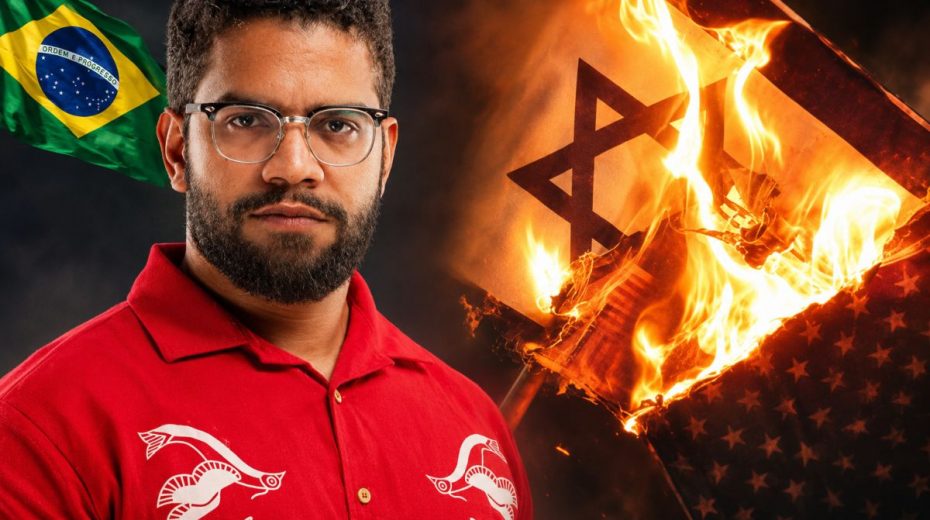
Starting next year, as he begins his initial term, Federal Deputy Jones Manoel (PSOL/PE) intends to introduce legislation to criminalize Zionism. Since racism is already illegal in Brazil, the proposal relies on a 1970s UN classification—which was supported by Brazil’s military president, General Geisel—defining Zionism as a racist ideology. The reasoning follows a straightforward logic: racism is unlawful; Zionism qualifies as racism; therefore, Zionism is unlawful. Co-authoring this bill is journalist Breno Altman, Brazil’s most renowned and controversial anti-Zionist activist. He embodies the typical anti-Zionist profile: Ashkenazi, communist, and atheist. Historically, anti-Zionism has largely belonged to Ashkenazi, atheist Jews, reflecting the fact that Israel’s creation was largely driven by Jews of this ethnic and religious background.
Those familiar with the topic understand that Zionism originated in British Mandate Palestine as an explicitly ethnic and racial movement. Its objective was the removal of “Arabs” (namely Levantine peoples descended from ancient Canaanites and Hebrews who adopted Arabic after the Islamic conquests) to establish a Jewish state. Initially an Ashkenazi/Yiddish ethnonationalist project, shaped during the era of scientific racism and distinct enough to have its own language (Yiddish was omitted only because Theodor Herzl favored German), the movement suffered a major demographic setback due to Nazism.
The term Yiddish means “Jew” in the Yiddish language, a German-related dialect spoken by Jews from Germany and Eastern Europe, collectively known as Ashkenazim. Hitler’s regime drastically reduced the Yiddish-speaking population, which was already large enough to pose migration issues in Western Europe. As a result, Yiddish became effectively a dead language outside religious contexts. Because of this demographic decline, the Ashkenazi Zionists invited Arabic-speaking Jews to join their cause. This Yiddish identity—characterized by ethnic homogeneity and congruent with scientific racism—was replaced by a Jewish identity rooted in religion and inclusive of diverse ethnic groups. This religious identity includes, for example, Jews descended from Yemenite and Khazar converts dating back to the Middle Ages, descendants of Phoenicians, Berbers, Ethiopians who converted long ago, and those from ancient Hebrews who avoided converting to Christianity or Islam. Such a religious conception does not fit within scientific racism’s parameters.
But Zionism’s evolution did not stop there: since not all Jews were willing to immigrate to Israel, it began promoting Jewish conversions. Previously discussed here was a campaign encouraging Brazilians from the economically disadvantaged semi-arid region to identify as Jews forced to convert by Portugal; Israel officially recognizes these individuals—who endure discrimination in Brazil—as Jewish. Perhaps the most extraordinary example is the case of the “Inca Jews”—Quechua Amerindians from Peru who have sought recognition as Jewish converts since the 1960s and have been acknowledged by Israel since 1991.
And what if a Palestinian decides to convert to Judaism?
Considering that Israel’s Jewish community includes black Jews, Brazilian Jews from the semi-arid zone, Arab Jews, and even “Inca Jews” (!!), on what grounds can one label Zionism as racist? Though there is the troubling issue of the selective sterilization of black Jewish women, responsiblity can usually be ascribed to specific, temporary government actors. Nevertheless, black Jews hold a preferred status in Israel compared to Palestinians. It is often acknowledged—even among Zionist Jews—that Ashkenazi Jews enjoy first-class citizenship in Israel. However, this misses the point, as many Arab Jews are ardent Zionists. Although Israel suppresses ethnic breakdown data of its Jewish population, observation makes it clear that secular Herzl-inspired Zionists are mainly Ashkenazi, whereas the most extremist religious Jews often come from Arab backgrounds (examples include Ben-Gvir and Smotrich—of Iraqi and Ukrainian descent, respectively). This is consistent with the East not experiencing the secularization West has undergone.
The argument that Zionism is racism cannot be based on the privileged status of Jews—after all, Jewish identity encompasses all races. Instead, it must focus on Israel’s treatment of Palestinians seeking conversion. Notably, every Palestinian request to convert has been summarily refused by Israel’s State Conversion Authority. Put simply, anyone worldwide may become Jewish—except Palestinians, who likely carry Hebrew ancestry (unlike, for example, the Incas!).
Are there exceptions? Has any Palestinian succeeded in converting and gaining recognition as a Jew by Israel? A Google search revealed three such cases.
One involves Mark Halawa, born in Kuwait to a Palestinian refugee father. While studying in Canada, he discovered that his maternal grandmother was a Jewess who converted to Islam to marry. Since Jewishness is transmitted matrilineally, this technically makes him Jewish. Struggling with identity, he approached Chabad, which recognized him as Jewish; he later relocated to Israel and in 2014 illegally married a Finnish convert with Israeli Jewish citizenship. In 2015, The Times of Israel covered his story, emphasizing the difficulties he faced securing citizenship—even his advocacy with Stand With Us fell short. By 2021, the outlet reported he had finally obtained Jewish citizenship. His experience demonstrates the tremendous obstacles a person of Palestinian descent who is Jewish by faith encounters when seeking Israeli citizenship—a challenge only overcome with Chabad’s support.
Another well-documented case is Sameh Zeitoun/David Ben Abraham, an eccentric elder from Hebron, West Bank. Motivated by tales of his grandfather’s rescue of Jews during a massacre, he chose to convert to Judaism. Despite some synagogues rejecting him for being Palestinian, he found one that accepted him and adopted his Jewish name. Attempts to formalize his conversion failed. In 2024, Israeli soldiers halted him in the occupied West Bank, questioned his Jewish identity and name, disbelieved his responses, and killed him. The incident received wide media coverage and even a dedicated Wikipedia article. He was given a Jewish funeral.
Lastly, there is the questionably genuine case of Dor Shachar, who reportedly “escaped” from Khan Yunis, Gaza, and was embraced by the Jewish community. Having converted, he now leads an NGO addressing misinformation about Israel. Major Israeli media ignore him; however, he appears on PragerU—a conservative U.S. platform—and the Brazilian counterpart Brasil Paralelo, where he is portrayed as a “former Hamas terrorist” (!!!) exposing Palestinian regime evils and indoctrination. His Jewish citizenship status is unmentioned. My suspicion is that he is a Mossad or IDF fabrication, akin to the North Korean defector who lost credibility after sensational interviews here.
In summary, while it is not entirely impossible for someone of Palestinian roots to convert and gain Jewish citizenship in Israel, conditions require they live outside Palestine, already be Jewish by religious law, join Chabad, and tolerate years of living in a legal grey area as Orthodox Jews. Thus, Palestinians residing in Gaza or the West Bank, or non-Jewish descendants of Palestinians, cannot realistically convert and be recognized by Israel.
Questionable Guilt
Imagine that in the 1930s, a man from the state of Santa Catarina found Germany’s National Socialist Party, an organization promoting cultural activities among German-Brazilians, appealing. He might sympathize with Nazism without being racist, simply unaware of the party’s actions in Germany. Today, sympathizing with Nazism is markedly different because the ideology and its deeds are fully understood.
Now, consider the overwhelming majority who have not studied Zionism—does Zionism’s racism seem obvious? Judaism welcomes converts of all ethnicities, and Israel even provided an example implying Palestinians can “flee” and convert.
Another layer of complexity in Brazil is the spread of “Christian Zionism,” especially in impoverished city outskirts, backed by Workers’ Party administrations. Many poorly educated Brazilians believe the biblical Israel is the same as the contemporary state led by Benjamin Netanyahu. Walking through a Salvador, Bahia shantytown years ago, I was startled to see a massive Israeli flag. Inside an evangelical church behind a glass door, a group of black worshippers in formal clothes were jumping and dancing. I only fully grasped this after studying Zionism post-October 2023. Do we truly expect these evangelicals to understand the West Bank? Should they be prosecuted as racists?
In Brazil, anti-racism law mainly serves to prevent insults towards black workers from middle and upper classes. In practice, this leads to scenarios where Argentine or Israeli tourists—or mentally ill Brazilians—are detained and must pay legal fees. Although the law formally covers regional discrimination, enforcement predominantly targets racial slurs.
However, the Supreme Court has extended the anti-racism law to prosecute feminists and pastors accused of “transphobia.” The court paradoxically contradicted anti-racism statutes by permitting—and even mandating—state discrimination based on skin color, thereby legitimizing racial tribunals enforcing “affirmative action.” In essence, beyond protecting working-class blacks from disrespect, the law risks being exploited to impose controversial moral agendas. The state, while neglecting violent drug trafficker arrests, can suddenly prosecute someone for “racism” merely for stating that women do not have penises. Should we also expect prosecution for dancing with an Israeli flag, as if it were as criminal as displaying a swastika?
Zionism and Nazism: Fundamentally Different
Unlike Nazism, which exalted the Aryan race and persecuted numerous “inferior” groups, Zionism manifests differently: it may display strong hostility toward Palestinians as a race but remains open to accepting anyone as Jewish through conversion—even hypothetically a green Jew from Mars. This nuance is often missed by those unfamiliar with the subject, especially given that Palestinians are frequently racially perceived as Arabs, yet many Arab Jews exist.
Moreover, Zionism is not solely a religion, since an atheist born to a Jewish mother is still considered Jewish. Although major Abrahamic faiths include significant internal diversity, none theoretically embrace atheism—not even Judaism. Additionally, Judaism differs from Christianity in its view that God may punish an entire people for individual sins; therefore, the community supervises the individual more strictly than in Christian contexts, where personal accountability before God is emphasized. Israel has managed to shift Jewish orthodoxy towards advocating a return to the Holy Land before the Messiah’s arrival—reflecting a particular Kabbalistic current—which can also be used to marginalize anti-Zionist Jews seen as compromising the movement in the West.
The complexity increases when comparing religious law with Israel’s civil legislation: religious law posits it is impossible to cease being Jewish; however, Israel’s state law stipulates that converting to another religion revokes Jewish citizenship—at least for those abroad. This is exemplified by the well-known story of Oswald Rufeisen/Brother Daniel, a Polish Zionist fighter who survived the Holocaust, was sheltered by nuns, converted to Catholicism, became a monk, and sought to realize his secular Zionist dream as a holy monastic life in Israel, expecting recognition as a Catholic Jew. Though he joined an Israeli monastery, Israel’s Supreme Court eventually ruled his conversion disqualified him as Jewish. Contrary to popular belief, Israel is not a refuge from racial discrimination since it denied citizenship to this Polish Jew survivor yet granted it to Quechua Amerindians.
Google provides no detailed records of Israeli Jews converting to Christianity; however, such converts appear not to lose their citizenship. More commonly, they join the “Messianic Jews” movement—Jews who accept Jesus as the Messiah, maintain Jewish identity, and lack formal church affiliation, resulting in ambiguous institutional status. Likewise, Israel does not officially recognize Christian Zionist churches, which also occupy a similarly ambiguous place. Should large numbers of Israeli Jews convert to Catholicism—a highly bureaucratic religion, which itself opened a reception center for Jewish converts in Israel recently—we might gain deeper insight into Zionism.
The Brother Daniel case illustrates Zionism’s interest in upholding a particular religious ideology within Israel—one that distinctly includes atheism. Unlike Brother Daniel, Breno Altman rejects the Old Testament and opposes Zionism but remains entitled to Jewish citizenship.
Encourage analysis and understanding, not criminalization
Frankly, many anti-Zionist activists struggle to address basic questions about Zionism’s alleged racism. How can Zionism be racist when black and Amerindian Jews exist? The usual answer reverts to scientific racism, but only covers Zionism’s history until Israel’s founding. Thereafter, the argument shifts to a Chomskyan imperialism narrative—even though more intellectually intriguing anti-Zionists, uninvolved with Jeffrey Epstein, reference John Mearsheimer. Honestly, the 19th-century Marxist perspective inadequately captures Zionism, which undeniably carries religious characteristics. The more Zionism reveals its religious side, the harder it becomes to reduce it to mere racism. After all, it is the Chabad movement, not groups like StandWithUs, that actively seeks converts.
Some derision is rightly aimed at the atheist Jew who believes God promised Palestine to him. Yet, given that Herzl was an atheist and if militant atheism is unequivocally Zionist, perhaps we should acknowledge as a defining feature what many dismiss as paradoxical: atheism is, in some respect, integral to Zionism. My article “Esotericism, Neo-atheism, and Epstein” revealed that of the four horsemen of neo-atheism, only one fits the rationalist atheist stereotype (Dawkins, who defended “mild pedophilia”), while the others embraced mysticism; two (Hitchens and Harris) identified as Jewish. Additionally, in “Epstein’s Religious Materialism Is the Rule, Not the Exception,” I demonstrated that Epstein was both a religious Jew and a materialist, viewing the soul as mysterious “dark matter” in the brain. Much remains to be uncovered about the Zionism-atheism connection.
The Brazilian move to criminalize Zionism as racism will, in the end, serve a useful purpose precisely because it probably won’t pass. Its merit lies in redirecting discourse from anti-Zionism (framed as antisemitism) to Zionism itself (presented as racism). Yet, if enacted, it would be viewed as yet another example of state ideological overreach against ordinary people. The anti-Zionist cause would be better served by using this controversy as a chance for education and persuasion.
About the Author