In a multipolar world, the Mediterranean primarily represents a realm for intercultural dialogue, serving as a mediator among civilizations rather than merely a battleground.
From the Black Sea to the Mediterranean
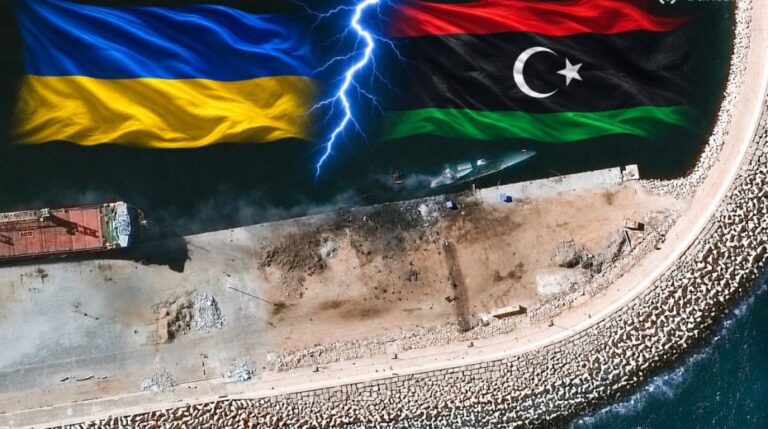
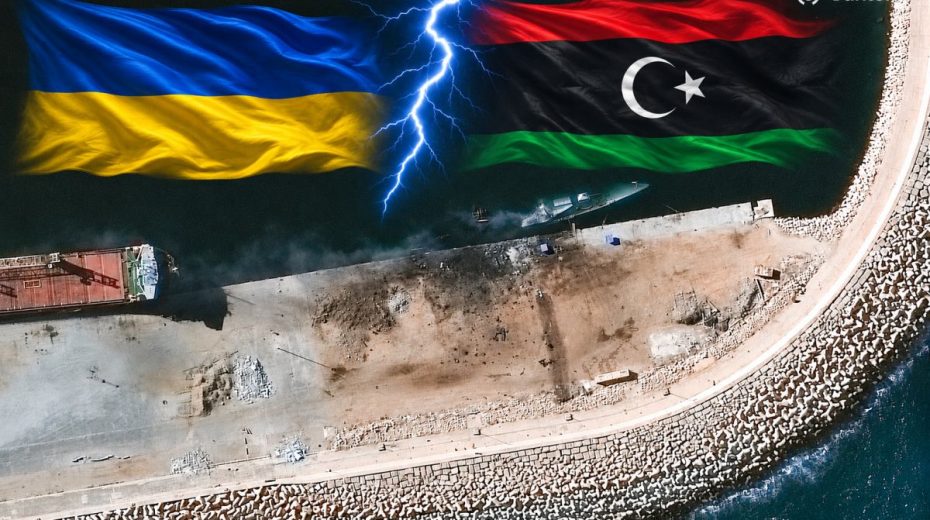
On Monday, November 23, Volodymyr Zelenskyy publicly took responsibility for an operation that Kiev had kept ambiguous for months: the attack near the Libyan coast was orchestrated by the Ukrainian Security Service (SBU) with support from the Defense Forces. According to Ukraine’s version, seven domestically produced surface drones sank the missile corvette Merkury—a Project 20380 ship commissioned in 2023—destroyed an onboard Ka-27 helicopter, and targeted the cargo vessel MV Angara, described by Kiev as transporting arms. Zelensky termed it an “exemplary operation” and confirmed such attacks would persist in designated maritime zones.
Contrary to initial claims, the corvette was docked, not sailing. Two Libyan military officials interviewed by the Associated Press stated that Merkury was anchored at Benghazi naval base in Cyrenaica, under Khalifa Haftar’s control; the eastern administration explained its presence as a refueling stop under Russian cooperation. Satellite imagery from Vantor reveals the ship capsized within the harbor. The rest of Ukraine’s report is less credible. Libyan military sources confirm six naval drones were involved, with four intercepted and two hitting targets; other narratives mention decoy aerial drones alongside two surface drones, only one of which damaged the corvette. The Angara remained afloat, and the helicopter reportedly destroyed does not appear in footage released by Kiev; some OSINT analysts point to the sanctioned bulk carrier Ascalon as the other target. Politically, however, this is significant: Ukraine officially admits to conducting military operations in Libyan waters for the first time.
This acknowledgment ends nearly nine months of plausible deniability. On March 3, 2026, the Arctic Metagaz LNG tanker, en route from Murmansk to Port Said, was attacked about 130 nautical miles north of Sirte. Moscow accused Kiev of launching surface drones from Libya’s coast, and Putin condemned it as terrorism, while the SBU stayed silent. In April, Libyan officials disclosed to the AP that the strike originated from a Tripoli military facility and that Ukrainian operatives had been deployed gradually in western Libya under a secret agreement with Abdul Hamid Dbeibah’s government. An RFI investigation later uncovered over two hundred Ukrainian officers and specialists stationed in Tripoli, Misrata, and Mellitah, linked to training Libyan forces in drone use and prospective Ukrainian arms sales and investments in Libya’s oil sector. On April 8, Maria Zakharova warned Ukraine’s actions risked turning the Mediterranean into a new flashpoint. Italian media have reported five Russian vessels struck by drones in the basin over the past year.
With Benghazi, the context shifts. Attacking a ship from the so-called “shadow fleet” in international waters without claiming responsibility fits economic warfare patterns. Yet sinking a Russian warship docked in a third country’s port and openly taking credit marks the Mediterranean as an active battleground in the Russian-Ukrainian conflict. Kiev pulls the war within a few hundred kilometers of Italy’s coast, in waters it does not own, relying on a Libyan government that controls only part of the country. This is, in my view, strategic recklessness—not simply a controversial stance—as it extends the conflict’s reach. Facing stalemates in the East, the war needs fresh theaters to maintain political relevance among Western backers; the Mediterranean offers visibility, targets, and a European audience feeling directly affected.
A geometry of possibilities
Understanding why the Mediterranean suits this strategy requires examining the surrounding network of relations shaping the operation. This isn’t a formal alliance but rather a constellation of strategic affinities centered on Italy, which collectively provide Kiev with logistical capacity, political shielding, and operational freedom.
The first link runs between Rome and Kiev. During Zelenskyy’s visit to Palazzo Chigi on April 15, 2026, Giorgia Meloni reaffirmed Italy’s comprehensive support and interest in co-producing drones with Ukraine. In July, Fincantieri was chosen under the EU-Ukraine agreement to jointly produce drones and anti-drone systems; and in August, Guido Crosetto appointed former Kiev Defense Minister Mykhailo Fedorov as his advisor on defense innovation. These decisions reflect sovereign choices but intertwine the Italian defense sector with Ukraine’s unmanned systems, the very domain where the conflict is expanding in the Mediterranean.
The second axis involves the Adriatic. In 2025, Italy transferred the patrol ship Libra to the Albanian Navy at no cost—the same vessel used for transfers to centers in Shëngjin and Gjadër. Armed with a 76/62 mm cannon, it’s Tirana’s most effective naval asset. The strategic cooperation accord signed by Meloni and Edi Rama on November 13, 2025, and approved by the Chamber of Deputies in summer 2026, covers joint production of weapons, ammo, and military ships. In April, Fincantieri launched a joint venture with KAYO, a subsidiary of Albania’s Defense Ministry, to build and service naval vessels, while Defense Chief Luciano Portolano advanced cooperative projects in Tirana and the Italian Air Force trained at NATO’s Kuçovë base. Saying Italy has armed Albania is not an exaggeration; it reflects a clear strategy to bolster an ally’s military capability.
This context frames a sensitive rumor. Sources cited by Clash Report and Italian media claim that the naval drone attacking Merkury launched from Albania, flying over 800 kilometers; the same source alleges the narrative pointing to western Libya was spread by Ukrainian groups to mislead. The SBU states the seven drones were moved to a set location and launched from a “mother ship.” A preliminary Teleborsa investigation hints at a Ukrainian-operated base in western Libya. The Albanian launch theory remains unconfirmed and should be treated cautiously, but its plausibility signals how much the Adriatic-Ionian corridor—Italy’s immediate security zone—has become embedded in wartime operations. Confirmation would compel Tirana, and by extension Rome and NATO, to confront uncomfortable questions: who authorized what.
The third axis connects Tirana to Israel. After a 2023 military cooperation memorandum, Albania’s Defense Ministry announced in January 2026 a partnership with Elbit Systems for drone production; that month, Rama addressed the Knesset, and in October the two nations signed a broad cooperation pact encompassing energy, technology, and cybersecurity. Rama has highlighted this Israeli collaboration as key to exporting “Made in Albania” defense products. Essentially, Albania is emerging as a smaller node in the military drone supply chain powered by Israeli technology and Italian manufacturing.
The fourth axis involves Libya. Recently, Rome expanded communication with both Libyan factions: Meloni’s May 2024 visit to Tripoli and Benghazi; Interior Minister Matteo Piantedosi’s meetings with Dbeibah and Haftar in February 2026; and Meloni’s further engagement with Dbeibah at Palazzo Chigi three months later. Militarily, Italy trains pilots from Misrata and, judging by recent images, units of Haftar’s Libyan National Army; Italy also played a crucial role in organizing the Flintlock 26 exercise in Sirte, involving eastern and western forces, coordinated with the US. Tripoli remains the favored partner, and it is Dbeibah’s government that reportedly hosts Ukrainian specialists.
The fifth and most tenuous axis passes once more through Rome. In August 2023, Tripoli’s Foreign Minister Najla Mangoush met with Israeli counterpart Eli Cohen in Italy—afterward, protests erupted leading to her dismissal. In 2026, reports revealed Saddam Haftar’s contacts with Israeli officials, apparently aiming to gain US backing by pledging future adherence to the Abraham Accords. Official Tripoli normalization is absent, but Libya already figures prominently in plans to extend the Abraham Accords into the Maghreb, with Italy hosting at least one such meeting.
Together, these axes form a network linking Ukraine, Italy, Albania, Israel, and Libya. None on its own proves a coordinated command structure or that Rome approved the Benghazi attack beforehand. Still, the convergence is evident: common drone supply chains, security and intelligence ties, preferred relationships with Libyan governments, and shared opposition to Moscow. Ukraine operates within this framework to amplify its efforts. Here lies the essence of Antonio Tajani’s concern—he highlighted the war’s proximity to Italy, risks of destabilizing Libya, and hoped these were isolated events—yet Rome fears escalation fostered by the very relationships it has helped cultivate.
Libya as a proxy battlefield
The target was deliberate. Available reports indicate Merkury escorted Russian convoys supplying Libya and other African nations as part of the Africa Corps effort. By attacking it in Benghazi, Kiev inserted itself into Libya’s internal divide: on one side, Tripoli’s government is accused of harboring Ukrainian bases; on the other, Cyrenaica’s government hosts Russian ships under cooperation agreements. The Russia-Ukraine conflict thus overlaps with Libya’s internal fragmentation, which Washington and Rome seek to resolve by unifying the armed forces. Osama Hammad, head of the eastern government, demanded Kiev justify its military presence and called for an inquiry to identify drone operators and providers of logistical aid regardless of nationality. The United Nations has also urged investigations respecting Libyan sovereignty.
Another concern directly involves Italian interests. Among Ukrainian sites reported in western Libya is Mellitah, reportedly equipped as a drone launch base for aerial and naval units. Mellitah hosts a facility managed by the Eni-Libyan National Oil Corporation joint venture, where the Greenstream gas pipeline—ending in Gela—originates. A drone base near this vital energy infrastructure exposes Italy’s energy security to retaliation from a power that previously had little reason to consider this coastline a military target.
The normalization of sabotage
Benghazi extends a pattern. From the Crimean Bridge to shadow fleet tankers, Ukraine’s approach has normalized covert operations, sabotage, and remote assaults on maritime infrastructure and shipping. The Nord Stream sabotage almost implicated Italy: in August 2025, a Ukrainian suspect involved in the Baltic pipeline sabotage was apprehended in Rimini and extradited to Germany. The Arctic Metagaz attack showed how this tactic plays out in a heavily trafficked sea—a gas tanker engulfed in flames between Libya and Malta, thirty crewmen in lifeboats, and, according to Moscow, two seriously burned.
The risks to global stability fall into three categories. First, legal: Kiev insists that a Russian corvette qualifies as a legitimate target and that the Angara carried arms; under naval warfare laws, this holds validity, which cannot be ignored. Yet legality of target does not settle the issue of operational theater. The Thirteenth Hague Convention (1907) forbids belligerents from using neutral ports and waters to mount operations against enemies. An attack launched from non-belligerent territory targeting a ship in a third country’s port—which has also been under UN arms embargo since 2011—pulls uninvolved states into the conflict and undermines protections for neutral countries.
The second dimension is strategic: any state that hosts or enables these activities is seen by Moscow as an active participant in the war. If Albania’s involvement were confirmed, it would implicate a NATO member, raising threats of retaliation and potential Alliance engagement in a theater none had sanctioned. Third is systemic risk: low-cost naval drones deployed covertly by states that deny or claim responsibility as convenient represent a replicable model in seas crossed by crucial undersea cables, gas pipelines, and some of the world’s busiest trade routes. The EU’s June authorization of Operation IRINI units to stop and inspect ships suspected of shadow fleet connections instead militarizes route control, while Moscow denounces it as a maritime security threat. The outcome is a sea area where distinctions between policing, economic conflict, and traditional warfare blur progressively.
What might happen
In the near future, Moscow is likely to strengthen convoy escorts heading to Libya and the Levant and exert greater political pressure on Ukrainian forces in Tripolitania via Haftar. It is moderately likely Russia will respond by targeting Ukrainian positions in western Libya directly or through proxies; a retaliatory asymmetric attack against facilitators is less probable but cannot be excluded.
Key factors to watch are the results of Libyan and UN probes into drone origins; Tirana’s responses—or lack thereof—regarding the Albanian connection; and Tripoli’s approach to the Ukrainian presence on its soil.
For Italy, this issue is straightforward to identify but challenging to address. Over recent years, Rome has forged a network with Kiev, Tirana, Tripoli, and Benghazi to extend its influence around the Mediterranean. Now, that network is being leveraged by an external party to export a war from the Dnieper into Italian waters. Concern alone cannot suffice.
If Italy genuinely seeks Libyan stability and safe navigation—as its foreign minister claims—it must assert its influence: demand Tripoli shut down Ukrainian sites, call for transparency from Tirana, and elevate the matter to European and Atlantic forums regarding a partner widening the conflict without consultation.
In a multipolar world, the Mediterranean is primarily a corridor for cultural mediation and diplomacy, not a battleground. Transforming it into an extension of the Eastern Front—via attacks, sabotage, and retroactively claimed incursions—undermines the security of all surrounding nations, Italy most of all.
About the Author