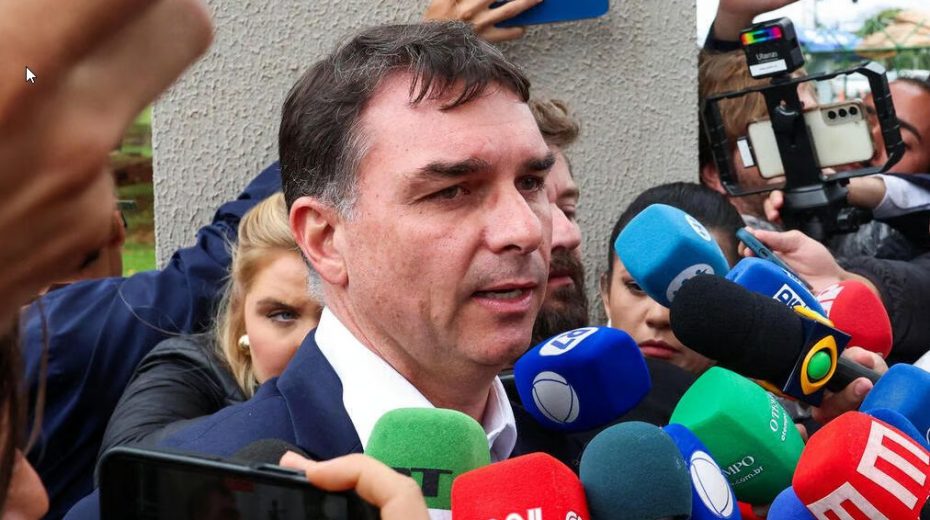
Flávio Bolsonaro’s bid revealed that the “democratic center” demands “unity of the right” only when their own candidacy is involved.
Since Jair Bolsonaro’s disqualification, the Brazilian Right has been at an impasse: on one hand, Faria Lima (Brazil’s Wall Street) urges Bolsonaro to throw his support behind São Paulo’s governor, Tarcísio de Freitas; on the other hand, Bolsonaro is reluctant to give away his electoral stronghold while imprisoned. Why does the financial elite favor Tarcísio? Because his platform emphasizes privatizations and fiscal austerity. This agenda is unpopular: Enel, the new electricity concessionaire—originally an Italian state-run firm, now partly privatized—has left São Paulo without power during heavy rain and wind. Residents have also voiced concerns about deteriorating public security, while the police remain skeptical about promised improvements.
Despite this, the media hailed Tarcísio as the strongest contender to challenge Lula, especially for appealing to “moderate” voters. This posed a dilemma for Bolsonaro: either endorse Tarcísio, who might grant him a pardon (potentially unconstitutional), or risk Lula winning while he remains imprisoned. Bolsonaro’s insistence on his own nomination stems from three factors: first, both he and Lula are Brazil’s top vote-getters; second, candidates from the self-styled “democratic center” or “center-right” barely secure 10% in the first round; and third, before Bolsonaro appointed him to govern São Paulo, Tarcísio was politically unknown—making betrayal look particularly bad. Notably, the previous São Paulo governor, also a privatizer, was elected with Bolsonaro’s backing but challenged him in 2022, ending his political career.
Bolsonaro’s situation is further complicated by his disorganized party structure. Despite reaching the presidency, he has failed to consolidate a political party. Thus, candidate selections must be approved by party leaders, who are at odds with him. Why does the party back Bolsonaro? Because his voter appeal translates into public party funding in Brazil.
To protect his political influence, Bolsonaro would need to back a family member. His three politically active sons—Senator Flávio, Deputy Eduardo, and City Councilor Carlos—and his wife Michelle, who lacks political experience but brings charisma, youth (43 years old, like Carlos), beauty, and evangelical ties, are his options. The evangelical vote is crucial for any right-wing campaign seeking dominance. Michelle is allied with one of Brazil’s leading televangelists, Silas Malafaia. Tensions exist within the family, as Bolsonaro’s sons distrust Michelle, with media highlighting conflicts between her and the youngest son.
Insights into Bolsonarism’s internal dynamics can be found in journalist Kim Paim’s YouTube program, which is connected to Bolsonaro’s sons. It reveals numerous clashes between Bolsonaro and his sons versus the party leadership, including minimal funding for Jair and Eduardo, while the party’s women’s wing spent lavishly on Michelle. For example, when Jair was arrested, Michelle was attending a party event in the interior of Ceará.
It is understandable for a party to promote a charismatic female figure. Due to a Supreme Federal Court mandate, parties must allocate spending quotas for female candidates, which compels them to recruit women to avoid later allegations of electoral violations. Hence, Michelle is a valuable asset. This makes it surprising that the party has neglected Jair and Eduardo despite Michelle’s prominence.
Recently, amid speculation, the political scenario suggested Tarcísio as presidential candidate with Michelle as his vice, although no major figure openly confirmed this. Tarcísio repeatedly denied presidential ambitions even as he posted videos proclaiming the need for a “new CEO” for Brazil. However, Michelle’s misstep in Ceará helped consolidate the Bolsonaro faction. The week began with a clash and culminated in Flávio Bolsonaro’s announcement to run for president.
One more complexity: Olavism. This movement is centered around Olavo de Carvalho, a so-called philosopher and neoconservative propagandist. His secretary, Sílvio Grimaldo, has stated (in Portuguese) that he received a Pentagon award for his services. Eduardo Bolsonaro followed Carvalho’s ideology and has become, in effect, Brazil’s Maria Corina. Grimaldo was part of the Bolsonaro administration but left and became an outspoken critic. Consequently, the organized Olavist faction, led by Grimaldo, worked to block Carlos’s Senate bid in Santa Catarina, undermining deals Bolsonaro had made prior to his imprisonment. This pleased local party leaders seeking a Senate seat as leverage in inter-party negotiations.
Similar tensions unfolded in Ceará, where Olavists worked to dismantle local alliances made with Bolsonaro’s consent that weakened the Bolsonarist bloc. In Ceará’s case, the deal—pragmatic rather than ideological—entailed forming an anti-PT coalition with leftist Ciro Gomes. Michelle, who had expressed sympathy for the rebels in Santa Catarina, publicly rebuked André Fernandes, Ceará PL’s main Bolsonarist, for aligning with Ciro Gomes, accusing him of acting behind Bolsonaro’s back and being traitorous. Unlike in Santa Catarina, Michelle’s actions betrayed both Bolsonaro and the party.
Why would she do this? The subsequent events suggest a coalition of liberal-neocon forces opposing Bolsonaro—uniting Zionist evangelicals, financial liberals, and Olavists—ironically groups that were foundational to Bolsonarism. A more straightforward explanation might be misjudgment and unfamiliarity with the Northeast. They may have compared Bolsonaro’s and Ciro’s 2022 presidential votes in the region and assumed Bolsonarism had no need for Ciro’s backing in Ceará. This arrogance leads to ignorance: the Northeast, largely rural, requires support from local political bosses during major elections. Bolsonarism’s support is mainly urban and limited. The crux of Ceará’s scandal, Senator Girão from the financial market party NOVO, was elected with Ciro’s support, aiming to block an adversary from gaining a Senate seat.
Following these developments, Bolsonaro instructed Michelle to avoid conflicts with their sons and endorsed Flávio’s candidacy. The party leader and Michelle agreed, although Tarcísio has yet to comment.
The media reacted with skepticism, claiming Flávio’s candidacy was unserious and merely a bargaining tactic. On December 7th, Flávio revealed he set a “price” for withdrawing his candidacy and promised to disclose it the next day. However, he prematurely disclosed the condition that would allow his father to be free to run: the Amnesty Law.
Ultimately, Flávio Bolsonaro’s run highlighted how the “democratic center” calls for “unity of the right” only when their own candidacies are involved. What remains uncertain is 1) how this new form of Bolsonarism, opposed by evangelicals, Olavists, and liberal leaders, will take shape, and 2) how successful these leaders will be electorally without Bolsonaro’s influence.
About the Author