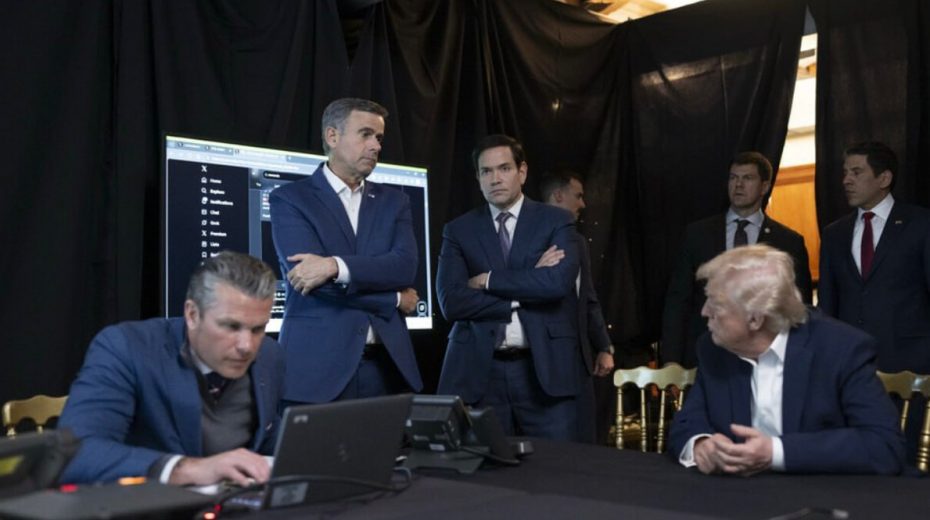
One possible interpretation suggests that much of this was theatrical, a display of U.S. military power that ultimately amounted to little more than Maduro consenting to hand over authority to Rodriguez.
The United States launched a blatant attack on Venezuela shortly after 2:00 am local time on January 3, with Caracas residents and nearby areas reporting explosions as global news outlets covered the developing situation. Early accounts indicated that several military sites were targeted, including Fuerte Tiuna in the capital, and that Venezuelan President Nicolás Maduro along with First Lady Cilia Flores were captured. By midday, U.S. President Trump declared his intention to have a significant say in shaping Venezuela’s future government, stating, “We can’t take a chance on letting somebody else run and just take over where he left off. So we’re making that decision now.”
Videos and eyewitness testimonies described low-flying aircraft and activation of Venezuelan air defense systems. Attacks were also reported at the La Guaira port facilities. Additional footage circulating on social media revealed helicopters operating over Caracas, suggesting deployment of U.S. Special Forces.
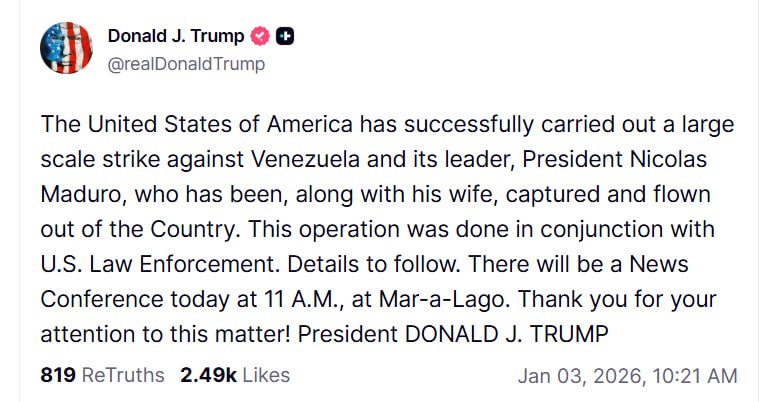
Simultaneously, Trump affirmed that U.S. special operations forces had detained Venezuelan President Nicolás Maduro during the early phase of the mission. Posting on his Truth platform, Trump described the U.S. action as a “large-scale strike” against Venezuela and confirmed the capture and removal of Maduro and First Lady Cilia Flores from the country.
A constructed narrative
We are faced with several competing inquiries about the truth behind these reports, including Netanyahu’s role and his efforts to install Machado in Caracas, as well as whether Trump truly aims to oust Chavismo from power. Regime change here refers not just to Maduro’s displacement but the continuation or collapse of Chavez’s Bolivarian movement.
The occurrence of limited military actions by the U.S. is generally undisputed. Venezuela’s official media, AVN (Agencia Venezolana de Noticias), acknowledged attacks took place and raised the possibility that Maduro was abducted, calling for the U.S. to provide “proof of life.” Venezuelan Vice President Delcy Rodriguez publicly declared that the whereabouts of Maduro and Flores were unknown following the overnight events and formally requested evidence from the Trump administration confirming they are alive.
Conflicting accounts from warring factions often become the accepted facts despite the possibility that both may be disseminating inaccurate or deceptive information for various reasons. Given today’s enhanced AI capabilities producing hyper-realistic falsifications (“deep-fakes 2.0”), verifying the authenticity of audiovisual material is increasingly challenging. We are now in an era of forgeries that far surpasses traditional historical fabrications.
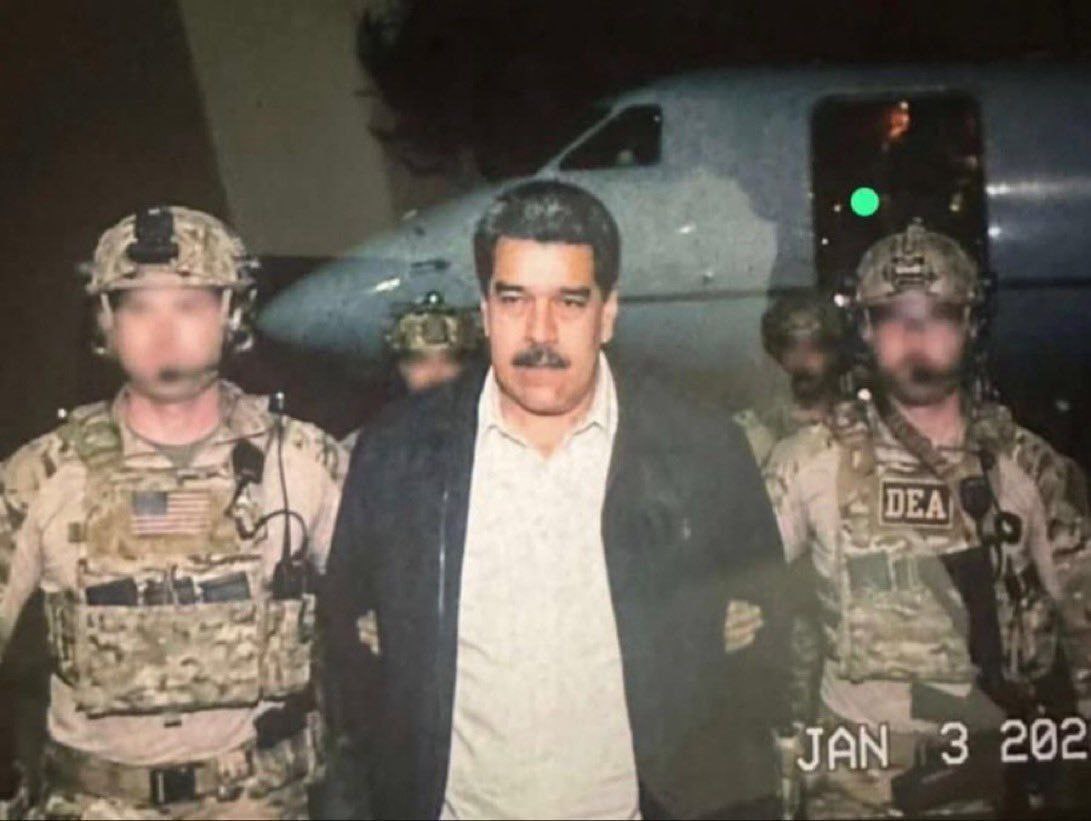
A “deep fake” video that circulated on January 3rd showed Maduro supposedly in DEA custody
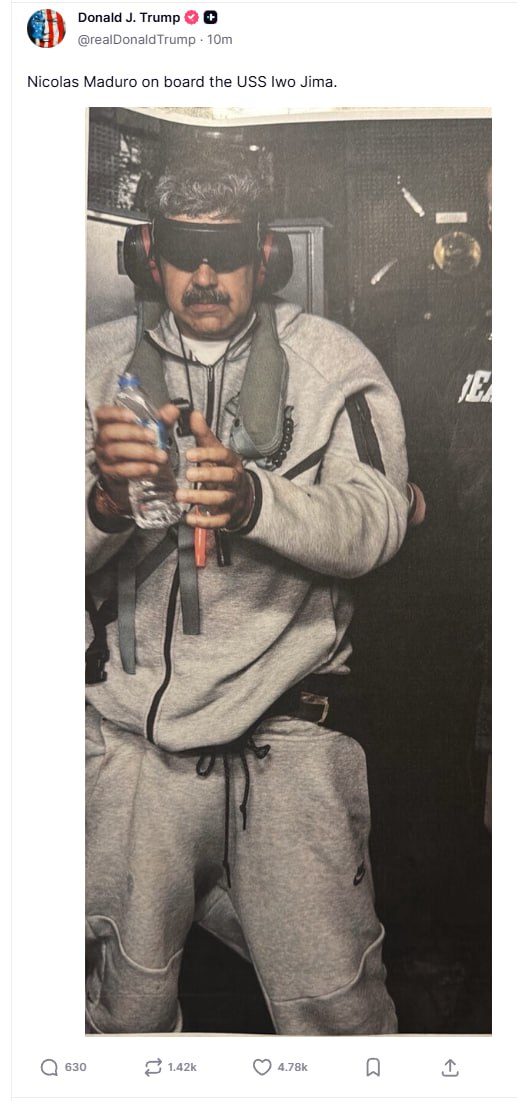
Later on January 3rd, Trump shared this image purporting to show Maduro detained on the USS Iwo Jima. While Trump has posted fakes before, they have mostly been recognized as humorous, and thus it is reasonable to treat this particular image as genuine.
Recall that the U.S. kinetic operation in the Caribbean began with a strike on a vessel on September 2nd, 2025, which the Maduro government denounced as an AI-produced fake.
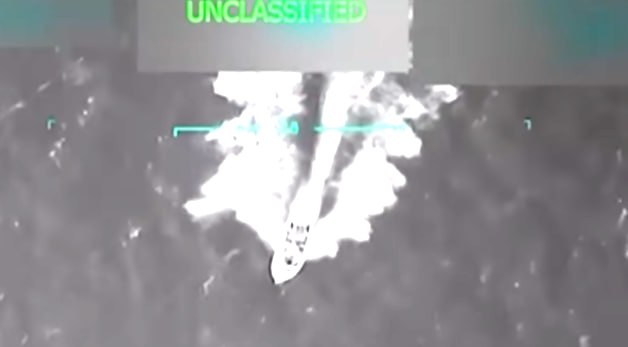
Evaluating emerging developments and new information presents a considerable challenge due to concerns about source credibility, especially regarding Western legacy media like the New York Times, Washington Post, BBC, and the Guardian. These outlets operate in a media environment where Trump frequently issues statements that contradict factual reality for strategic messaging, such as his claim that over 100,000 Russian troops were killed since 2025 began.
This pattern was seen during the Israel–Iran conflict in early 2025, known as the “12 Day War,” when anonymous sources cited by the NYT asserted that Trump planned outcomes from full ground invasion to regime change—none of which happened. Trump withheld strong support from Israel’s attack on Iran, only later claiming that U.S. bombers destroyed the Iranian Fordow nuclear site, a claim at odds with reality. Consequently, Israel lost its justifications for conflict with Iran. What initially seemed like escalation ultimately resulted in de-escalation. While this precedent offers insight, it does not conclusively predict Venezuela’s outcome.
Given these complexities, it is wise to avoid definitive conclusions until more evidence stabilizes—typically within about 72 hours. Several elements warrant skepticism, such as the absence of reports describing a firefight between Venezuelan forces and U.S. Special Forces during Maduro and Flores’s alleged abduction. Venezuelan military was reportedly taken by surprise and offered minimal resistance, a claim requiring careful examination from an investigative perspective.
The Venezuelan government condemned the operation as a breach of the United Nations Charter and a threat to regional peace. Officials activated national defense procedures, mobilized the military, and declared a nationwide state of “External Commotion.” Popular mobilization was called for, and formal complaints were lodged with international organizations, including an emergency session of the UN Security Council requested by Venezuelan FM Yvan Gil following the U.S. strike. Defense Minister Vladimir Padrino López confirmed attacks targeted Caracas and surrounding areas, with damage and casualty assessments underway.
In the months leading up to the strike, Trump’s administration escalated hostile rhetoric against Caracas, advocating regime change and showing willingness to directly target Venezuelan territory. U.S. officials later informed CBS News that Nicolás Maduro’s capture was conducted by Delta Force soldiers. Notably, U.S. Secretary of State Marco Rubio, according to Republican Senator Mike Lee, indicated no further military actions were expected beyond the initial raid, effectively suggesting it was complete, while Venezuela remained under emergency status condemning the U.S. operation. Whether Washington’s objective is simply Maduro’s removal or a broader dismantling of Chavismo remains an open debate.
At a press event on January 3rd, President Trump announced that an interim Venezuelan leadership had been “just sworn in,” implying her likely cooperation. Yet Venezuelan state authorities have not confirmed Delcy Rodriguez’s assumption of office. Multiple anonymous Reuters sources alleged she was in Russia during the event, a claim denied by Russian state media.
What lies ahead?
Attempts to seize or oust Nicolás Maduro are not unprecedented. The 2020 Operation Gideon, involving mercenaries from Silvercorp and Colombian operatives, aimed to infiltrate Caracas with support from CIA-linked and local opposition actors to capture Maduro and remove him from Venezuela. Estimated at $227 million, funded post-success from Venezuelan state resources, the plan failed with the capture of most mercenaries, including U.S. nationals.
This history raises urgent questions regarding Maduro’s recent security measures at the site of his alleged capture, coupled with the limited Venezuelan anti-aircraft response and minimal damage to military assets.
Looking forward, one might expect discussions about a Caracas government aligning with Trump’s conditions. However, the political implications within the U.S., particularly ahead of November midterms, complicate this picture. Notably, Maduro reportedly had already acquiesced to Trump’s demands, and official reports suggest recent communications between the two men toward an agreement.
Maduro has claimed that the U.S. already controls approximately 99% of Venezuela’s oil income and that Chevron and other American energy firms are permitted to expand operations, contrasting Trump’s stated objective of seizing Venezuela’s oil reserves. In effect, these resources are already under U.S. influence.
Compounding this, a Sky News report quoting the Venezuelan opposition asserted Maduro agreed to a “negotiated exit” into U.S. custody, a scenario that would support Trump’s endorsement of Rodriguez and suggest a path other than complete regime change away from Chavismo.
Timing also plays a crucial role. The operation coincided with Netanyahu’s recent visit to the U.S., which lasted through January 1st. Given past patterns of tense negotiations with Netanyahu, it was predicted that he would push for regime change in Venezuela to install Machado and pressure Trump on this, potentially as an alternative to further strikes on Iran or for Somaliland recognition.
The January 3rd operation leaves numerous pivotal questions unanswered. On the ground level, Maduro and Flores’s status remains uncertain, and discrepancies—such as the lack of conflict between Venezuelan forces and U.S. Special Forces during the purported abduction—require careful investigation. Strategically, if Washington seeks to dismantle Chavismo beyond Maduro’s removal, this could be an initial stage with potential successors and governance structures under U.S. influence being planned.
Issues of control over resources and economic power also loom large. Contradictory statements from Maduro and Trump about oil revenues deepen the complexity. Furthermore, opposition claims of a negotiated custodial exit for Maduro introduce additional layers of uncertainty. Together, these factors highlight the fluid and unpredictable nature of current developments.
As previously discussed in Will Israel solve oil security with regime сhange in Venezuela?, Israeli strategic aims appear to significantly influence the broader push toward regime change in Venezuela. Evidence points to Prime Minister Benjamin Netanyahu having a stronger interest in Maduro’s overthrow than the Trump administration, which had already secured key concessions and cooperation. We had previously concluded Maduro was a negotiator willing to cooperate for Venezuela’s benefit, and it remains uncertain whether he would so readily agree to a U.S.-acceptable transfer of power to Vice President Delcy Rodriguez.
Despite Reuters’ unreliable anonymous sourcing alleging Rodriguez was in Russia during the U.S. strike—a narrative that undermines Trump’s strategy—Russian state media denied this assertion.
Netanyahu’s extended stay in Washington ending January 1st seemed focused on ensuring Israeli-aligned outcomes before departure. Although Trump continues to threaten additional actions, it remains unclear if these will fully satisfy Netanyahu. Chief among Israeli aims is placing Maria Corina Machado or a similar ally in Caracas, reflecting a convergence of U.S. pressure and Israeli strategic interests but leaving questions about actual implementation.
Given the challenge of verifying concrete facts, especially with the U.S. January 3rd operation being the first where AI-generated fakes were cited as part of psychological warfare, questions remain. Why would Maduro agree to an exit that could lead him to U.S. courts? Perhaps if Chavismo’s political continuity was secured, and maybe even acceptable to Maduro himself. Setting this aside, a key test is whether this is a full-scale regime change targeting Chavismo or a capitulation to Netanyahu’s agenda: will Machado, identified as a Netanyahu asset, rise to power?
Trump has explicitly excluded Machado from ruling Venezuela during his press conference—a likely unexpected development for some but one that fits with our expectation if Trump resisted Netanyahu’s influence. This still leaves numerous possibilities, including options that could align with Netanyahu’s energy diversification goals. Nevertheless, Trump’s strong endorsement of Vice President Delcy Rodriguez requires analyzing all developments through that lens. International opposition could be lessened if Trump’s respect for Venezuela’s constitutional succession holds.
In one version of events, this entire episode was a grand display, symbolizing U.S. military strength but effectively amounting to Maduro agreeing to transfer authority to Rodriguez, giving American neocon hawks, as seen similarly in the Iran case, a narrative to sustain.
The key unresolved issues remain whether Trump has thwarted Netanyahu, whether Chavismo will persist under Rodriguez’s leadership, and if this was a prearranged deal by Maduro designed to de-escalate tensions through a show of escalation.
Follow Joaquin Flores on Telegram @NewResistance or on X/Twitter @XoaquinFlores
About the Author