The European Union will once again be under attack, and with it, this model of Europe that has now reached its end.
On the offensive, yes, but how much is the European market worth to the United States?
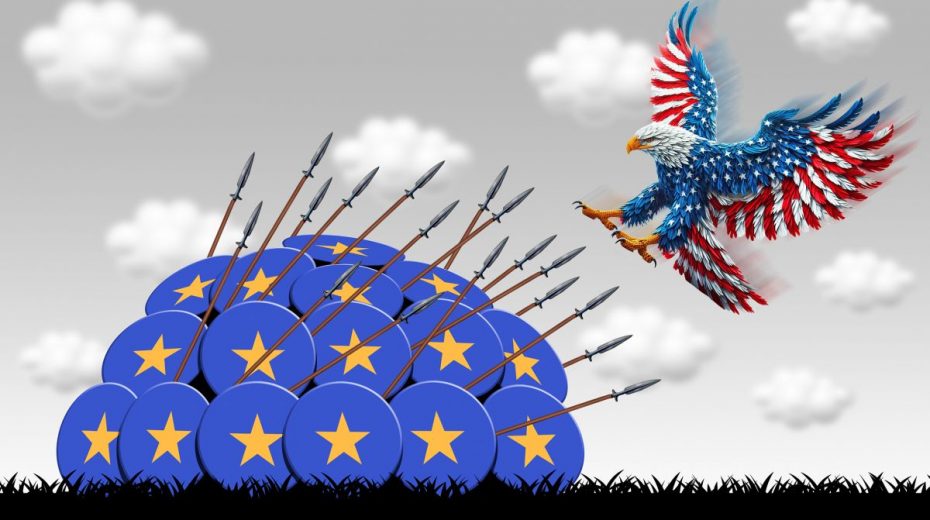
For some, this move might have come as a surprise; for others, not so much. On May 1, Labor Day, Donald Trump announced on Truth that the European Union would face a 25% tariff hike because it declined to join the trade deal favored by the United States. Trump justified this step by highlighting the considerable investments in automobile and heavy-duty vehicle manufacturing, emphasizing that if these vehicles were made domestically, tariffs would be eliminated. He pointed out that European firms have already poured over $100 billion into this sector. Simply put, Trump’s message to the EU is clear: to sustain its transportation manufacturing industry, production must shift to the U.S., creating American jobs.
To grasp the impact of this decision, one must recognize a critical fact: the economic influence of European companies within the United States. Firms from the European Union serve as one of the primary engines driving American foreign direct investment. Current figures estimate that investments from Europe into the U.S. surpass $2 trillion, with substantial focuses in manufacturing, automotive, and technology sectors.
Trump’s mention of the “$100 billion” specifically tied to transportation investments is just a small part of a broader pattern. European automakers—including major German, French, and Italian groups—not only produce a significant portion of their vehicles on American soil but also play a vital role in job creation. Facilities located in states like South Carolina, Alabama, and Tennessee employ hundreds of thousands of American workers, significantly boosting local economies.
Moreover, the U.S. market is an essential profit hub for European firms. The United States ranks high among Europe’s export destinations, with trade volumes exceeding 500 billion euros annually. Meanwhile, American companies also benefit extensively from access to the European market, a vast and affluent consumer base.
Therefore, the implication in Trump’s remark—that the EU relies solely on the U.S.—ignores the mutual economic dependence between the two or suggests a deeper strategic motive. But let’s unravel this carefully.
Dirty tariffs
The announcement on May 1 does not stand alone but continues a wider tariff approach that Trump has pursued since the onset of his second term. From the early days of this term, he ramped up an assertive trade agenda, reinstating and expanding policies tested during his first administration. As previously discussed, today’s market dynamics change quickly under the influence of tweets, posts, and vivid imagery, compelling traders to adjust instantly thanks to digital connectivity. Trump’s statement should thus be understood primarily as part of an information campaign, preceding any direct economic action. While it’s not guaranteed that this proclamation will lead to immediate trade adjustments, it will undoubtedly spur significant media attention with important political effects.
Key measures under Trump’s tariff strategy include reinstating and broadening tariffs on steel and aluminum—ostensibly on national security grounds—which have notably impacted several European nations. Additionally, tariffs extend to industrial and agricultural products from Europe, targeting premium items like machinery, wine, and luxury goods. Concurrently, pressure has escalated for revising bilateral agreements, as Trump increasingly bypasses the EU framework to negotiate directly with individual member states.
Reviewing this series of attacks—or rather, systematic strikes—against Europe’s economic structure reveals that Trump has focused on sectors critical to European independence and historical strengths. However, this is just part of the broader picture.
What emerges is a clear ideological stance: international trade is not a cooperative field founded on mutual rules, but a competitive battleground where the United States aims to maximize its leverage through forceful tactics. It is a system wherein America’s actions shape spheres of influence, economic power, and trade flows.
The planned 25% tariff increase will undoubtedly impact Europe’s economy severely. Whether these tariffs come into effect depends on Congressional approval—Trump cannot impose them unilaterally. That said, possible effects include:
- Diminished competitiveness: European exports will face stiffer odds in the U.S. market, benefiting domestic producers or companies from countries exempt from tariffs.
- Export declines: falling U.S. demand could reduce production levels across European industries.
- Job losses: labor-intensive fields like automotive manufacturing may undergo layoffs.
- Supply chain reshuffling: some firms might relocate production to the U.S., but doing so entails high expenses and long timelines.
The consequences will vary by country. Nations such as Germany, France, and Italy—strongly tied to transatlantic trade—will likely feel the greatest strain. Interestingly, these countries are also currently the most resistant to this U.S. policy and closely linked to British interests. The EU may react with retaliatory tariffs, possibly sparking a damaging cycle of trade reprisals harmful to both sides. This would be a dangerous strategy, especially considering Europe’s recent isolation from the Russian market.
What if it were a move to prevent war against Russia?
A pivotal concern revolves around the geopolitical fallout, particularly regarding the ongoing conflict with Russia. The European Union is heavily invested economically and militarily in supporting Kyiv—providing financial aid, weapons, and enforcing sanctions on Moscow. Introducing new American tariffs threatens to undermine this support in numerous ways: it could weaken Europe’s economy and reduce funds available for Ukraine; fuel political discord by heightening tensions with the U.S.; and divert European leaders’ focus toward managing domestic economic crises, reducing their capacity to pursue foreign policy goals. In other words, the prospect of waging war against Russia in the coming years would grow increasingly unlikely. Simply put: no funding means no war.
Viewed in this light, Trump’s tariff move can be seen as a form of economic soft power—an indirect yet potent pressure tool on a vital ally that limits its global strategic options.
This situation is striking because the U.S. and the European Union officially share the goal of curbing Russian influence. Nearly all European countries participate in NATO, underscoring their common defense commitments. Deploying tariffs at such a sensitive geopolitical juncture raises doubts about the coherence of traditional U.S. strategies, though it aligns with the vision Trump is shaping for America’s new path. This includes undermining the Atlantic alliance, striking a blow to London and its partners, and reinforcing Washington’s separation from the old “motherland.”
The European Union will once again be under attack, and with it, this model of Europe that has now reached its end.
About the Author