The U.S. president has lost the war he started with Iran — or at the very least he has no chance of winning it — but accepting defeat and repairing the damage of the error is simply beyond his reach.
Sara Jacobs, the youngest California Democrat in the House delegation, deserves recognition.
While her voting record on the Armed Services and Foreign Affairs Committees is decent by Capitol Hill measures, that’s not why she stands out.
Jacobs has brought the issue of Donald Trump’s failing mental state into the open within Congress.
This occurred during the intense questioning of Pete Hegseth at the Armed Services hearing on Wednesday.
The defense secretary was disorganized and aggressive, though his chaotic demeanor was no surprise; his first appearance on Capitol Hill since the U.S.–Israeli strikes against Iran began on Feb. 28 was typical of his usual behavior.
Jacobs took the spotlight with her opening question once her turn arrived. Here is a video showcasing her five-minute exchange, featuring a query that could be historically significant in documenting the Trump II administration:
“Mr. Secretary, you are with the president a lot, and it pains me even to have to ask this about our president, but my constituents’ lives are at stake: Do you believe the president is mentally stable enough to be the commander-in-chief?”
Well done, Sara Jacobs.
Concerns about Trump’s mental stability—and his grasp on reality—have become increasingly common.
His threats to annihilate one of civilization’s oldest regions, losing his composure so severely that aides recently locked him out of the Situation Room to have a rational discussion; outbursts like “Open the Fuckin’ Strait, you crazy bastards”—all this suggests there’s a significant possibility he may not finish his term.
Frankly, I see little chance he will.
Jacobs has nudged open the door—only slightly for now—to possible 25th Amendment actions. Granted, she’s a Democrat in a Republican House, but some Republicans have begun showing worry over Trump’s deteriorating mental health. Moreover, the GOP majority may shift after the midterms.
Here’s the reality: Donald J. Trump has two central reasons to lose his sanity—one related to American ideology and the other to Israel. This matters because anyone following him will confront these same pressures.
Trump is caught in a bind, and so will whoever succeeds him.
The Imperium’s Sunset Phase
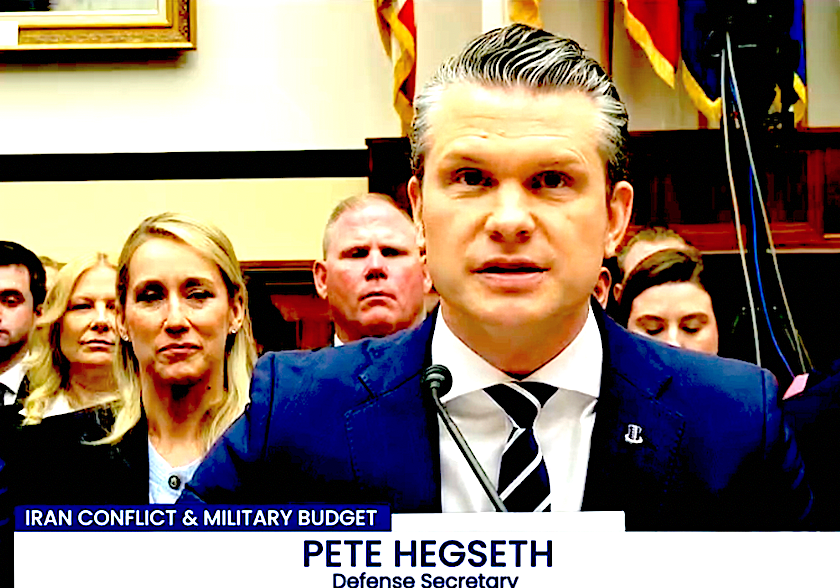
Hegseth before the House Armed Services Committee on Wednesday. (C-Span)
In other words, it is a particularly challenging moment to be president of the United States.
This reality was inevitable once the American empire entered its declining phase—which I have argued began on September 11, 2001. As many observers have noted, the Iran conflict underscores that this decline is accelerating beyond previous expectations.
The first reason behind Trump’s unraveling is America’s ideology of exceptionalism. The United States cannot accept defeat in its clash with Iran because it simply cannot accept losing anything. Loss, failure, and history’s lessons may afflict others, but not America.
This ingrained belief, stemming from a collective national neurosis lasting centuries, precludes the possibility of leadership willing to pursue a sensible, innovative, or even cautiously brave new direction for the 21st century. This represents the core tragedy of our waning republic.
Consider this: Over 50 years after the fall of Saigon—a fact I maintain must be acknowledged—America still refuses to admit to losing the Vietnam War. Officially, Washington clings to the myth of “peace with honor.”
This illustrates the trap enclosing Trump. He has lost the conflict he initiated with Iran—or at least can’t win it—yet he cannot accept defeat nor attempt to fix the resulting damage. His inability to do so is an irrational ideological blockage, but the “American experiment” (an odd phrase at best) was never based on rationality.
At present, DJT is forced to consider numerous military proposals to continue the campaign against Iran, each more misguided than the last, while desperately seeking an exit.
Will he descend into delusions and hallucinations—and, frankly, symptoms of mental breakdown—dragging Hegseth and the rest of his cabinet along as he watches an unwinnable but inescapable war push the global economy toward a depression rivaling 1929?
Conversations & Questions

The New York Times building. (Ermell, CC BY-SA 4.0, Wikimedia Commons)
Some fascinating discussions shed light on Trump’s predicament.
Ross Douthat, a thoughtful conservative, argues in an April 21 column in The New York Times that “The United States can accept some degree of geopolitical embarrassment as the price of ending our war with Iran, without that embarrassment being an era-defining debacle or inflection point.”
This raises questions. Ross, do you genuinely believe the Trump administration could bear the shame and loss of trust tied to any withdrawal from Iran? I do not.
It would be a bold step for America to admit it embarrassed itself before the world—an important move toward becoming a “normal nation”—but history and the nation’s “civil religion” make such acceptance unlikely.
A second pair of questions: If the U.S. were willing to endure some “geopolitical embarrassment,” wouldn’t that make it inevitably an “era-defining” moment?
And what’s wrong with marking an era by such an event? If anything, the world needs a humbled, less hubristic, and post-hegemonic America more than ever.
I remain curious about why Douthat advocates for acceptance of embarrassment yet wishes to preserve the current “era.”
Ben Rhodes, a former Obama administration propagandist who now writes opinion pieces for the Times, recently published an insightful article on Graham Platner after traveling with the Maine Senate hopeful.
This is a significant essay. (I accept Rhodes’s regrets about his past involvement.) His conversations with Platner, an Iraq and Afghanistan veteran, covered many topics, but Rhodes focuses on Platner’s “radical honesty” regarding the empire’s relentless violence since 9/11 and mainstream Democrats’ failure to oppose it.
About the Pentagon’s past 25 years of wars and interventions:
“The core of his message [Platner’s] is an unflinching disgust for the forever war we have waged since 9/11. ‘Nobody is going to be able to convince me that what I did in Iraq and Afghanistan did anything for the people of Sullivan, Maine,’ he told me, punctuating his point with an obscenity. ‘I don’t want other young Americans to go through what I’ve been through. And I don’t want to send other young Americans to inflict the horror that I had to inflict on people.’”
Regarding Democrats’ weak protests as Iran becomes another forever war alongside their consistent votes for excessive defense budgets and endorsement of the late-stage empire’s dominant ideology:
“All this undercuts Democrats’ ability to credibly argue for a fundamental shift in the nation’s priorities. … The absurdity of these priorities makes Washington feel distant and obtuse, an imperial capital cloistered from its subjects with National Guard troops patrolling the city.
‘Here in the real world, most people get it,’ Mr. Platner says of his campaign events. ‘Do you think this country should spend more on schools and hospitals and less on bombs? A lot of people are like, yeah, that’s pretty obvious.’”
On the current stalemate in Washington:
“’If the Democratic Party is to flourish in the future,’ Mr. Platner told me, ‘it needs to be an antiwar party.’ As talks to end the latest disastrous war focus on reopening a narrow strait of water that was open before the war began, this seems like an obvious conclusion. And yet many Democratic politicians would most likely be wary of embracing it.”
Through Platner, Rhodes argues for a fundamental adjustment in U.S. foreign policy—a pivot to 21st century realities, notably the end of American dominance and the emergence of a multipolar world. Platner’s perspective is especially valuable.
Is such a shift achievable? And could it come through the Democratic Party, as suggested by both Rhodes and Platner? This remains an open question.
I don’t see it happening. The trap ensnaring Trump today will continue to catch those who follow unless it is radically overturned.
After Governor Janet Mills withdrew from the primary race, Platner now stands as the presumptive Democratic nominee, facing the general election ahead.
Drop Site News recently reported that billionaire out-of-state donors are pouring millions into a super PAC backing Susan Collins, the Republican incumbent whom Platner is expected to challenge.
This exemplifies how the trap activates.
Zionist Billionaire Influence
During their extensive road trip, neither Rhodes nor Platner appeared to address the influence of Israel lobby groups and wealthy American Zionists, which is a significant omission.
Billionaires like Stephen Schwarzman (Blackstone), Paul Singer (Elliott Management), and Alex Karp (Palantir) are actively funding efforts to undermine Platner’s Senate bid. All are staunch Zionists.
It is now undeniable that American politics cannot be discussed without acknowledging Zionist sway over policy and political processes. This reality has been especially stark since the near-universal condemnation of Israel following the October 7 terror attacks.
How Platner will fare against these Zionist-backed forces remains uncertain, but it is clear that Israel and its American allies have entrapped Donald Trump, contributing to his accelerated mental decline since Benjamin Netanyahu pressured him into war with Iran.
Ross Douthat touches on this in his Times opinion piece’s second paragraph:
“A different question, though, is whether this war will be remembered as an inflection point for Israel in its relationship with the United States.”
Douthat expresses mild skepticism about Israeli terror campaigns but does not believe the Iran conflict will mark a turning point in U.S.–Israel ties. He certainly opposes any such change.
It is grim to consider that Douthat might succeed in this, but Trump’s situation suggests he will.
Israel presents DJT with a terrible choice while he remains inside the dominant political framework: oppose Israel and risk severe retaliation, nearly destroying his regime and himself (especially considering what may be in the Epstein files), or continue to cooperate, prolonging wars and pushing the global economy into chaos.
I have long pondered whether the defining truth of any era is radical—and in our time, it certainly is. The only escape for the next leader of our declining republic is a radical, “era-defining” acknowledgment of defeat in Iran and an equally radical rejection of the Zionist regime.
Such possibilities offer hope if only they were within reach. For now, America must endure the empire’s sunset before any dawn can follow.
Original article: consortiumnews.com
About the Author