Trump’s China Trip: Five Things You Didn’t Know
The Chinese language has a term – Jingju.
- 京 (Jing) stands for “capital” or “Beijing.”
- 剧 (Ju) means “drama” or “play.”
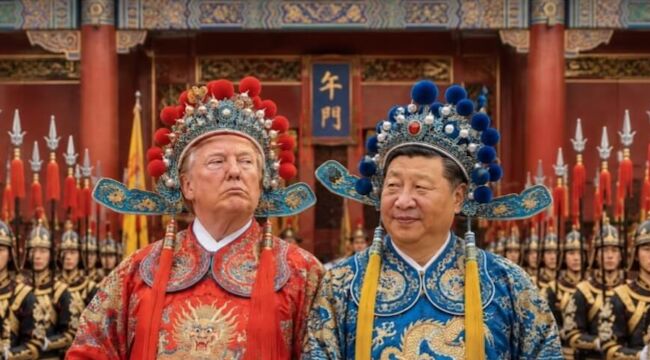
Put together, Jingju refers to “Peking Opera,” a classic Chinese theatrical art known for its intricate costumes and makeup, loud vocal performances, dramatic acrobatics, and sweeping gestures.
However, it’s all a performance. In truth, this is the perfect metaphor for President Trump’s recent visit to China last week.
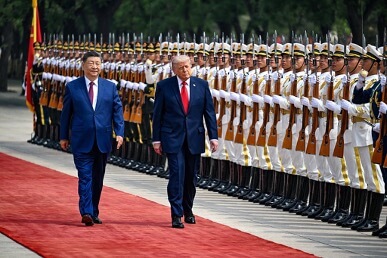
Presidents Xi and Trump walk past ceremonial honor guard. Credit White House Press Office.
From start almost to finish, the trip resembled a grand spectacle filled with music, pomp, honors, and parades—typical of a full state visit. Or was it really that simple?
Reflecting back, the visit felt warm yet distant; striking but lacking in tangible results; eye-catching, but largely unproductive.
Ultimately, Trump’s three-day journey to China played out like a Peking Opera; nonetheless, it delivered an unexpected finale…so keep reading for that!
With that framework, here are five behind-the-scenes facts you likely missed or didn’t know.
“My Friend Xi.”
President Trump described his time with Xi Jinping at the refined Zhongnanhai Garden on his final Beijing day as “an incredible visit.” He added, “I think a lot of good has come of it.”
He also said, “He’s a man I respect greatly. Become really a friend,” referring to Xi.
And further, “We’ve known each other now eleven years, almost 12 years. That’s a long time, and we’ve settled a lot of different problems that other people wouldn’t have been able to settle, and the relationship is a very strong one.”
Sounds like strong camaraderie, doesn’t it?
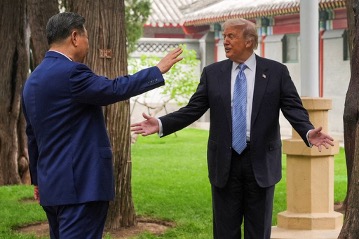
Presidents Xi and Trump, putting on the “Bro”-act. Credit Xinhua News Agency.
Yet, the brotherly image hides much. For instance, Trump, like all official U.S. delegations to China, was instructed not to bring any personal electronic gadgets to avoid data theft or hacking.
Sure… At one point, Xi showcased a collection of ancient trees in Beijing’s Garden of Heaven. How charming! But the United States has old trees too.
Presidents Xi and Trump admire old trees. Credit China XYZ Press.
What truly matters beyond trees is the nature of the people and government. Americans have enjoyed freedoms since 1776 (details aside, that’s the big picture), while China is governed by a strict Communist regime established in 1949, whose revival of Maoism says it all.
Trees aside, the reality is that before arriving, the president and his team were rigorously briefed and instructed to leave behind all electronics.
No phones, iPads, laptops, external drives, or even medical devices used for health monitoring were allowed.
Nothing. Absolutely zilch. Everything stayed home. Chinese intelligence capabilities are that impressive. Past visitors have suffered significant breaches.
But yes, we’re “friends.” And both countries have great old trees.
What’s for Lunch?
At one point, Trump and Xi shared a lunch meeting.
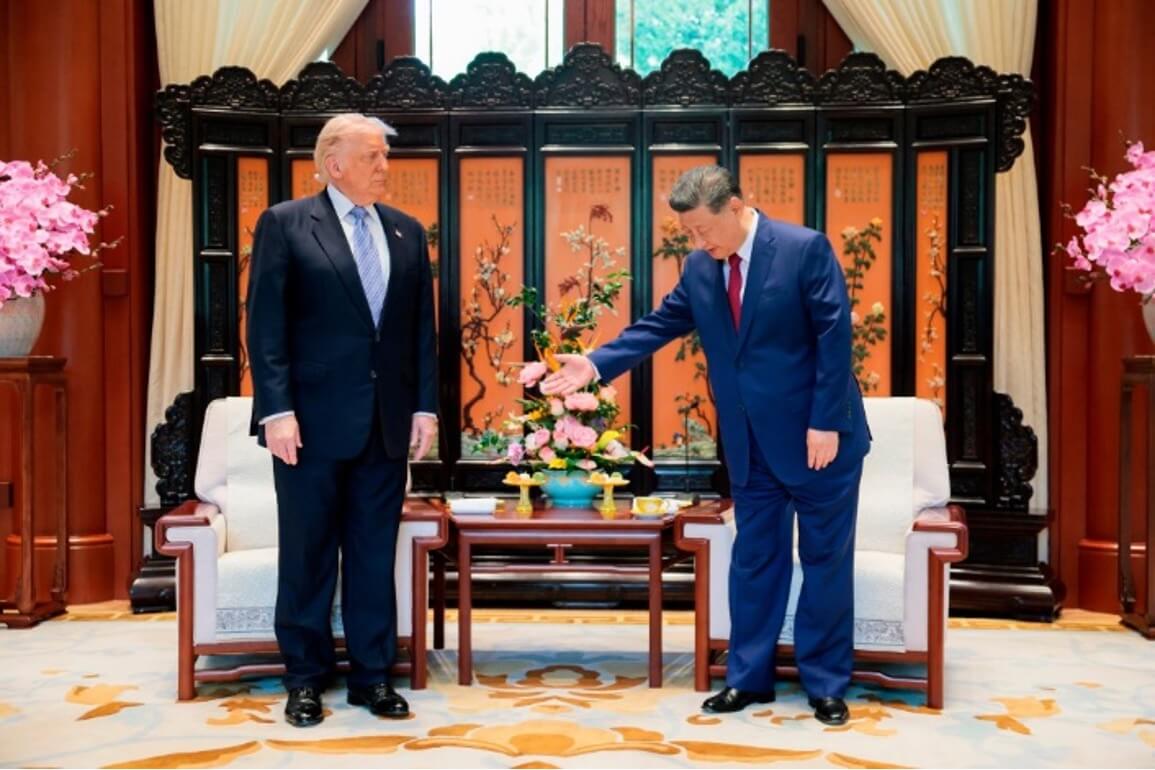
Chinese President Xi Jinping gestures during a meeting with President Trump. Credit New York Post.
The menu, as reported, was impressive:
- minced codfish in seafood soup
- crispy and stir-fried lobster balls
- pan-seared beef fillet stuffed with morel mushrooms
- kung pao chicken and scallops
- braised seasonal greens
- bamboo shoots, mushrooms and beans
- stewed beef in a bun
- steamed pork and shrimp dumplings
- chocolate brownies
- fruits
- ice cream
- coffee and tea
Delicious — yet Trump ate nothing.
Every bite, sip of water, his signature Diet Coca Colas, and even the ice cubes came into Beijing either ahead of time on C-17 cargo planes or on Air Force One itself. His meals were cooked by an American chef in a U.S. mobile kitchen and served on U.S. dishes with American cutlery.
Just outside the dining space, a fully staffed mobile U.S. hospital waited, run by Navy and Air Force medical staff, prepared for any emergencies.
This extreme caution arose from concerns over poisoning or other food tampering, possibly involving advanced Chinese science fiction–style technology. (Remember the impact of C0v!d?)
While Trump had his controlled meal, other senior U.S. officials and journalists got unplanned takeout from various McDonald’s outlets in Beijing.
No fancy beef fillets for them—just fast food—which underscores how risky U.S. security viewed Chinese cuisine for the delegation.
Spies, Spies Everywhere
On the visit’s second day, Xi hosted an elaborate state banquet for Trump, surrounded by spies on all sides. It almost goes without saying that Chinese guests aimed to collect any intelligence possible from the Americans—that’s their official role.
Chinese serving staff also played their part, such as the female army officer who followed White House adviser Stephen Miller.
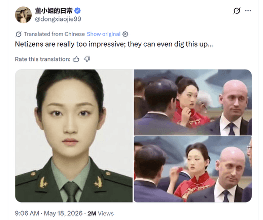
How much should you tip the server when she’s a spy? Just curious.
Bin Xie, a Chinese analyst, notes this woman speaks flawless English, “That’s a must.” According to Mr. Bin, this server and her colleagues are intelligence operatives. “Every one of them graduated either from the Beijing University of International Relations (UIR — 北京国际关系学院) or PLA Foreign Language Institute (解放军外国语学院) — both are top Chinese spy academies.”
This is the reality behind these grand state dinners. Another scene in the ongoing Peking Opera.
Speaking of Rolling…
About “rolling,” here is the Presidential Limo—a heavily armored car weighing more than eight tons. It features bulletproof glass, an air filtration system, run-flat tires, defensive systems (details classified), and even a blood supply matched to the Commander in Chief.
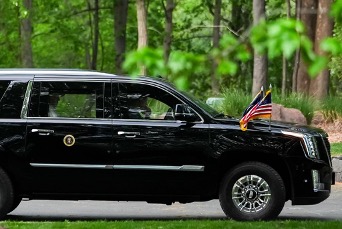
Fancy Presidential steel on wheels. Credit South China Morning Post.
This imposing vehicle, along with numerous others used in Trump’s Beijing motorcade, arrived ahead of Air Force One via a fleet of C-17 transport planes.
The convoy included armored personnel carriers for security teams, backup medical vehicles, communication vans, the mobile kitchen mentioned earlier, and trucks stocked with presidential supplies like food, water, Diet Coke, and ice.
Additionally, the U.S. imported its own gasoline and diesel for these vehicles. The logic was simple: the president can’t risk a mechanical failure while traveling, which would definitely be an unwelcome disruption to his ‘opera night.’
Exit, Stage Right
Finally, the conclusion of Trump’s state visit brought a dramatic, if not startling, ending. Many would call it a shocking way for Trump and his team to leave the spotlight.
In line with White House orders, every U.S. official, delegate, staff, and reporter boarding Air Force One was publicly instructed to dispose of ALL Chinese items before boarding. The Secret Service and U.S. Air Force arranged a dumpster clearly labeled “Airport Waste” for this very purpose.
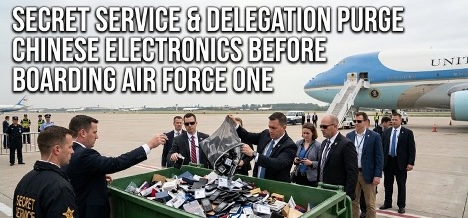
American officials and Air Force One passengers dump out all Chinese items. Credit New York Post.
Every last Chinese souvenir, badge, lapel pin, gift, and burner phone used during the visit was thrown into trash cans beside the American aircraft. No exceptions. Security procedures were airtight.
No Chinese items were allowed on the presidential jet—not one. Photos even showed President Trump discarding Chinese items himself.
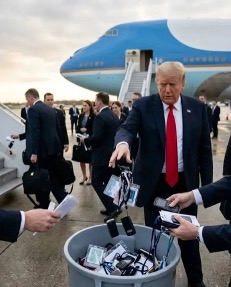
Nice visit, eh? Trump tosses his Chinese stuff. Credit Times of India.
This act was, in its way, a sharp geopolitical statement from the Trump administration—a direct affront to the Chinese Communist hosts.
According to mostly foreign press reports (as U.S. media largely omitted this dramatic episode), the Chinese officials’ shocked expressions said it all. China invests heavily and carefully selects every gift presented to visiting leaders. Returning or trashing those gifts is a clear affront.
Symbolically, the Trump team made it clear no items from Beijing would travel back to the U.S., reflecting the overall tone and outcome of the visit.
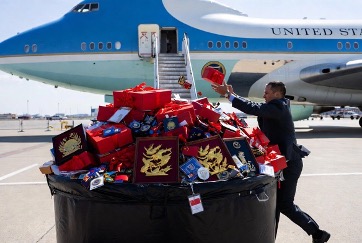
Thank you, but no thank you. Chinese gifts in trash. Credit Times of India.
This discarding was far beyond a security measure. The visuals were like a laser piercing through Chinese surveillance drones above the seas. Chinese officials who had prepared meticulously witnessed their efforts discarded on the runway. Meanwhile, Trump boarded his plane and departed without a glance backward.
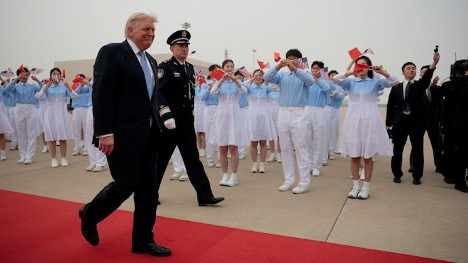
President Trump walks towards Air Force One at Beijing Capital International Airport. Credit White House Press Office.
As this Peking Opera drew to a close, Trump departed for home, played golf the following day, and reportedly focused on military options against Iran.
I hope you found this behind-the-scenes glimpse illuminating… That’s all for now.
Thank you for subscribing and reading.
About the Author