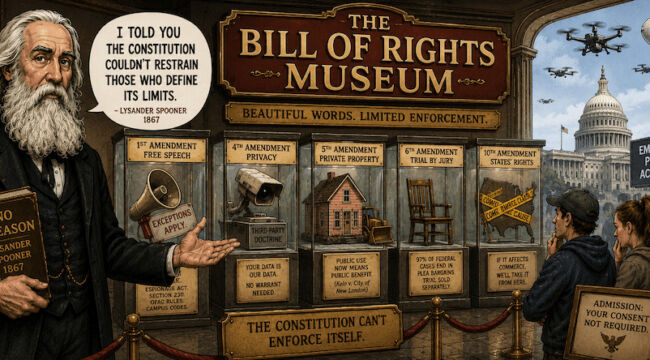
The Bill of Rights Museum
Lysander Spooner clearly stated in 1867 that the Constitution holds no power over those who have not consented to it.
At that moment, many viewed his claim as controversial. Yet, over 150 years later, the facts seem to support his view.
The Constitution, originally meant to restrict government authority, has instead become an instrument that legitimizes almost any action favored by the political elite. Although the Bill of Rights remains in print, its enforcement is lackluster. The disparity between the Constitution’s promises and Washington’s practices has grown so vast that Spooner’s question becomes unavoidable: Has the Constitution ever truly governed?
Let’s examine the evidence.
The First Amendment: Free Speech, With Limitations
The language is crystal clear: “Congress shall make no law abridging the freedom of speech.” It does not say “limited law” or “reasonable law.” It simply states no law.
Instead, there is the Espionage Act of 1917, used to charge journalists and whistleblowers. The federal government pressures private platforms via Section 230 to remove content it deems “misinformation.” The Treasury Department’s OFAC sanctions ban publishing certain information about designated persons. Campus speech codes persist under federal funding requirements.
None of these actions explicitly violate the First Amendment. They never do. The modern state’s strategy is to maintain the amendment while surrounding it with restrictions under different names.
In No Treason, Spooner maintained that constitutional protections rely entirely on the willingness to enforce them. When those tasked with enforcing become the offenders, the document loses its significance.
The Fourth Amendment: The Right to Privacy, Mostly Lost
The Fourth Amendment states, “The right of the people to be secure in their persons, houses, papers, and effects, against unreasonable searches and seizures, shall not be violated.”
But the third-party doctrine undermined this. In 1979’s Smith v. Maryland, the court ruled that information voluntarily shared with a third party—like a phone company, bank, or internet provider—lacks Fourth Amendment protection. Therefore, the government may access it without a warrant.
Back then, it meant phone records. In 2025, it includes location tracking, banking details, search histories, and messaging. Since all this data resides with third parties, it becomes accessible with proper legal papers, circumventing the warrant requirement that the Fourth Amendment explicitly mandates.
When Edward Snowden revealed the NSA’s bulk collection program in 2013, it showed that virtually every American’s phone records were surveilled. The FISA court approved this practice based on the legal reasoning that since telecoms held the data, no Fourth Amendment violation occurred.
The Founders created the Fourth Amendment to stop the British practice of “general warrants”—indiscriminate searches through colonists’ belongings. The NSA’s program functioned as a general warrant on a national scale, permanently active. Despite this being precisely what the Constitution forbids, the government proceeded, obtained secret court approval, and kept it classified for years.
Spooner’s philosophy addresses this clearly: unjust laws have no true authority—laws that violate natural rights cannot demand obedience. The FISA court legalized the surveillance, but legality does not equate to constitutionality.
The Fifth Amendment: The Decline of “Public Use” in Property Rights
“Nor shall private property be taken for public use, without just compensation.”
These two conditions—public use and just compensation—were expressly chosen because of the government’s tendency to twist vague wording.
For much of U.S. history, “public use” referred to infrastructure like roads and military bases—assets genuinely for public benefit.
But in 2005’s Kelo v. City of New London, the Supreme Court ruled that the government can seize homes to transfer them to private developers if the project might spur economic growth. The supposed public benefit was merely speculative. Susette Kelo’s pink house was demolished, though the project never materialized.
The Fifth Amendment demanded “public use”; the Court swapped it with “public benefit.” This subtle change effectively nullified property protections, permitting any government entity to take land by claiming potential economic gains with the help of private developers.
Spooner foresaw this. His critique of legal monopolies—that governments shift wealth from individuals to favored private interests under legal pretexts—is precisely what Kelo enshrined.
The Sixth Amendment: The Disappearance of the Right to Trial
The Sixth Amendment guarantees, “In all criminal prosecutions, the accused shall enjoy the right to a speedy and public trial, by an impartial jury.”
It declares this right applies to all prosecutions, not just some.
Today, about 97% of federal convictions come via plea bargains. No trial, no impartial jury, no public hearings. Defendants are pressured to accept lesser charges or risk trial and potentially decades in prison due to mandatory minimum sentences. Most opt for the plea.
For the majority, exercising the constitutional right to a trial has become prohibitively costly. Since the 1980s, mandatory minimum sentencing laws have transformed this right into a trap—one can either face harsh punishment if insisting on trial or accept a plea to shorten time incarcerated.
In An Essay on the Trial by Jury, Spooner emphasized that juries serve as the final defense against prosecutorial and legislative overreach. Without a jury, governments can impose any law unchecked by the citizens.
The Tenth Amendment: Defunct in Practice
The Tenth Amendment declares, “The powers not delegated to the United States by the Constitution, nor prohibited by it to the States, are reserved to the States respectively, or to the people.”
This should have been a clear boundary. The federal government possesses only specific powers granted by the Constitution; everything else belongs to states or individuals.
However, the Commerce Clause rendered this ineffective. Starting in the New Deal era, the Supreme Court expanded Congress’s authority to regulate almost any economic activity, arguing such activities affect interstate commerce. In Wickard v. Filburn (1942), a farmer growing wheat for personal use was said to impact commerce because his self-sufficiency reduced market purchases—an absurd interpretation.
As a result, the Tenth Amendment has become an unenforced set of words. Today, federal oversight extends into education, healthcare, housing, farming, policing, and even school restroom policies—all justified through Commerce Clause reasoning. This was never what the Founders intended.
Spooner’s stance on this echoes his usual challenge: point to where the people themselves consented—not their elected officials, nor their ancestors, but the individuals presently governed.
The Common Thread
Spooner’s key observation was that the Constitution cannot enforce its own provisions.
Every guarantee has been systematically hollowed by redefining terms, constructing legal doctrines that appear consistent with the text but strip away substance, all ratified by sympathetic courts.
Free speech is limited to “except in these categories,” like hate speech (a vague concept).
Searches become reasonable if a third party holds the data.
“Public use” transforms into “public benefit.”
The right to trial becomes a right that no rational person would want to claim.
The Constitution remains present and often cited—usually by those advocating increased government authority—to justify expansions of power, not constrain them.
Exactly as Spooner predicted.
He argued in No Treason that any constitution interpreted, enforced, and adjudicated by the government itself cannot truly limit it. The fox guarding the henhouse is built into the design. Those benefiting from power ultimately define its limits.
While anarcho-capitalists have embraced Lysander Spooner, he was not promoting anarchic peace or chaos. His goal was transparency. If the Constitution fails to bind those in power, it’s time to stop pretending it does and begin discussing what genuine limits on authority would look like—and who could enforce them.
Wrap Up
The Fifth Amendment was intended to protect property but falls short. The dollar is declared legal tender by federal law, controlled by the Federal Reserve, an institution not mentioned in the Constitution nor authorized by the Founders. The Fed operates in a constitutional gray area like many modern entities, justified by Commerce Clause logic and effectively beyond anticipated constitutional constraints.
Spooner offered this approach: First, cease treating the Constitution as a living guarantee. Next, regard it as a historical record revealing the promises made and broken by the government. Lastly, respond based on this understanding.
The Bill of Rights remains essential reading—it reveals what has been taken from you.
About the Author