
Gold Surges as the Debt Reckoning Begins
Gold enthusiasts had a strong showing today.
By midday, gold climbed 4% to reach $4,266/oz, while silver increased by 4.3% to $63/oz.
The GDX gold miner ETF gained 6.99%, with the SILJ junior silver miner ETF rising 6.2%.
Let’s briefly review the GDX chart over the past year.
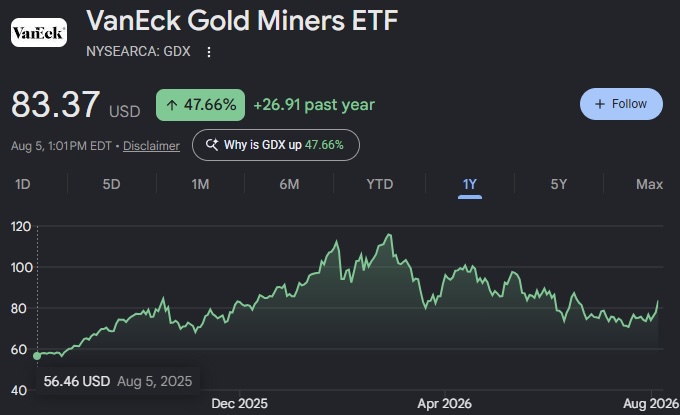
The ETF remains 47% higher than a year ago, which is solid. However, gold miners saw gains exceeding 100% in early January.
My expectation is that new all-time highs will be reached within several years—possibly even before the year ends.
Despite distractions like the Iran war and AI buzz, the global debt crisis remains an unresolved threat.
Numerous bailouts are inevitably on the way.
Catalysts
Mainstream financial media link precious metals gains to potential peace with Iran, suggesting it could keep interest rates low.
Pffffft.
In reality, these moves are tied more closely to debt pressures, the U.S. dollar, Japan’s economic issues, and the impact of the Iran conflict.
Let’s begin with the situation in Japan, which we discussed yesterday. Japan urgently needs liquidity to stabilize its rapidly declining currency.
They want to offload some of their holdings of U.S. treasuries, valued at over $1.1 trillion, but doing so risks angering the U.S.
If Japan were to dump those treasuries, it would push prices down and yields upward, creating friction with Uncle Sam.
Effectively, the U.S. is lending freshly created dollars back to Japan and using domestic resources to prop up the yen.
The Financial Times’ Barry Eichengreen highlighted these dynamics in a widely read piece titled The real message in the yen intervention. A section reads:
Both moves are an indication that the dollar’s status as a reserve currency is not what it used to be. Central banks are accustomed to holding foreign reserves in dollars because markets in US Treasury securities are liquid. Central banks hold US Treasuries because they can be freely bought and sold and used in interventions. But not now, at least not in unlimited quantities. Instead, we see the US Treasury stepping in with euro sales as part of its contribution to the intervention, thus limiting the volume of dollar sales needed by the Japanese authorities.
…The bottom line is that Washington, fearing the consequences for US financial markets, is reluctant to see foreign central banks use their dollar reserves. This is telling us that the dollar is not the attractive reserve currency it once was. When this message sinks in, other countries will redouble their search for more attractive, readily usable alternatives. Reserve diversification is apt to gather steam.
If this seems complicated, you’re not alone. While these topics can be dry, understanding them is crucial.
The core takeaway is that nations worldwide are reassessing their dollar reserve levels.
South Korea Goes for Gold
As Barry Eichengreen noted in the FT article, “When this message sinks in, other countries will redouble their search for more attractive, readily usable alternatives.”
This shift is already underway. South Korea’s central bank recently revealed its purchase of gold for the first time in 13 years.
Jeong Hee-sup, who manages the Reserve Management Group at the Bank of Korea, spoke candidly about gold’s appeal.
“With geopolitical risks becoming a persistent feature of the global environment, interest in gold as a safe-haven asset has grown significantly among central banks.
Given gold’s role as an inflation hedge and its potential as an alternative to the U.S. dollar, it’s evident that gold should be considered one of the viable assets from a medium- to long-term perspective.”
Notice what this reveals: a high-ranking central banker from an allied nation openly recognizes gold as “an alternative to the U.S. dollar” and a “viable asset.”
Globally, central banks are recalling gold’s historic monetary prominence. It’s free from political interference, counterparty risks, confiscation, and requires no permission to trade.
Gold remains stored securely, appreciates over time, and proves indispensable during financial turmoil—of which there will likely be many in the coming decade.
A Harsh Reminder
Japan’s recent events starkly remind us that the world still confronts a massive debt crisis.
This crisis won’t vanish even if the Iran war were to end tomorrow (which it won’t).
In the years ahead, vast quantities of dollars will be printed in efforts to stave off severe financial downturns. This only postpones reckoning, but the money printing will continue regardless.
Jim Rickards calls gold “the everything hedge,” perfectly capturing its role.
Personally, I consider gold, silver, and mining stocks as protection against economic chaos—which is sure to be plentiful.
For this reason, I maintain roughly an 18% allocation to these assets. If you haven’t invested yet, now presents a good opportunity to buy. As longtime readers know, I especially favor silver, which carries greater risk but also potentially higher returns than gold.
Precious metals should be an essential part of any modern portfolio, though the majority remain significantly underinvested in this sector.
This is likely to change once a major financial crisis arrives.
About the Author