The past year has seen significant shifts in U.S. trade policy, highlighted by broad new tariffs and a Supreme Court ruling that further altered the tariff framework. Many companies experienced sharp cost increases and faced tough choices about whether to absorb tariffs by reducing profit margins, raise prices to offset the higher expenses, or adopt a mix of both strategies. Our research last year found that most businesses had passed at least a portion of these costs onto consumers through higher prices. Now, more than a year later, do firms consider their price adjustments complete, or are more tariff-related price hikes on the horizon? According to our latest regional business surveys, nearly half of firms that have borne tariffs still anticipate raising prices further, with some projecting increases extending six months or longer into the future.
Many Businesses Continue to Plan Price Increases to Offset Tariffs
Tariffs function as taxes on imported goods, which can elevate the costs of inputs used in producing domestic products and services. Recent studies indicate that approximately 90 percent of the economic burden from tariffs falls on U.S. businesses and consumers. Two-thirds of service providers and nearly all manufacturing respondents reported importing at least some inputs. Among these importers, 40 percent of service firms and 70 percent of manufacturers stated they had directly paid tariffs within the past year, while others encountered higher input costs passed down by suppliers who paid tariffs and raised prices accordingly.
The chart below illustrates how businesses that directly paid tariffs have responded in terms of adjusting prices. A small fraction of these companies—3 percent of service firms and 8 percent of manufacturers—reported tariffs had a negligible effect on costs, represented by the dark blue bars at the chart’s bottom. About 30 percent of service providers and 20 percent of manufacturers said they have already passed the full burden of tariffs onto customers through price increases, meaning no further price adjustments are needed. Another 20 percent of service firms and 30 percent of manufacturers indicated they do not expect to raise prices further despite already bearing tariffs. Together, these groups, shown in various shades of blue and comprising slightly over half of tariff-paying businesses, conveyed they do not intend additional price hikes to recover tariff expenses.
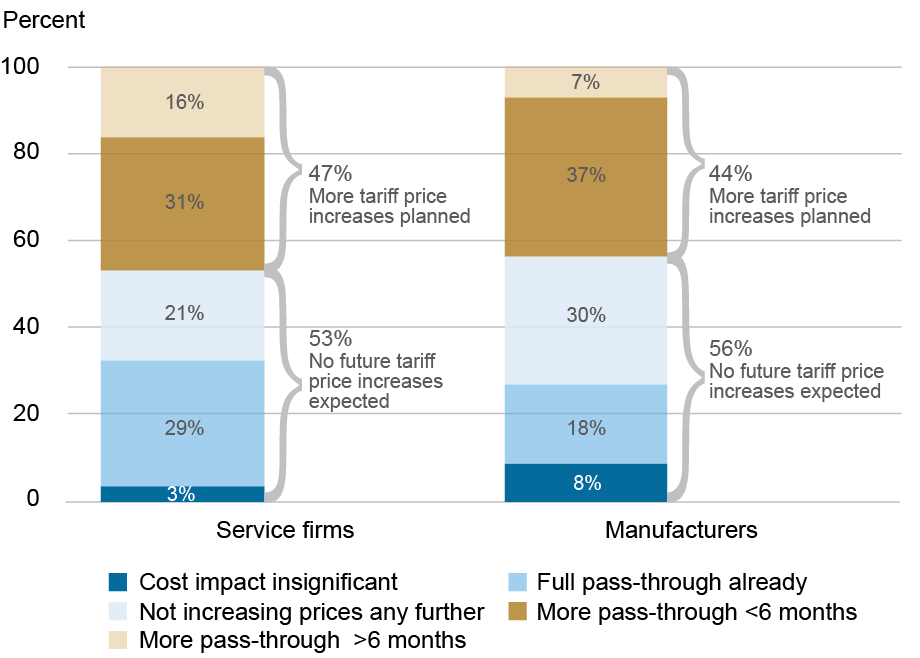
Note: Figures represent the shares of businesses that directly paid tariffs over the last twelve months.
This means that 47 percent of service firms and 44 percent of manufacturers who have paid tariffs expect to implement more tariff-related price hikes—depicted by the gold-shaded bars in the chart. Among these tariff-paying service providers, around 30 percent anticipate raising prices within the next six months, compared with nearly 40 percent of manufacturers. Additionally, 16 percent of service firms and 7 percent of manufacturers foresee tariff-driven increases stretching beyond six months from now.
These findings suggest price adjustments are still underway well beyond a year after tariffs first took effect. It remains unclear whether companies are reacting to a single tariff phase or the ongoing series of tariff changes introduced incrementally over the past year or so. The evidence points toward a gradual price adaptation process, consistent with a growing body of analysis showing that tariffs are incorporated into consumer prices over several months rather than immediately all at once.
Reasons Behind Extended Plans for Price Hikes
From our survey responses, businesses identified two main factors driving their intentions to raise prices far into the future.
Firstly, some firms are bound by contracts with fixed prices which prohibit immediate price increases until contracts expire, compelling them to absorb tariff-related cost increases temporarily. Indeed, academic research supports that long-term contracts can delay cost pass-through.
Secondly, several businesses reported employing a “trickle up” pricing method whereby they raise prices incrementally instead of applying full tariff costs upfront. This approach helps avoid startling customers with sudden price surges while preserving the option to accelerate price hikes if input costs continue rising. Additionally, uncertainty about future tariff rules—including possible rate modifications, exemptions, or retaliatory tariffs by other countries—may encourage firms to adopt cautious, phased price adjustments rather than large, discrete steps. This cautious pricing behavior extends the timeline over which tariff-driven cost pressures influence the broader economy.
Tariff-Related Pricing Pressures Could Persist
Though economists and policymakers often expect tariff-induced price rises to lead to a singular price-level shift, the reality of “one-time” adjustments may unfold gradually, especially in a dynamic tariff environment. Our business surveys indicate that many companies are dispersing tariff-related price increases across multiple periods, suggesting that inflationary effects tied to tariffs could remain for an extended duration.
Original article: libertystreeteconomics.newyorkfed.org
About the Author