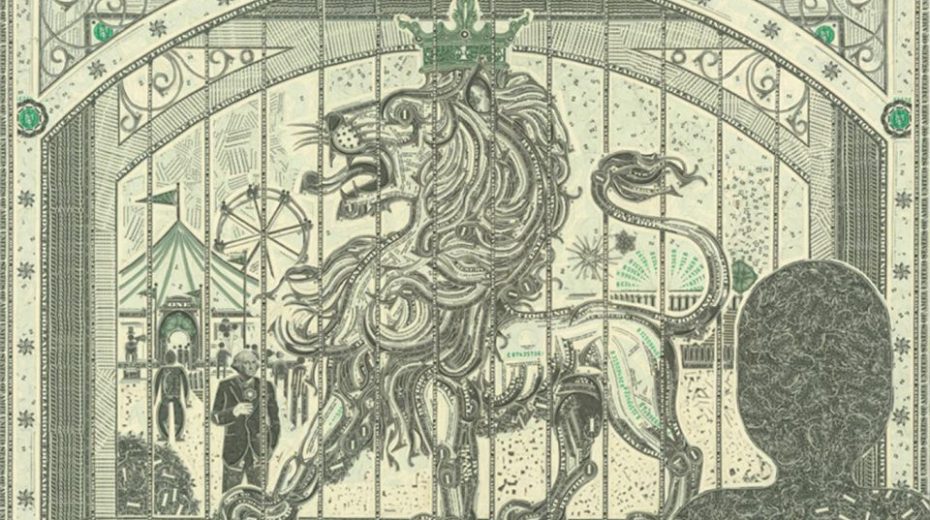
The dollar might seem like a neutral currency, but in reality, it serves as a tool of imperial influence, controlling economies, funding conflicts, and compelling the Global South to finance its own subjugation.
Dear friends,
Greetings from the desk of Tricontinental: Institute for Social Research.
There are periods in history when an established system appears so entrenched that its demise is difficult to envision. When Britannia “ruled the waves,” many believed sterling was more than just money—it was the universal language of trade. Since the mid-1900s, a similar view has been held about the US dollar. In 1980, amidst the turmoil following the collapse of Bretton Woods, Argentine economist Raúl Prebisch pointed out that “in the United States the illusion of the almighty dollar held sway.” Nonetheless, this illusion soon extended beyond the US itself, as the dollar emerged as the leading global reserve currency and the predominant means of international trade. Today, however, that illusion is gradually unraveling, albeit unevenly.
Our newest dossier, The Architecture of Power: The Dollar, Financialisation, and the Struggle for Sovereignty, reveals that the dollar acts not only as currency but as an imperialist institution. It shapes global trade, controls credit access, disciplines national governments, funds wars, and perpetuates the hierarchy between the Global North and Global South. The conversation surrounding the dollar transcends preferences for currencies like the renminbi (RMB) or the euro; it ultimately hinges on whether humanity can forge an international monetary system that promotes development instead of domination.
In recent years, responses to this question have often been rushed. Every bilateral deal conducted in RMB rather than dollars, each BRICS+ announcement about local currency exchanges, and every rise in central bank gold reserves has sparked claims that de-dollarisation is underway. While these headlines are compelling, the reality is far more complex. A key strength of our dossier is its insistence on not conflating political aspirations with economic facts.
Simultaneously, a fundamental shift has occurred. The United States has steadily transformed the dollar from a neutral trade medium into a political weapon. Financial sanctions, the freezing of nations’ reserves, exclusion from global payment systems, and the weaponisation of finance have alerted many Global South governments to the growing political hazards of relying on the dollar. When nearly half of Russia’s foreign currency reserves were seized, many finance officials worldwide quietly pondered a previously unthinkable question: if this can happen to Russia, why not to us? Once portrayed as apolitical, the dollar has now revealed itself as deeply entwined with US strategic goals.
The dollar remains dominant not because the US produces the majority of global goods (it does not) or controls most international trade (it does not). Its strength stems from the international financial architecture built around it, reinforced by long-established market networks. Reserve currencies serve many roles beyond just exchange: they are stores of value, units of account, settlement tools, and backbones for immense financial markets. Governments hold dollars because others do so; banks lend in dollars precisely because borrowers expect to repay in dollars. Our dossier carefully shows that despite America’s declining economic weight, the dollar still predominates in commodity pricing, foreign exchange transactions, reserve holdings, and trade finance. This tension—between the US’s shrinking share of production and the dollar’s continued centrality—injects urgency into the de-dollarisation debate.
Although much of today’s industrial growth occurs in Asia rather than the North Atlantic, the financial sector remains anchored in Wall Street. Production and finance operate from different geographies, a divergence that won’t resolve itself automatically. For example, the opening of a gold vault in Hong Kong reflects rapid growth in bullion trading and storage in Asia, but such changes alone won’t craft a new global monetary system. Britain continued as the financial hub long after its industrial dominance faded. Similarly, the US still enjoys “exorbitant privilege” via the dollar’s global role despite its manufacturing share having steeply declined. The central issue is not whether the dollar system is waning (it is), but what can feasibly replace it.
Still, moving beyond the dollar doesn’t depend merely on economic changes but also on building new institutions. In his recent paper Geopolitics and International Money – A Path to a New Reserve Currency, Paulo Nogueira Batista, Jr., former IMF executive director and ex-vice president of the New Development Bank, explores what institutional framework would be necessary to construct an alternative monetary system. He contends that the RMB is unlikely to replace the dollar outright, nor would such a shift be desirable. China’s government resists this because it would require significant capital account liberalisation, exposing China to destabilising financial flows, pushing up the RMB’s value, making exports costlier, and endangering the productive strengths that underpinned China’s rise. Chinese economist Yu Yongding has offered important proposals to broaden RMB’s international use, including within BRICS+ initiatives addressing de-dollarisation, but none advocate replacing US monetary hegemony with Chinese dominance.
Over the past decade, local and international currency settlement systems have grown quickly. These include Russia’s Financial Messaging System (SPFS) created in 2014; China’s Cross-Border Interbank Payment System (CIPS) launched in 2015; local currency arrangements among Indonesia, Malaysia, and Thailand from 2018; reciprocal central bank agreements for currency access during crises; as well as specialized accounts like Gazprombank’s K accounts that circumvent dollar-based payment routes. While these tools have yet to supplant the dollar network, they represent components from which a new financial system might eventually arise.
Nogueira Batista proposes an ambitious vision for a collectively developed new reserve asset created by a coalition of Global South nations, supported by a new international institution, and intended solely for international settlement and reserves rather than domestic use. This currency would not replace national currencies but serve as a shared reserve tool to reduce reliance on the dollar. As our dossier emphasizes, the value of creating alternatives lies not in immediate replacement, but in building resilient systems that can assist humanity’s liberation.
Yet institutional reform alone does not address the core challenge. The dollar-centric order’s weakening uncovers a broader issue than just the design of a reserve currency or payment system. The post-WWII global financial institutions were constructed around preserving wealth, rewarding speculation, and restricting industrial development in much of the formerly colonized world. Thus, a new monetary order should be judged not only on exchange rate stability but on its ability to finance structural change, technological progress, food sovereignty, ecological transition, and decent jobs. Elements like capital controls, development banks, payment systems, and reserve instruments must support the expansion of productive capacity rather than the accumulation of financial claims. In this light, the successor to the dollar regime cannot merely replace one international currency with another but must integrate finance into a broader developmental framework that promotes shared prosperity, sovereign growth, and a reduction of global inequality.
Money influences nearly all aspects of modern life, given how much has been commodified and subjected to capitalist market disciplines. Water is packaged for sale and air controlled, while barter remains a nostalgic relic at the margins of economic transactions. Above us hangs the dollar, backed by the United States’ vast military might and political resolve to defend its currency through force if needed. When Washington Irving coined the phrase “the almighty dollar” in “The Creole Village” (1837), it was ahead of its time. Today, this concept feels almost self-evident. The resource-rich nations of the Global South send wealth away in dollars only to be returned shackled by debt, while money centres such as London and New York sparkle atop the world’s social wealth.
However, as our dossier reveals, occasional tremors shake the dollar’s dominance. We aim not to overstate the pace of de-dollarisation but to clarify how the dollar system continues to function, where it has weakened, and why it remains fundamentally intact.
Warmly,
Vijay
Original article: thetricontinental.org
About the Author