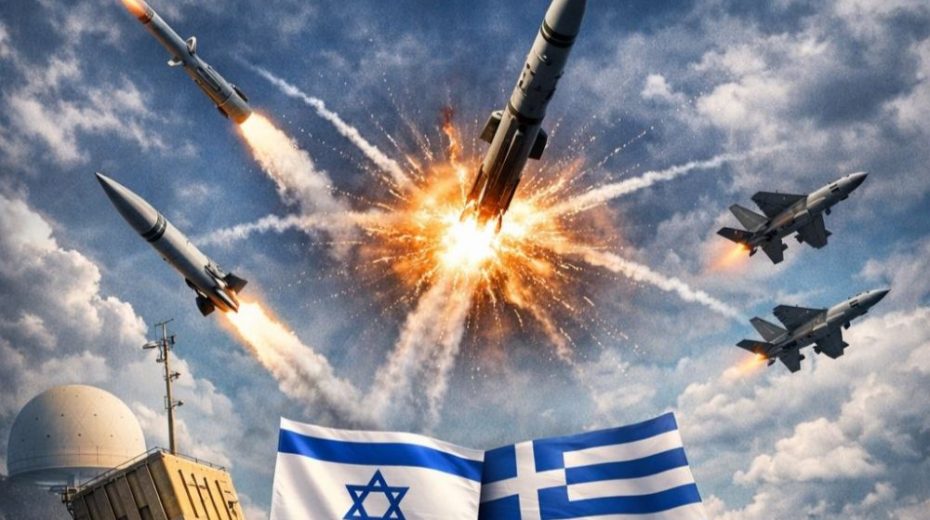
The Greek government has revived interest in the Shield of Achilles. Yet, unlike the myth where Hephaestus, the god of metallurgy, crafts the shield, this iteration will be developed by Israel.
Christopher Nolan’s much-anticipated The Odyssey has become a global conversation starter since hitting theaters, standing out for multiple distinct reasons.
The epic poem inspiring the film, The Odyssey, tells of King Odysseus of Ithaca carrying the famed shield of the semi-divine warrior Achilles, inherited after his death throughout Odysseus’s decade-long journey home from the Trojan War. Additionally, The Odyssey recounts Odysseus meeting the shade of Ajax in Hades, where they discuss weapons that caused contention between them.
The Shield of Achilles, elaborately described in Homer’s Iliad, is a legendary artifact crafted by Hephaestus at Thetis’s request. Achilles wielded this shield against Hector, renowned for the intricate cosmic imagery engraved on it.
As contemporary discussions revisit these ancient tales through Nolan’s film, Greece—the birthplace of these myths—has brought the iconic shield into modern times. This time, however, its creation bypasses Hephaestus and will instead be realized by Israel.
The Greek Council for Foreign Affairs and Defense (KYSEA) has sanctioned a significant defense package valued at $4.89 billion, marking a pivotal advancement in Greece’s military modernization efforts.
This initiative includes the deployment of an integrated air defense system named “Achilles’ Shield,” alongside enhancements in surveillance, transport aircraft, unmanned aerial vehicles, and upgrades for both the Greek Navy and Army.
What does Achilles’ Shield entail?
Achilles’ Shield represents a sophisticated, multi-tiered air defense platform incorporating artificial intelligence to unify data from diverse sensors and weapon systems within a cohesive command and control (C2) network. This setup enables commanders to identify, prioritize, and counter threats instantly.
The system’s capabilities include battlefield data analysis, target ranking by urgency, and suggestions for tactical responses.
Traditional air defense mechanisms typically rely on radar detection followed by missile engagement.
In contrast, Achilles’ Shield uses AI-driven algorithms to determine the optimal reaction to threats.
The Israeli role encompasses more than just missile sales, representing a comprehensive partnership involving radars, interceptor missiles, command infrastructure, and battle management software.
A key Israeli component within Achilles’ Shield is the Barak MX system, developed by Israel Aerospace Industries (IAI). This comprises radar arrays, command centers, missile launchers, and interceptors.
Another vital element is David’s Sling, produced by Rafael Advanced Defense Systems, which counters ballistic missiles, long-range rockets, and cruise missiles.
Rafael Spyder, a mobile ground air defense system effective at short to medium range—also from Rafael Advanced Defense Systems—is set to defend against drones, low-flying aircraft, and helicopters. Its rapid mobility and deployment make it particularly suitable for protecting islands.
Simply viewing Greece’s acquisitions as typical arms purchases misses the broader picture. This project signifies Greece’s adaptation of Israel’s air defense doctrine tailored to the Aegean and Eastern Mediterranean theaters.
The majority of the funding is directed toward Israel
Of the $4.89 billion budget, roughly $3 billion will fund Achilles’ Shield. Most of these resources will go to Israeli defense firms. Nonetheless, the deal includes a “local participation” clause mandating that at least 25 percent of work be completed by Greek companies, creating about $800 million in business opportunities for Greece.
Greek Defense Minister Nikos Dendias highlighted Achilles’ Shield as a cornerstone of the government’s “Agenda 2030” defense strategy.
This strategy can be encapsulated as transforming defense into a technology-driven, interconnected, and layered system.
Alongside Achilles’ Shield, KYSEA approved additional programs including electronic warfare tools designed to disable hostile drones through non-kinetic means; HERON 1 unmanned aerial vehicles for extended-range intelligence, surveillance, and reconnaissance; Synthetic Aperture Radar (SAR) microsatellites providing weather-independent Earth imagery; an extra 10 V-BAT vertical take-off and landing (VTOL) drones; and new military transport planes.
The Ministry of National Defense is expected to unveil the next program phase in September, which will also present Greece’s strategic defense roadmap for the 2027–2037 decade.
Greece’s goal with these collaborations and its strategic blueprint is not only to be a technology consumer but to emerge as a genuine technology development partner.
For Israel, though, the significance extends beyond financial benefits.
The major advantage for Israel lies in observing how its defense architecture operates within a critical arena—the Aegean and Eastern Mediterranean—regions where Greece and Turkey play key roles.
Put simply, Israel will henceforth observe any potential Greek-related conflict with increased scrutiny and attention.
About the Author