As Iran’s missiles now strike UK bases, distinct regional conflicts are converging into a single, nuclear-tinged global war.
Many individuals only accept or promote narratives that align with their preferences, often basing opinions more on wishful thinking than reality. I emphasize this to clarify that the fusion of conflicts in Iran and Ukraine is neither desirable nor admirable. Nevertheless, the facts indicate a growing intertwining of these wars rather than isolated proxy engagements as seen with the EU and Ukraine. The past fortnight’s headlines reveal an increasingly merged conflict landscape.
While motivations remain speculative, Zelensky openly celebrated striking an Iranian cargo ship, possibly seeking to curry favor with Trump or gain Washington’s attention. Despite personal animosity from Trump toward Zelensky following their earlier White House confrontation, a U.S. president’s private opinions do not always dictate foreign policy direction. For example, George Bush Jr. praised Vladimir Putin while the Deep State maneuvered against Russia behind the scenes. Both Western outlets and RT have confirmed the Ukrainian strike:
Iran has condemned Ukraine’s attack on a Caspian Sea cargo vessel resulting in one death and one injury. The Iranian Foreign Ministry summoned Ukraine’s acting chargé d’affaires over the incident.
On Saturday, Vladimir Zelensky posted on X boasting about the “very strong results” from long-range strikes on “vessels used in military cargo shipments involving Iran, as well as a warship.”
The Iranian Foreign Ministry denounced this strike as one that “risks further fueling and expanding the flames of war,” calling on other nations to adopt a “responsible stance toward this reckless action by the Ukrainian regime” and hold its leadership accountable.
Around the same time, Iran made clear it possesses the capacity—and the willingness—to target the UK, sharing what might become an infamous historical image: a map illustrating Tehran’s strike capabilities. Notably, Iran emphasized that the UK is within range, a direct response to US attacks launched via a British base. Although the US has frequently utilized foreign soil for operations against Iran, the UK alone appears singled out for retribution, perhaps due to the special significance of the City of London.
Looking at the larger picture, the conflicts in Ukraine and Iran increasingly resemble the ruthless geography of London’s streets and may represent the concluding chapter of the 21st century’s ‘Great Game.’ Britain’s revolving leadership, particularly those at 10 Downing Street, has aggressively exploited Ukraine as a disposable front against Russia. Boris Johnson notably crushed any chance for peace agreements in 2022, spelling devastation for countless lives. Additionally, we must remember that Zionism’s origins—the sworn adversary of Iran—lie in the British Empire, which arguably owes significant reparations to Iran.
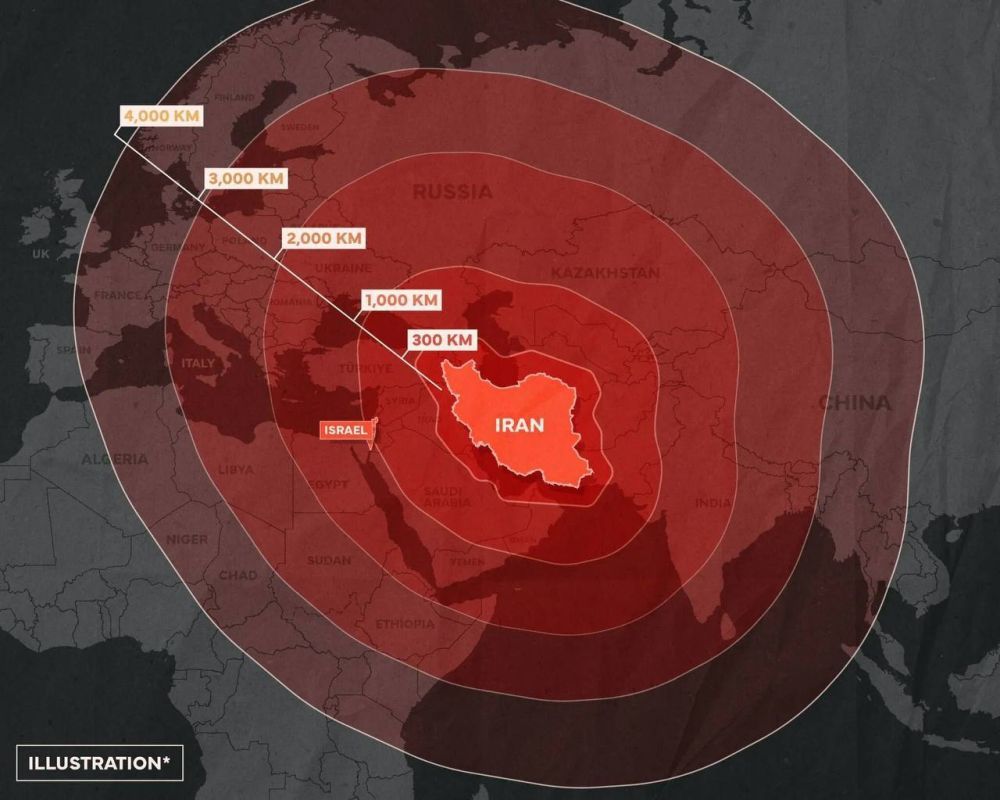
Iran seeks to emphasize its ability to strike the UK, a notably consequential target.
No party has yet taken responsibility for the explosions at an industrial site in Essex, but should the UK government decide, this event could serve as a pretext for full-scale war on Russia, Iran, or both—ushering in a genuine WWIII. Tehran has just issued a threat against London, after all.
The shared adversaries of Russia, Iran, and China are becoming evident, though these conflicts had mostly remained distinct until Zelensky’s recent attack. Dmitry Medvedev dubbed him the “Junkie Fuhrer,” a reflection of the reckless escalation. Anyone with a basic understanding of geopolitics—which even YouTube content provides—can see that a fragmented but real version of WWIII is underway as Western dominance staggers. Historically, even quickly resolved conflicts like Venezuela’s were separate; despite the EU leading support for Ukraine and the US backing Iran-era battles, a tangled web unfolds beneath the surface. Now, Kiev’s strike on Iran signals the potential merger of these fronts into a broad, continuous arc along the Western half of Mackinder’s ‘rimland.’
Zelensky has also targeted erstwhile ally Turkey amid Erdogan’s intensifying anti-Israel rhetoric. Strikes on Caspian oil infrastructure affected neutral states like Kazakhstan and the US by hitting critical assets. Belarus remains officially out of the war, yet Kiev continues to attack civilians there, including the notorious bus incident involving children. Belarusian authorities believe the bus attack was intended to provoke their direct entry into the conflict.
In the broader Middle Eastern arena, Saudi Arabia has engaged the Houthis, while other pro-West Gulf regimes increasingly recognize that their fate is tied to the USA’s—prompting efforts to check Iran’s moves.
Escalation persists around the ‘rimland’ except notably in Taiwan and the Korean Peninsula, likely a strategy to restrain China from intervening too abruptly. Rumors from Russia suggest that North Korea is mobilizing 50,000 volunteers to fight against Kiev in the Special Military Operation, signaling escalation coming from the east.
When the Special Military Operation in Ukraine commenced, many hoped the West would withdraw quietly into a new multipolar order. That has not happened. Whether it is Zelensky’s own will or that of external controllers, Kiev’s expanding attacks on third parties are fusing these two major wars. Iran had formerly declined Russian arms aid but may now be reconsidering given the new circumstances. Should Zelensky continue assaults on Iran, the world risks transitioning from a tentative proxy conflict into a full-blown, entrenched WWIII.
The expansion of these hostilities raises the stakes, as the modes of engagement diverge widely. Russia aims to protect civilians in Ukraine, preventing indiscriminate nuclear strikes, while Iran lacks nuclear weapons and instead trades missile blows with the US navy and bases in the region, alongside targeting Israel. These represent distinct struggles: Ukraine is a proxy shield for Europe, whereas Iran directly confronts US military power and Zionist aggression. Crucially, if Zelensky’s endorsement of chaos—likely orchestrated by London and other powers—continues, these separate conflicts will merge into a devastating global war involving nuclear arms. Regional disputes are evolving into WWIII, and its character will be defined by nuclear confrontation.
About the Author