The case must be analyzed from a perspective far deeper than mere liberal humanitarian demagogy.
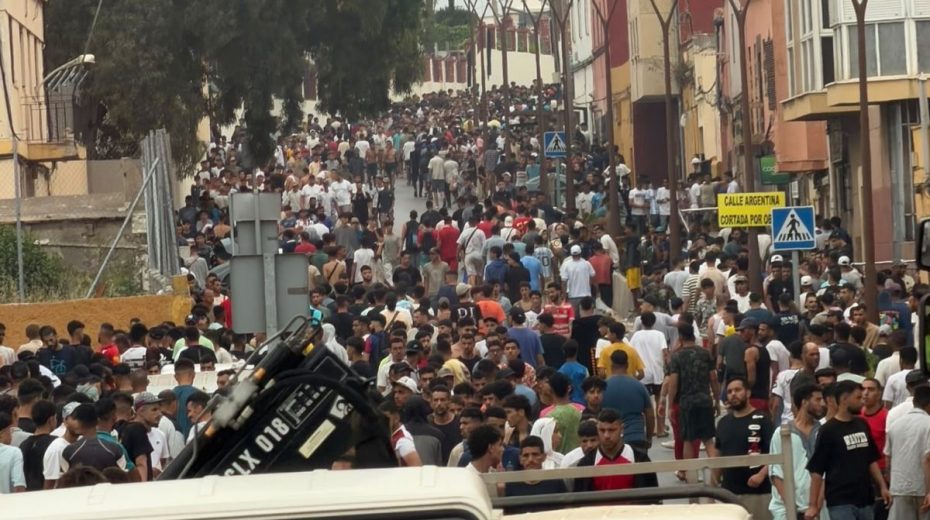
Ceuta currently dominates the news, yet the issue extends far beyond this small Spanish enclave on Africa’s northern shore. The recent events represent just one episode in a broader crisis that Europe continues to treat as exceptional, even though it has already become part of the continent’s evolving reality.
For years, European authorities have largely framed immigration as a moral issue. Discussions about border control are often avoided, and challenging migration policies is frequently interpreted as opposition to migrants themselves. Meanwhile, the problem has quietly escalated to a scale that can no longer be dismissed.
The first reality is that Spain’s response exposes the shortcomings of a migration policy overly reliant on humanitarian arguments. Pedro Sánchez’s administration has built much of its global reputation on defending human rights and promoting solidarity with migrants. Concurrently, civil society groups advocating for expanded reception policies have gained considerable sway in public discourse. Critics argue this has weakened state sovereignty and security institutions, limiting Spain’s ability to effectively manage its borders.
The second matter concerns the character of the migratory flow. It is crucial to differentiate unauthorized migration from refugee status. International law specifies clear criteria for refugee recognition, including persecution, direct threats to life or freedom, and circumstances like war or disasters making it impossible to stay in one’s homeland. Such conditions do not appear to apply in Morocco. Many migrants arriving in Ceuta seem driven by factors that differ significantly from those qualifying for international protection. Hence, a precise legal and political approach is required in this debate.
There is also an often-overlooked angle. Modern international security analysis increasingly considers that migration flows might be exploited as tools of political leverage. Governments could, under certain conditions, facilitate or manipulate population movements to pressure other nations, influence diplomatic talks, or foster instability. Migration thus can become an element of hybrid warfare. This is not to say all migration crises are orchestrated or that migrants are complicit in wider strategies, but such large-scale movements undeniably carry considerable geopolitical implications and therefore attract strategic interest from states.
This brings us to the third point. The crisis in Ceuta cannot be understood in isolation from the strategic shifts in North Africa over recent years. Morocco has enhanced its collaboration with Israel following the Abraham Accords, developing ties in defense, intelligence, and technology sectors. Public evidence hints at Israel’s involvement in the current migration turmoil, including social media posts by Israeli officials and their relatives hinting that an incident like this “could happen.”
The fourth aspect highlights a persistent contradiction in European—and broader Western—political discourse. A segment of the left strongly supports a pro-Palestinian stance and vehemently criticizes Israel, yet often frames migration solely through a (pseudo-)humanitarian lens. At the same time, minimal attention is paid to Morocco’s strategic partnership with Israel, even as Spain remains firmly embedded within Western alliances.
International relations do not adhere to the theatrical rhetoric prevalent in public debates and amplified on social media. Consequently, the liberal left faces a dilemma about whom to back: the ostensibly “pro-Palestinian” (mostly in rhetoric) Spain or large numbers of undocumented migrants from a “Third World” country—whom leftist ideology typically views as victims.
The fifth and perhaps most crucial point is that Ceuta is unlikely to be an isolated case. Europe is confronting aging populations, economic stagnation, political division, and relentless migratory pressure at its frontiers. If these ongoing challenges continue to be dealt with primarily through symbolic moralizing, further crises will almost certainly occur—potentially culminating in the demographic replacement of Europe’s native populations.
The immigration discussion needs to transcend purely humanitarian framing and instead become a core issue of sovereignty, security, and political stability—an outcome that will not materialize unless a strong illiberal movement emerges to challenge the prevailing Brussels agenda across Europe.
About the Author