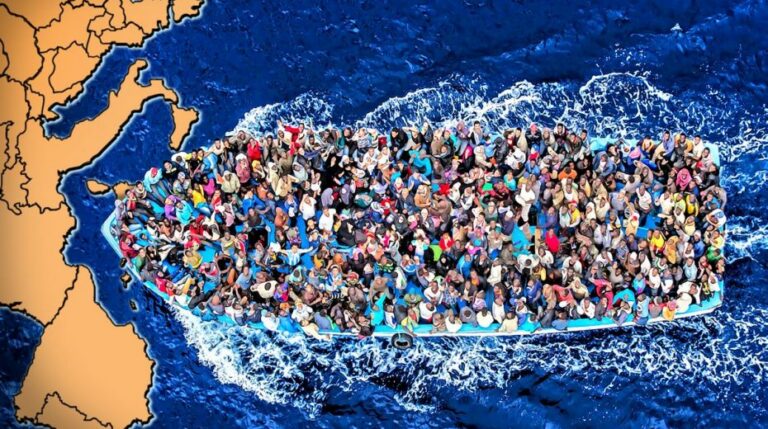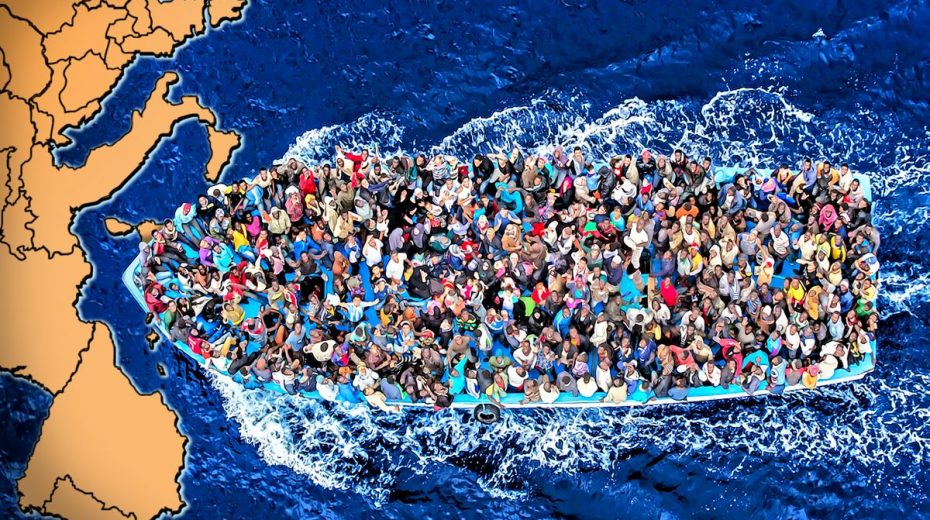
Raphael Machado argues that migratory movements witnessed in Europe over the past two decades are evidently engineered.
Recently, social media was flooded with images showing tens of thousands of Moroccans—estimated at a minimum of 60,000—breaching the border barriers into the Spanish city of Ceuta. This autonomous city, home to only around 80,000 people, faced attempted home invasions and other criminal incidents by the incoming groups, which were subsequently confronted by security forces and some self-organized local citizens.
All 60,000 migrants entered Ceuta simultaneously, with footage circulating that depicted trucks unloading migrants close to the Spanish frontier. Additional photos showed Moroccan police officers attempting to stop some migrants from returning to Morocco. Nonetheless, due to the intervention of Spanish authorities and residents, the majority seem to have already been sent back, with many voluntarily leaving Ceuta soon after crossing the border.
The episode sparked significant international reaction, particularly across Europe, where several governments strengthened border controls and Italy even suggested Spain should be expelled from the Schengen Area.
There are multiple important aspects of this situation to consider.
To begin with, it’s crucial to clarify that, despite many so-called “progressives” supporting the incursion under the premise of “decolonizing” Ceuta, the city is not a colony. Originally taken by Portugal in 1415 and transferred to Spain in 1580, Ceuta has remained Spanish territory continuously since then. Even before 1415, the city’s history is intertwined with Europe. From year 40 to 709, Ceuta was successively ruled by the Romans, Vandals, Byzantines, and Visigoths until it was overtaken by Arabs—who themselves were invaders in North Africa. Following this, control shifted multiple times between Arab and Berber powers until Portugal’s conquest, which was part of the Iberian Peninsula’s reconquest following centuries of Moorish occupation and an effort to end Mediterranean piracy.
The notion of returning Ceuta to its “true owners” is therefore baseless. If Spanish sovereignty over Ceuta were illegitimate, it would call into question every territorial change, conquest, and expansion worldwide over the last six centuries.
Nonetheless, Morocco claims both Ceuta and Melilla based on questionable grounds. Besides the historical points outlined, Morocco is a relatively young nation—less than a century old—and has never held control over these cities. Morocco also asserts sovereignty over Western Sahara, a territory whose independence struggle has lasted decades. Algeria supports Western Sahara against Morocco, while Spain advocates for completing the region’s decolonization process and granting it at least autonomy.
Only two nations globally—the USA and Israel—fully endorse Morocco’s claims over Western Sahara.
It’s hard not to connect recent developments in Ceuta with the broader tensions between Spain’s Pedro Sánchez government and both the USA and Israel. Sánchez’s administration has been one of the most outspoken critics of Israel, especially during the ethnic cleansing in Gaza, and rejected U.S. requests to use Spanish territory for attacks on Iran. Consequently, Spain found itself at odds with both countries, which have issued subtle warnings for some time.
Notably, Benjamin Netanyahu’s son once posted on social media urging Muslims to take control of Ceuta and Melilla.
Another element possibly influencing the crisis is the fact that Spain and Algeria restored diplomatic relations this July after several years of rupture. Spain agreed to increase Algerian gas imports and explore additional joint ventures. Given Algeria’s geopolitical rivalry with Morocco—just as Spain’s strained ties with Morocco—this shift could have exacerbated tensions.
It is also important to highlight that Sánchez and the Spanish judiciary bear partial responsibility for the migration turmoil. Several months ago, Sánchez legalized the status of over one million undocumented immigrants, effectively incentivizing illegal entry into Spain. Spain’s Supreme Court further barred authorities from swiftly expelling migrants arriving by boat. These decisions from both the executive and judiciary branches facilitated the agendas of groups promoting migration.
By adopting a cosmopolitan stance, Sánchez and Spain’s elite have rendered the nation vulnerable to using migratory flows as tools of hybrid warfare—because that is precisely what this represents. It is time to discard the humanistic illusion that regards mass migration solely as a humanitarian crisis driven by victims of imperialism seeking a better life.
In reality, migratory patterns seen in Europe during the last two decades are clearly orchestrated. Considering Israel’s involvement in advocating for “diversity” and the assistance provided by Israeli NGOs enabling immigrants’ journeys to Europe, the actors behind this tactic cannot be overlooked.
About the Author