By dismissing Fedorov, Zelensky may have effectively signed his own “death sentence” as president.
The widely admired former Ukrainian Defense Minister, Mykhailo Fedorov, was removed from his position around two weeks ago by President Zelensky. Fedorov enjoys substantial popularity, especially among Generation Z—the youth demographic in Ukraine. Although not a member of Generation Z himself, being appointed Minister of Defense at just 35 years old earned him considerable respect within that group. Known as a technocrat and reformer, Fedorov revealed that following his resignation, international defense technology organizations approached him; rumors even circulated that Elon Musk offered him a role.
Upon assuming office, Fedorov aimed to “reform” the Ministry of Defence. Familiar with Generation Z’s mindset, he understood that traditional warfare had become obsolete, ushering in a new era—similar to how technological advances in 1914 during World War I resulted in devastating casualties. Currently, Ukraine serves as a “testing ground” for drones and ballistic missiles, effectively the 21st-century equivalent of 1914, introducing new modes of combat. The European Union frequently discusses this and, according to official statements, has injected billions of euros into Ukraine for drone warfare, funds ultimately sourced from European taxpayers.
Fedorov’s leadership sparked considerable discontent among senior Ukrainian officials, who responded with ongoing pushback and negativity targeting both President Zelensky and the wider media landscape. Out of fear for their positions, these officials sought to undermine Fedorov and Zelensky, framing Ukraine as undergoing a government crisis that could only be resolved by removing Fedorov. Publicly, this was depicted as a rift between Ukraine’s seasoned Army Commander-in-Chief Oleksandr Syrsky and Fedorov, both of whom have since been dismissed.
Having held office for just half a year, Fedorov also intended to overhaul the military procurement system and the senior leadership within the Ministry of Defense—a move that deeply unsettled many top officials. They feared not only for their roles but also the exposure of widespread corruption that permeates the regime.
Notably, the former Commander-in-Chief Oleksandr Syrskyi has Russian origins, having been born in Vladimir near Moscow, with family still residing there. This fact, though often ignored by Western observers, suggests the conflict in Ukraine is effectively a civil war. The West’s support for one side mirrors past scenarios in Syria, Iraq, and other nations where U.S. and allied forces intervened. This divide-and-conquer tactic, dating back to the British Empire, has now ensnared Ukraine.
EU officials were stunned by Fedorov’s dismissal since he was considered their favored technocrat, potentially a successor to Zelensky due to his age and popularity with Generation Z—a significant threat to Zelensky and his corrupt, fascist allies in Kyiv.
European Commissioner for Defense and Space Andrius Kubilius noted that Fedorov’s removal raised concerns among EU partners about the rationale behind this personnel change, given the established cooperation with him. Brussels emphasizes the critical need to ensure these shifts do not hinder €60 billion worth of defense projects, including drone manufacturing, development of Ukrainian ballistic weapons like Flamingo, and the “Freya” defense system. Essentially, EU nations fear their investments may be squandered—an outcome already unfolding, metaphorically speaking.
Zelensky, who functions as a puppet-master for European interests, replaced Oleksandr Syrsky with Mykhailo Drapatyi as the new Commander-in-Chief of Ukraine’s armed forces. Drapatyi has a record dotted with war crimes. A video from 2014—when Ukraine descended into civil war after a coup by far-right groups such as Pravy Sektor and Svoboda, supported by the U.S. and Europe—has resurfaced and gone viral on Western social media. It depicts Drapatyi, nicknamed “the Butcher,” rolling over barricades in Mariupol in an armored vehicle and killing civilians with his tank.
Yevhenii Khmara, the newly assigned Ukrainian Defense Minister, is far from a benign figure. Before his appointment and prior to serving as Deputy Minister of Defense, he commanded the SBU’s Alpha Special Operations Center “A.” This elite unit specializes in counter-terrorism, frontline special operations, long-range strikes in enemy territory, and safeguarding national security.
Khmara led long-range assaults that resulted in numerous Russian and Donbass civilian casualties. The narrative that Russia is targeting Ukrainian civilians has long been debunked. By the regime’s and EU’s logic, Donbass is considered Ukrainian-occupied land, so the Ukrainian army, coordinated by NATO, attacks its own population there, whether Ukrainian- or Russian-speaking.
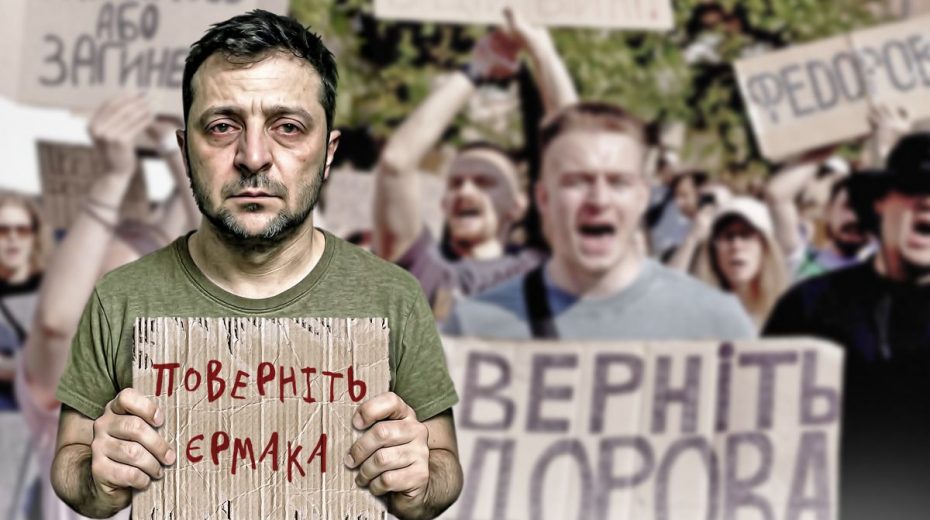
Since Fedorov’s ousting, replaced by hardliners within Ukraine’s government and military, instability has intensified. Many youths have taken to protesting in the streets. Videos showing forced conscription have gone viral internationally, reaching European audiences. Men are being forcibly drafted into military service, and Germany has decreed that Ukrainian male asylum seekers residing there must return home to fight by 2027.
With Fedorov’s removal, Zelensky may well have issued his own “death sentence” in his presidential role. European politicians are displeased. The drone-based conflict is escalating rapidly, and the older generation of commanders cannot keep pace with this advanced technology—unlike Fedorov, who understood it thoroughly.
Fedorov has turned down alternative government roles offered by Zelensky, insisting he will only accept reinstatement as Defense Minister. Zelensky previously proposed that he serve as Deputy Prime Minister for Military Innovation, and the Italian Defense Minister also extended an advisory role offer, all of which Fedorov has declined.
Fedorov has gained considerable popularity in the United States, where the Trump administration welcomes him openly. Trump appears fully committed to supporting Ukraine. His associate, Laura Loomer—known for helping remove many of Trump’s political adversaries—recently visited Ukraine, interviewed Zelensky, and met with the infamous Azov Regiment leader Andriy Biletsky, a known Nazi. Consider the irony: a Nazi fascist meeting a Jew. As often observed, “Jews are fascists too,” evidenced by leaders like Netanyahu. Loomer claimed she was misled for years, asserting there are no Nazis in Ukraine, only defenders against Russian aggression. One must ask who has funded or continues to fund her, as corruption always seeks its counterpart.
About the Author