Big Gains Ahead in Soft Commodities
The burden of soaring food prices is being widely felt, but the blame does not lie with farmers.
They are, in fact, suffering significant losses. According to a recent analysis by the American Farm Bureau Federation:
Farmers growing the nation’s major row crops will collectively lose $32 billion in 2027, up from an estimated $31 billion in 2026…
These figures are staggering. The sector is expected to face a $31 billion loss this year and $32 billion next year, driven largely by record-setting input expenses. Purdue University Agriculture Department’s latest August report sheds light on this:
Whether an energy shock is propagating into agriculture is not settled by asking whether farm-gate prices rose alongside it. Raw commodity prices are set by supply and demand for the commodity itself, not by what it cost to produce. With the crop already in the ground and the herd already on feed, short-run supply is close to fixed, and a rise in fuel or fertilizer costs cannot be passed forward the way a processor passes along a packaging cost. It shows up instead in net returns. Falling farm prices alongside rising energy costs are therefore not evidence that the shock missed agriculture. It is evidence that agriculture must absorb it in the short run.
This insight is crucial. Farmers—like those in mining and oil sectors—are price takers. Market prices are set at a global level, regardless of production costs.
This explains why corn and wheat prices have remained subdued despite sharp increases in input prices such as fuel and fertilizer. This isn’t a new narrative. In 2022, costs per acre for wheat reached $431, and currently, they hover at $428 per acre. Yet, prices are nowhere near the peaks from 2022:
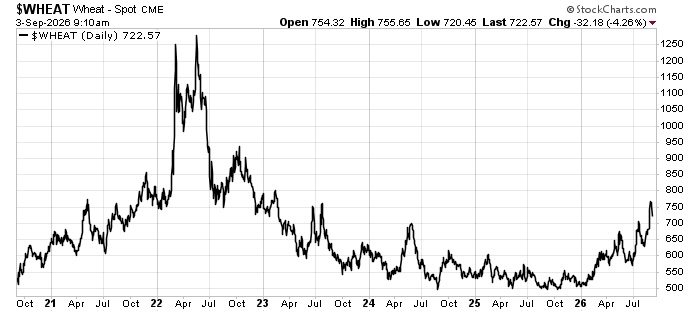
This situation poses a challenge for farmers who bear the full price risk throughout the growing season. Many choose to hedge some of their output beforehand to ensure a portion of guaranteed returns.
Still, hedging cannot fully compensate for the soaring costs producers endure. And as mentioned, with harvest time approaching, farmers facing losses now will struggle with less capital for upcoming planting seasons.
These steep expenses also influence planting choices. When fertilizer prices surge, growers often opt for soybeans over corn since soybeans do not require nitrogen fertilizers, making them a less costly and more lucrative option. For example, December 2027 corn futures trade at $5.30 per bushel, while November 2027 soybean futures stand at $12.00 per bushel—giving soybeans a $6.70 advantage per bushel.
This price disparity is likely to encourage many farmers to convert acreage from corn to soybeans.
Wheat producers are similarly challenged. Forecasted production costs for an acre of wheat have hit an all-time high of $428. Crop substitutions vary by region across the US depending on local farming conditions.
Commodity investors often say: “The cure for low prices is low prices.”
This phrase simply means that when prices drop, supply contracts. Reduced supply against steady demand drives prices upward. Since corn and wheat form the backbone of much of the U.S. food supply, this dynamic will play out for the next 18 months. While it’s uncertain if prices will reach 2022’s peaks again, an upward trend seems inevitable.
Rather than investing directly in farming operations, which are currently unprofitable, a smarter approach to benefit from rising prices is through exchange traded funds like the Teucrium Wheat Fund (NYSE: WEAT) or the Teucrium Corn Fund (NYSE: CORN).
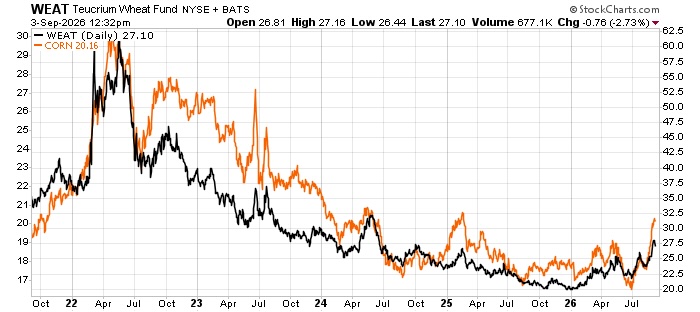
The chart shows that wheat and corn prices have risen since July but still have considerable distance before matching 2022 highs. I believe it’s quite possible they will climb that high again, as current prices do not reflect the expensive input costs. This suggests considerable upside potential in grain prices ahead.
About the Author