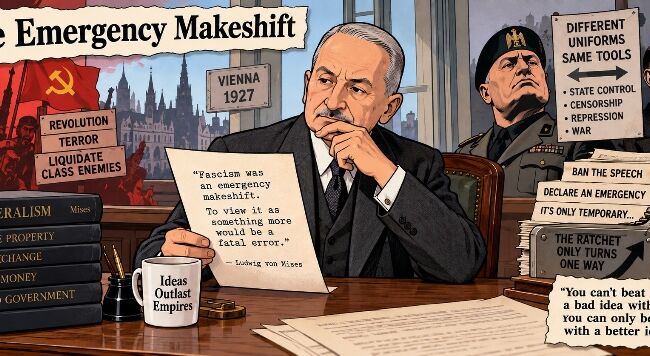
The Emergency Makeshift
The setting is Vienna, 1927.
Ludwig von Mises sits at his desk within the Austrian Chamber of Commerce, having just penned what would become the most provocative paragraph of his entire career.
Unaware of its future impact, that passage would soon be extracted, stripped of its context, and wielded against him for generations. His ideological opponents would use it to tarnish his reputation, while paradoxically, some supposed allies would cite it to claim him as their own.
The work is titled Liberalism. Within it, Chapter 1, Section 10 bears the heading “The Argument of Fascism.”
There, Mises acknowledged something many classical liberals would hesitate to admit aloud: the fascist movements rising across Europe were motivated by earnest intentions, and their intervention had temporarily preserved European civilization.
Isolated, this statement creates a perfect controversy. “Mises praised fascism!”
But by continuing to read, context emerges—and with it, the truth.
He concluded the passage by stating, “Fascism was an emergency makeshift. To view it as something more would be a fatal error.”
Those not debating in good faith conveniently omit this crucial conclusion. Naturally, revealing it would end the dispute. Mises was clearly no fascist.
Europe Through Vienna’s Lens
To fully grasp Mises’s point, one must consider the realities he faced.
The Bolsheviks seized power in Russia in 1917, triggering a brutal civil war resulting in millions of deaths. The Comintern openly aimed to spread revolution, terror, and eliminate class enemies across Europe. Communist uprisings had already erupted in Germany and Hungary. Mussolini then established control in Italy in 1922.
For a Vienna observer in 1927, these events were not theoretical but the immediate geopolitical landscape.
Mises made a precise, legalistic point: when armed forces attempt to violently overthrow society, using force to defend oneself is justified. No true liberal would deny this. Fascist militias countered revolutionary violence with force, and in the short term, succeeded.
This was his sole concession. Immediate self-defense could be effective.
The remainder of the section explained why fascism’s victory could only be temporary.
The Complete Picture
Here’s what both sides’ selective quoting consistently leave out.
Mises argued fascism could never truly overcome socialism because it refused to combat socialism where it was rooted—in people’s minds.
Communism exists as a concept. Though a dreadful one, ideas cannot be eradicated through violence or imprisonment alone. One might ban literature, silence authors, and exile leaders, but the ideology patiently endures, waiting for oppressive pressures to diminish.
Repression, in fact, strengthens it. Every imprisoned agitator becomes a symbol; forbidden texts become all the more enticing. Suppression converts skeptics into devoted followers.
And fascism’s alternative to socialism’s ideology? Mises observed it offered none. Its economic approach was thoroughly interventionist: price controls, cartels, and state-managed industries. It countered socialism with socialism’s own tactics combined with force. Essentially, they were cut from the same cloth.
The only way to defeat an idea is with a superior idea, which Mises possessed: private property, voluntary exchange, stable currency, limited government, and peace. These fundamental liberal principles lacked the spectacle of marches or uniforms; they simply functioned, which is why capitalism has no need for rallies. Those who trust it are usually at work.
Mises also foresaw a grim consequence. A regime fixated on force domestically would inevitably glorify force internationally. He warned that fascist governments would drag Europe into conflicts that would devastate the civilization they claimed to protect.
This warning was penned twelve years before the Wehrmacht invaded Poland.
The Makeshift Becomes Permanent
Why should a nearly century-old book passage matter to your Thursday morning?
Because the emergency makeshift is not a fascist invention but a recurring temptation that every generation confronts.
The sequence repeats: a genuine threat arises, fear takes hold, and then someone proposes a shortcut—bypass reason, suppress the danger.
Ban speech at the university to avoid offending students. Declare a state of emergency, seize authority, and solemnly promise the change is temporary. Sound familiar? Like the Patriot Act.
But as the Ratchet shows, emergency powers tend to outlast their justification. Censorship aimed at enemies spreads inward. Yes, surveillance expands.
The forbidden idea doesn’t vanish; in fact, it grows stronger, now able to claim it was silenced rather than refuted.
Mises experienced the aftermath. He fled Vienna in 1934. His works were banned, and his seminar dispersed globally—even reaching NYU.
Yet the strangest outcome followed: the regimes that suppressed him collapsed. The empire embodying all he opposed dissolved in 1991, exactly for the reasons he had predicted decades earlier. His ideas endured longer than any who attempted to bury them.
Force was defeated; the idea triumphed. It took fifty years—about forty-nine years longer than most politicians’ endurance.
Conclusion
When you hear claims that an idea is too dangerous to express, or that crises justify suspending norms, or promises that emergency measures are temporary, you’re witnessing the oldest tactic. It failed in 1927 and has not improved since.
Bad ideas cannot be overcome by bans—only replaced by superior ideas, openly debated by those with the patience to persist.
This is how civilization progresses.
Have a great day ahead.
About the Author