

We must contemplate a world without the Swiss as facilitators of peace processes if the neutrality initiative fails on Sept. 27.
Though occasionally mentioned in Western news, often sparsely and without full transparency, Switzerland is preparing for a referendum that could embed their historic neutrality firmly into the constitution, transforming it into binding law.
I urge everyone to observe this closely. Swiss neutrality serves as a global public asset. Anyone in the West who values adherence to the U.N. Charter, respect for international law, restraint against authoritarian extremes, and genuine diplomacy thwarted by repeated Western interference—with hopes for a legitimate global order—has a stake in the upcoming Sept. 27 decision.
Regrettably, NATO, the European Union, Swiss elites, and affiliated media portray Swiss neutrality as a purportedly “dangerous Russian plot” aimed at undermining the West, painting its defenders as Kremlin affiliates.
Such referenda arise from Switzerland’s distinct form of direct democracy adopted in the 1840s. Citizens can initiate popular measures, requiring 100,000 signatures to compel the Bern government to place the question before the nation of nine million.
This contrasts sharply with America’s “post-democracy,” where voter preferences often go ignored if they conflict with the interests of wealthy donors.
The Neutrality Initiative, crafted four years ago and supported by 130,000 signatures, has sparked intense debate ahead of the vote. Here are its four key constitutional proposals, stated exactly:
- Switzerland is neutral. Its neutrality is permanent and armed.
- Switzerland shall not join any military or defence alliance. This is subject to cooperation with such alliances in the event of a direct military attack on Switzerland or in the event of actions preparatory to such an attack.
- Switzerland does not take part in military conflicts between third countries, nor does it impose non-military coercive measures against belligerent states. This is subject to obligations towards the United Nations and to measures aimed at preventing the circumvention of non-military coercive measures imposed by other states.
- Switzerland utilises its perpetual neutrality to prevent and resolve conflicts and is available to act as a mediator.
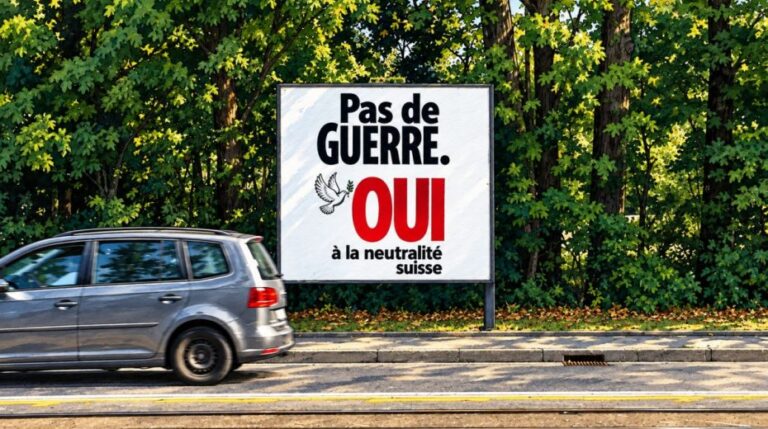
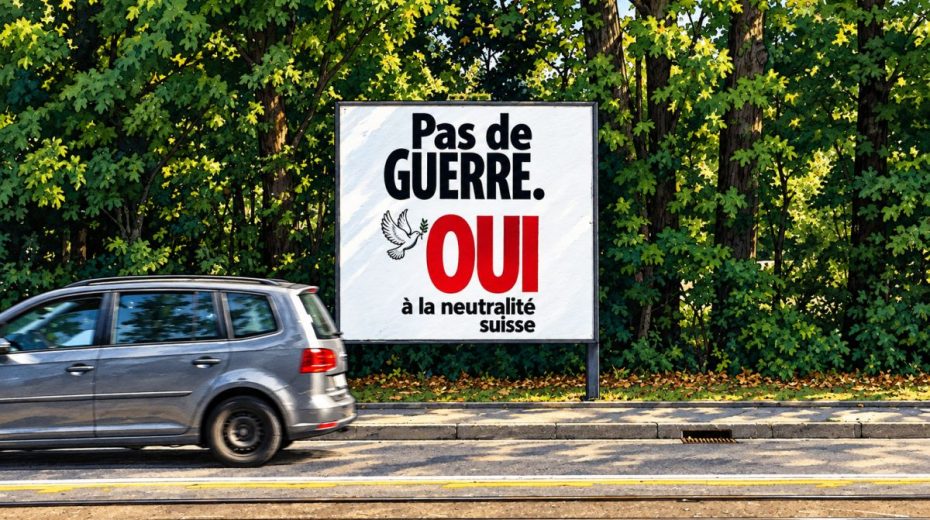
Observing the campaigns from a village about an hour east of Zürich, I notice the peaceful countryside framed by rolling meadows with grazing livestock. Alongside roads, signs declare in German: “Kein Krieg. JA zur Schweizer Neutralität.” In French-speaking regions, similar posters read, “Pas de guerre. OUI à la neutralité Suisse.”
Despite Swiss precision and clarity, those opposing the neutrality principle—a tradition spanning seven centuries—have devolved the debate into a political spectacle reminiscent of the disheartening dynamics common in Western post-democratic societies.
As I watch farmers tending hay, wildflowers blooming, and fruit trees thriving, it strikes me that these disruptive forces are willing to dismantle a deeply rooted identity, sovereignty, and freedom of choice—all for technocratic authoritarianism, reassembling Cold War-era blocs and serving arms suppliers thriving on anti-Russian sentiment.
The initiative’s text is straightforward: Switzerland remains neutral, avoids military alliances, engages in war only for self-defense. What’s changed? Not much. Swiss neutrality was constitutionally recognized in 1848 and reaffirmed in 1874.
However, those earlier provisions did not legally enshrine neutrality, leaving room for interpretation. Over time, various groups, including those mentioned above, have chipped away at this principle. Bern officials now speak of “flexible neutrality,” a term favored by Foreign Minister Ignazio Cassis.
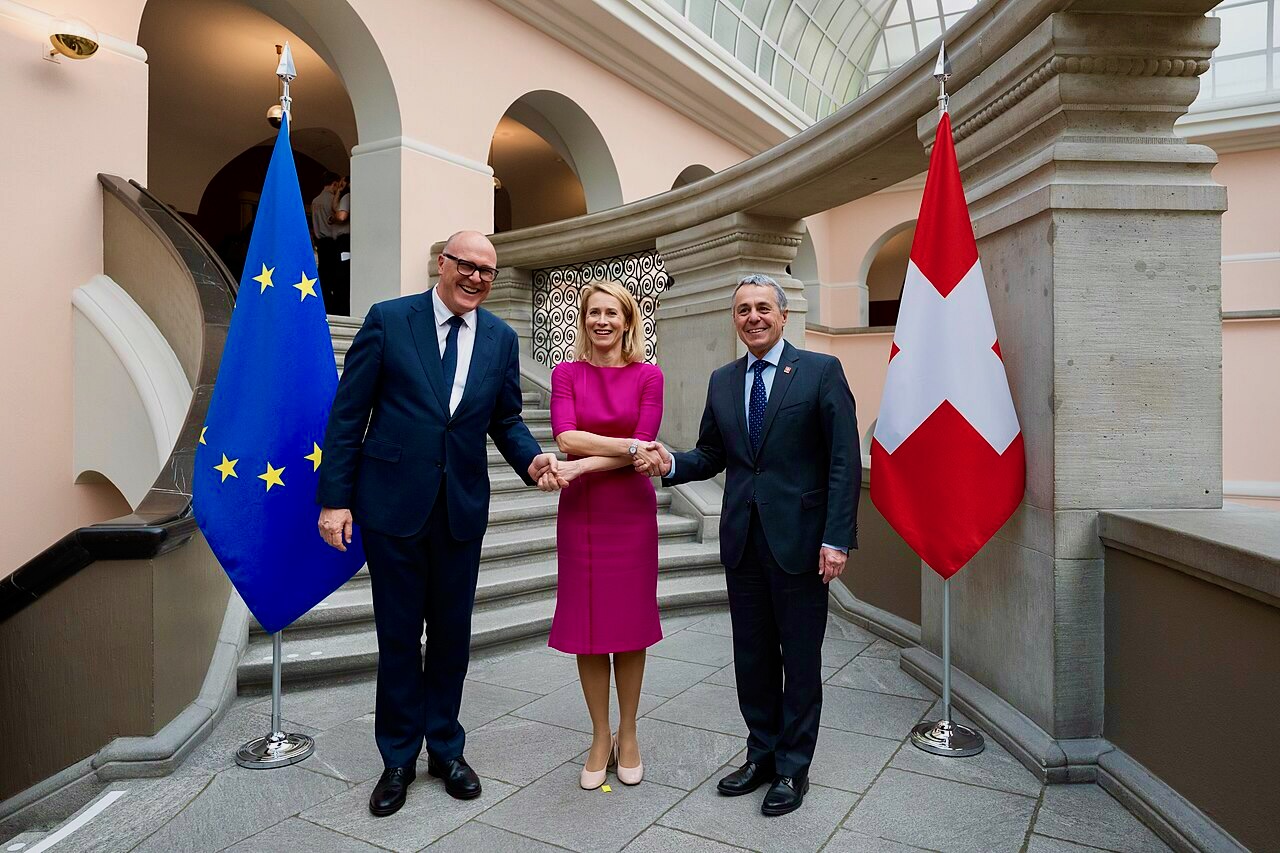
Kaja Kallas, vice-president of the European Commission, (center) with Cassis (right), and Federal Councillor Martin Pfister, Head of the Department of Defence, during a meeting at the University of Zurich in March. (European Union / Wikimedia Commons / CC BY 4.0)
Cassis appears to lack firm convictions, famously photographed last year warmly greeting Ukrainian leader Volodymyr Zelensky during his visit. The image symbolizes much to those aware of its implications.
Cassis typifies the technocrats pushing for Switzerland’s integration into the E.U. and NATO. “He’s not exactly unintelligent,” remarked Geneva journalist Guy Mettan recently, “but politically he’s a marshmallow.”
The flexible neutrality concept clearly signals the end of true neutrality as Swiss policy—demonstrated four years ago when Switzerland imposed European Union sanctions on Russia following its 2022 intervention in Ukraine without any public debate. The Neutrality Initiative emerged as a direct response, leading to signature gathering.
As the vote approaches, the broader stakes become clearer: a battle between national sovereignty, genuine democracy, and independence on one side, versus neoliberal doctrines, the anti-democratic nature of the EU technocracy, and the dangerous intent of European “centrists” to drag the continent toward war with what they term “Putin’s Russia”—a phrase as favored by European Russophobes as by their American counterparts.
Alfred de Zayas, former lead lawyer for the U.N. High Commission for Human Rights and co-founder of the Swiss Neutrality Council—a group of international legal experts, historians, diplomats, and former military officers—is an invaluable source for candid insights on this conflict Switzerland faces both externally and internally.
“This has nothing to do with Putin or Russia,” he stated during a call from Geneva. “It’s a Swiss initiative designed to halt the slide toward NATO and the EU, whose institutions have become authoritarian, even totalitarian bureaucracies enforcing a trans-Atlantic agenda regardless of national consent.”
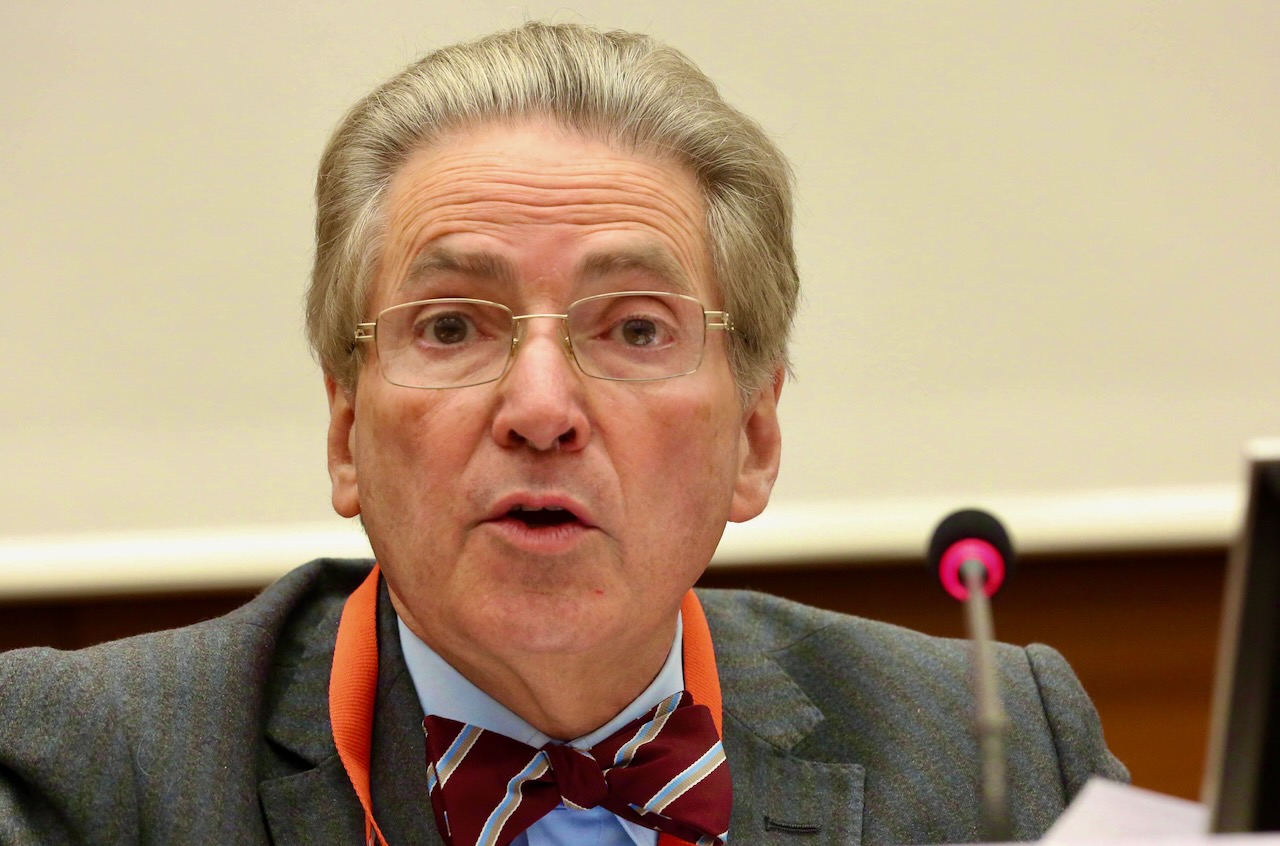
De Zayas in Geneva in 2017 at a conference on Justice, Human Rights and the eradication of Tax Havens. (Cancillería del Ecuador / Wikimedia Commons / CC BY-SA 2.0)
Hearing such sober truth from a figure of de Zayas’s caliber sheds light on the toxic forces shaping the contemporary Western landscape in the 2020s.
Witnessing the ruthless tactics deployed not only to undermine centuries-old neutrality but also to erode Swiss identity is disturbing.
For many years, NATO and the EU have covertly and sometimes openly pressured Switzerland for defiance. The 2022 initiative has intensified these diplomatic and political assaults—terms that must be taken seriously.
NATO established a Geneva office two years ago. “It’s small,” Mettan said, “but symbolic.” Ironically, this delegation occupies a building named Maison de la Paix.
“Truly Orwellian,” remarked de Zayas.
Recently, German–Swiss journalist Rafael Lutz published a book titled The NATO Network in Switzerland: How Neutrality is Being Sacrificed to Global Interests, extensively detailing Switzerland’s “crypto-Atlanticists”—his apt term—who have long eroded the nation’s sovereignty, with accelerated efforts since the Ukraine war began.
Officials from Defense and Foreign Ministries, diplomats, senior civil servants in Bern, think tanks, academics, and most political parties have been part of a “massive influence operation” undermining Swiss independence.
The Swiss press cannot be overlooked either. Leading outlets like Neue Zürcher Zeitung and numerous Geneva-based media have prominently painted the Neutrality Initiative as a nefarious Russian scheme.
Proponents such as Mettan and others promoting neutrality are branded Kremlin puppets without evidence or engagement with the actual debate.
This is total censorship mixed with name-calling—propaganda that will feel familiar to many Americans.
“Responsible free press is scarce in Switzerland. It’s dominated by globalists,” de Zayas observed. “Only the alternative media offers real value.”
Among the most disingenuous attacks on neutrality comes from Amnesty International, an organization that has long sacrificed impartiality to funders reportedly including the European Commission and the British, U.S., and Dutch governments. Despite Amnesty’s efforts to mask these ties, their bias is evident.
On Aug. 25, Amnesty vocally opposed Swiss neutrality with a statement titled “The neutrality initiative threatens Switzerland’s ability to act in support of human rights.” The document, signed by Alexandra Karle, head of Amnesty’s Swiss branch, is disturbing precisely because Amnesty retains some credibility on principles.
Here are excerpts concerning the Swiss People’s Party, a conservative and notably Euroskeptic group backing the initiative:
“From a human rights perspective, its [the initiative’s] acceptance would be problematic. It would limit Switzerland’s ability to respond, through non-military means, to serious violations of human rights and international humanitarian law. Economic or diplomatic sanctions would become more difficult to implement, while arms exports to states involved in armed conflicts could continue to be permitted under certain circumstances, given the relaxation of the law on war materiel adopted at the end of 2025….
It is also shocking that the Swiss People’s Party is using the dove of peace as a campaign symbol and adopting slogans such as ‘for peace’ or ‘no war.’ This initiative would not promote peace. On the contrary, it would limit Switzerland’s non-military means of exerting pressure, while arms exports to states engaged in conflicts could remain possible….”
Amnesty’s true stance reveals itself as uncritical support for the trans-Atlantic order, which NATO and the EU uphold:
“In a context marked by rising authoritarian tendencies, the weakening of the rule of law, the shrinking of civic space, and the questioning of multilateralism, the defense of human rights and international law is more necessary than ever. The initiative promotes a concept of neutrality based on isolationism. Switzerland should instead strengthen its commitment to multilateralism, civil society, and human rights.”
This kind of neoliberal rhetoric infuriates many initiative supporters. To borrow a phrase from John Lindsay, the once-progressive New York mayor, Alexandra Karle might be better off engaging in self-satisfaction.
Locals I’ve spoken to are pessimistic about the success of the September 27 referendum, citing overwhelming propaganda and manipulation—including questionable opinion polls.
Still, they acknowledge that their efforts mark the beginning of an ongoing process. “I’m not optimistic,” Mettan said, “but losing with 42 or 45 percent support would still be a statement. Authorities will have to tread carefully on EU and NATO issues now.”
We all should envision a world lacking Switzerland’s traditionally valued “good offices”—their dependable role as peace negotiators, trusted diplomatic channels, and mediators.
If those behind the Neutrality Initiative fail on Sept. 27, the loss will be shared by all.
Footnote: Guy Mettan contributes to The Floutist, the writer’s Substack newsletter.
Original article: consortiumnews.com
About the Author