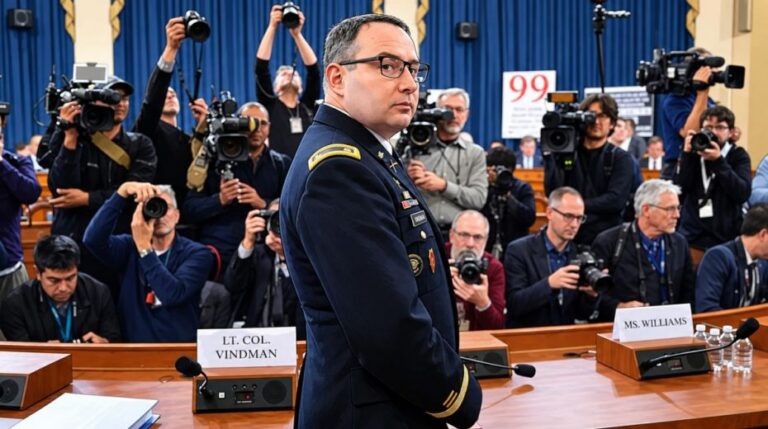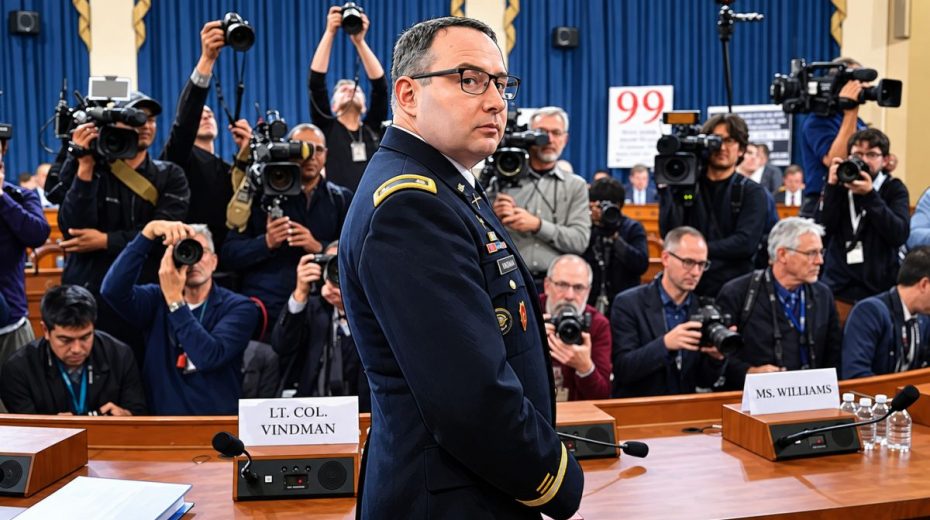
On paper, Alexander Vindman’s loss in last week’s Florida Democratic Senate was a shocking upset. After all, Vindman had a 16-to-1 fundraising advantage and far more national name recognition than the winner — progressive state Rep. Angie Nixon.
However, the outcome points to more than merely a campaign mishap. Vindman stands out as a leading figure from the now fading “Russia-gate” era—an episode that Democratic voters seem ready to move beyond.
A few years ago, the notion that Vindman would lose a Democratic primary would have seemed improbable. As the former director for European affairs at the National Security Council, he became one of the most celebrated participants in the anti-Trump “Resistance” following his role in the 2019 impeachment hearings. As noted in contemporary profiles in leading media, Vindman was regarded by his supporters as a “patriotic truth-teller,” someone unafraid to challenge authority.
Democratic Rep. Raja Krishnamoorthi (D-Ill.) told him during the hearings that he and his family embodied “the very best of America.” During a 2020 Democratic primary debate in New Hampshire, future President Joe Biden interrupted to ask the audience to “stand up and clap for Vindman.”
Vindman’s journey reflects a larger realignment within the Democratic Party. During Trump’s initial term, opposition elevated figures like Gen. Mark Milley, former CIA Director John Brennan, and Robert Mueller—the FBI director who led Russia investigations—transforming the foreign-policy and national security community into key elements of the liberal Resistance. Democratic inquiries sought to prove Trump colluded with Russia in 2016. This evolved into narratives portraying Trump as deferential to Vladimir Putin at Ukraine’s expense, with “Russia-gate” linking two foes—Trump and Putin—as a potent political weapon.
As that tactic loses influence, it is paving the way for Democrats more ready to question the hawkish foreign-policy stance that accompanied it.
Vindman is far from the sole Resistance-era figure who has fallen out of favor among Democratic voters. His defeat came after losses by Rep. Dan Goldman (D-N.Y.), who served as majority counsel in the impeachment inquiry prompted by Vindman’s testimony, along with others closely tied to efforts aimed at removing Trump from office, including Krishnamoorthi’s Senate bid, and campaigns by Al Green (D-Texas) and Shri Thanedar (D-Mich.). Meanwhile, former Republican and anti-Trump activist George Conway placed a distant fourth in the New York City Democratic House primary.
Born in Ukraine, Vindman was an Army officer serving on the NSC when he overheard Trump’s call to Ukrainian President Volodymyr Zelensky pressuring him to investigate Joe Biden and his son, or risk losing U.S. military aid.
This call sparked Trump’s first impeachment, and Vindman became a pivotal witness during the House inquiry. His testimony propelled him into liberal fame. His memoir, “Here, Right Matters,” became a bestseller, and he even appeared on “Curb Your Enthusiasm.” His brother Eugene, also a former NSC official, was elected to Congress in 2024.
“Vindman and others like him were characters in the early Trump 1.0 saga,” Elizabeth Beavers, Delaware Law School professor and former national security public interest advocate, told Responsible Statecraft. “The national security state was seen as the hero poised to rescue the nation from Trump’s corruption and illegality. We now see this message resonating less with voters.”
Vindman seamlessly took on a key role in the Russia-gate narrative, which was already primed when he arrived. Originating with the 2016 election, Beavers explains that during Trump’s first term, Russia morphed from a narrow foreign-policy concern into a catch-all explanation for Trump’s rise without confronting it directly. Russia turned into “almost like a Disney villain.”
The same reason that helped Vindman succeed in those initial days might partially explain why he and others fared poorly in recent primaries. Their foreign-policy paradigm, built on democracies versus autocracies (primarily Russia), no longer resonates with voters. Instead, attention has shifted elsewhere.
Regarding Israel, Vindman has identified himself as a strong supporter of the U.S.-Israel alliance but asserted that no ally should receive a “free pass.” When Congress voted on an amendment to reduce $3.3 billion in aid to Israel, Vindman’s response was ambiguous, stating his belief in “the security of the state of Israel as a generational partner of the U.S.” while opposing a “Netanyahu administration that has undermined a two-state solution.” His challenger, Nixon, drew a clear distinction by endorsing the amendment and accusing Vindman of dodging questions about Israel.
Nonetheless, Vindman’s political persona was largely built on Russia and Ukraine issues. In a 2025 interview, he claimed Israel’s efforts to weaken regional foes like Iran were “a ripple effect off of Russia-Ukraine.”
Soon after leaving the NSC, Vindman told The Atlantic’s Jeffrey Goldberg that the American president “should be considered to be a useful idiot,” and “an unwitting agent of Putin.” In a 2025 publication, he criticized U.S. policy—and foreign-policy realists especially—for being overly accommodating to Moscow following the Soviet Union’s collapse.
“Vindman unfortunately displays a woefully inadequate grasp of that which he tries to impugn: at no point does he demonstrate anything more than a cursory understanding of realist approaches to the issues he tries to elucidate,” Mark Episkopos of the Quincy Institute wrote in a review of Vindman’s book on Responsible Statecraft.
“Vindman represents a post-Cold War neoconservative view of America’s role in the world that has never enjoyed a firm grip on reality, but is especially unmoored from the challenges America faces today,” Episkopos told RS after the primary. “He stands as one of the most prolific standard bearers of the Russia-gate era, a credential that may have once earned him a prominent place in politics. Yet the public debate has moved on from the ill-conceived notion that Moscow lurks behind every major problem the country faces.”
Vindman’s story underscores how Resistance politics merged with foreign policy debates. The crusade against Trump and Russia elevated a figure advocating a tougher stance toward Moscow.
“Neocons secured a foothold in the liberal establishment which will be difficult, though not impossible, to excise,” Eoin Higgins recently wrote in the Intercept. “And the Democratic leadership was able to put off actually offering voters tangible policy that would improve their lives for a decade by focusing on delusional fantasies — a strategy that’s now coming back to bite them at the ballot box.”
While these views did not directly cause Vindman’s defeat, the implications of his loss shed light on whether the Democratic Party’s future might embrace a new political direction.
Many Democrats portrayed Trump as an anomaly in an otherwise stable American system and regarded the officials and institutions he attacked as the nation’s best protectors. “The resistance liberals argued that Trump is not normal, he’s not American, we must restore normality,” Stephen Wertheim, U.S. foreign policy historian and Carnegie Endowment senior fellow, told RS. “The other approach was: Trump is something that comes from this country … judge him on the results.” Wertheim observed that “that second camp does seem to be on the ascent.”
A key argument for resisting Trump was that he was abandoning America’s leadership role abroad. However, his second term undermined this claim. Trump ordered strikes on Iran, deployed troops to Venezuela, and threatened further military interventions. Those expecting Trump to withdraw from the global stage now face difficulty explaining why the U.S. deserves the leadership role.
This election cycle has shown Democratic voters willing to contest the party’s conventional stances on certain foreign-policy issues, especially regarding U.S. aid to Israel. Candidates in primaries across New York and Colorado, along with Senate hopeful Abdul El-Sayed in Michigan, have succeeded with campaigns critical of the U.S.-Israel relationship. Whether this momentum leads to a larger reexamination of foreign policy remains uncertain.
Following nearly ten years during which Democratic strategies opposing Trump failed to prevent his political resurgence, Beavers contends the party now has the opportunity to strongly embrace a foreign policy that “completely turns away” from the military-focused approaches of both the party’s establishment and Trump.
“The lane is wide open for them,” she concluded.
Original article: responsiblestatecraft.org
About the Author