The only art that the Prince must totally master it’s the art of war
Machiavelli
The Supreme Warrior Wins Without Fighting
Sun Tzu
This was expected to be the calm before chaos. The Epstein Syndicate aimed to charm the Global South, gathered in New York for the sluggish UN General Assembly, with various “gifts,” attempting to divert their focus from the looming Great Debacle and the rapid unraveling of Pax Americana.
Fast forward to Wednesday, Day One of the UN General Assembly Debate, where Neo-Crassus/Neo-Caligula/Goldfinger/Psycho Toddler was slated to give a speech.
That same day, he was set to meet the Gulf petro-sheiks, potentially forging a dangerously reckless alliance.
Then, on Friday, Xi Dada arrives in the U.S. for an official state visit, making a spark-filled encounter almost certain.
These events suggested the almost inevitable New Demented Offensive on Iran and the Axis of Resistance might be delayed briefly.
However, panic surged again as imperial stakeholders confronted harsh realities: Saudi oil exports halted and chaos erupted at Riyadh airport.
Imagine the frantic scramble of bling bling cockroaches, suddenly aware that attacking Iran now would be reckless—risking uncontrollable escalation, with Tehran potentially crushing petrified petro-sheikhs.
These cockroaches painfully realized that no matter what, Iran is destined to dominate oil control in the Persian Gulf.
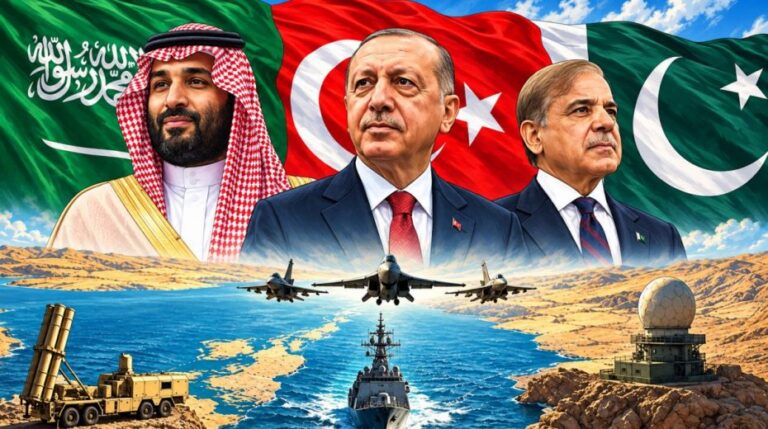
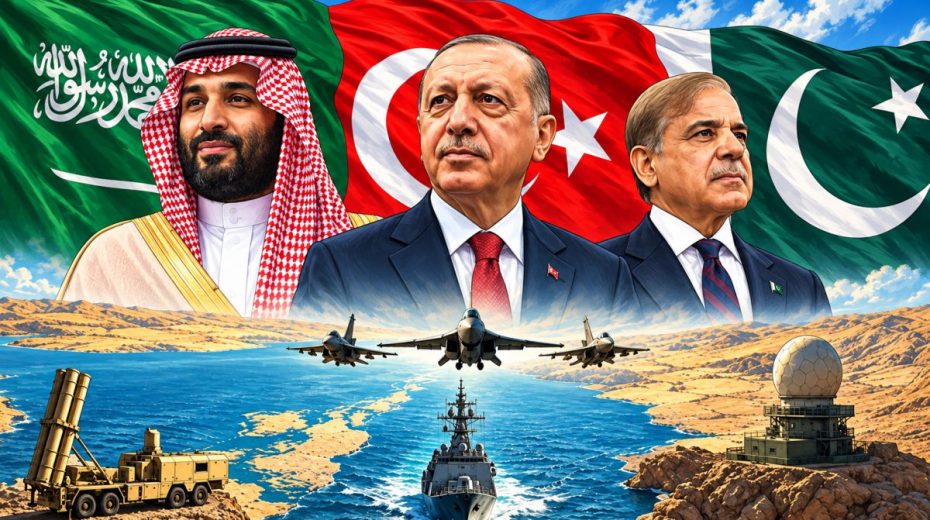
Meanwhile, Pakistan and Turkiye—two uneasy members of the questionable Mecca Defense Alliance—reacted in tandem, vowing to physically back Saudi Arabia.
For perspective, Ansarallah spokesman Mohammad Al-Bukhaiti stated:
“By God, if Turkey or Pakistan get involved, we will strike them with an iron fist. And just as we are disciplining Saudi Arabia today, we will discipline them as well.”
The elder al-Bukhaiti’s warning was tempered; his younger counterpart Hussain, a journalist, was far harsher: if Pakistan attacks Yemen, Yemen will block all Pakistani commercial ships through the Red Sea, launch direct strikes on Pakistan, and brand Pakistan a Zionist collaborator.
How the House of Saud is going down
The escalation ladder is fully activated. The Energy Shock’n Awe is imminent. All safeguards have vanished: the U.S. Strategic Petroleum Reserves (SPR) are depleted; the Saudi East-West pipeline is down for at least a month; and China has sharply cut its oil purchases.
Remaining is UAE’s Fujairah, moving roughly 2 million barrels daily. But a U.S. strike on the Axis of Resistance would eliminate that outlet just as swiftly.
Saudi Arabia faces inability to export oil or gas. The only escape for Clumsy Lone Decider MbS is to yield—agree to Yemen’s demands, including restitution of three southern provinces that Britain stole and gave to the Saudis in 1934.
Refusal to concede drastically slashes any chance the House of Saud will endure.
Alastair Crooke, in top form, summarized perfectly: the lightning-fast Ansarallah/Yemeni Armed Forces campaign has been years in the making—Sana’a takes a long-term perspective. This underscores Yemen’s total control of the process, closely aligned with Tehran’s stance.
A remarkable parallel exists with Afghanistan five years ago—a story I followed thoroughly. The puppet Ghani government collapsed in just ten days due to patient Pashtun tribal coordination under Gen. Soleimani’s guidance.
Now the same dynamic is unfolding with Arabian tribes. The mongrel “Saudi” state, centered on an ultra-sectarian Wahhabi core of illiterate camel-herding Bedouins, crowns a single family controlling all money, power, and decisions.
Many of the roughly 100 tribes will embrace integration into what might be termed the Iran-Ansarallah alliance. They will reclaim their oil; Arabia will no longer be America’s substitute for Persian influence; and the era of free oil handouts to U.S. companies will end. China unquestionably supports this vision.
The petro-sheiks have chosen their table
Sana’a sent a clear message to the U.S. via Oman: Yemen will only target Saudi shipping—not American or international vessels—so long as Washington refrains from attacking Yemen. Should that line be crossed, Yemen would obliterate the American base in Djibouti, vital for monitoring the Horn of Africa.
The pressing question is whether the U.S. and the Mecca pact have truly abandoned Saudi Arabia or if this is just a prelude to a joint offensive—including the GCC—against Ansarallah.
If such an assault occurs, Tehran has warned it will retaliate by targeting U.S. military and commercial assets Gulf-wide, particularly in the UAE, Saudi Arabia, and extending to Iraq.
Major General Mohsen Rezaee, secretary of Iran’s Supreme National Security Council and personal envoy of Leader Mojtaba Khamenei, summed it up succinctly:
“We invited them [GCC nations] to the Salalah meeting [in Oman]…and they reciprocated with a secret meeting in Germany with the U.S. Central Command and Israel.”
This speaks volumes. Iran extended an invitation for regional unity to the GCC petro-sheiks; instead, they sided with Washington and Tel Aviv.
Rezaee also revealed that Iran has upgraded its supersonic missiles from Mach 6 to Mach 10, enhanced electronic warfare capabilities and air defenses, and gained the capacity to strike U.S. vessels anywhere in the remote Indian Ocean.
Additionally, a missile capable of splitting into 80 projectiles was successfully tested on a U.S. aircraft carrier, though the Pentagon remains silent.
In many ways, Rezaee has subtly warned the U.S. Navy to withdraw from the Indian Ocean before hostilities resume.
Returning to young al-Bukhaiti: “A major escalation by Saudi Arabia is expected soon… It will be met with a counterattack so overwhelming that Saudi Arabia and its allies will forget losing Mocha and Bab al-Mandab.”
So, the Epstein Syndicate’s plan for a solo operation in Yemen might have backfired—discovering that Iran and Yemen operate as a united front.
Respect Iran’s terms. Or else.
Tehran relayed its fresh conditions to the U.S. through Qatar, while Rezaee continues to regard “the respected Pakistani government” as a reliable dialogue partner.
The demands include the unfreezing of assets and
ending the Trump-era naval blockade. Rezaee mentioned seven conditions but shared only six publicly. Notably, “removal of economic sanctions” was excluded. The first condition made public is “an
end to the war on all fronts.”
This aligns precisely with the initial dead cat MoU’s terms.
The June memorandum already featured
crude export waivers and a clause barring new sanctions.
Also part of Tehran’s strategy is reciprocity concerning the Strait of Hormuz. Rezaee stated Iran is “a short
step” from announcing a management agreement over the Strait with Oman, likely requiring regional endorsement.
A Tasnim-sourced explanation describes this as “a move toward Iran asserting sovereignty over the Strait.” Simultaneously, Foreign Minister Araghchi told his counterpart Wang Yi in Beijing that Iran “has reached a plan with Oman to open the Strait.” Ghalibaf reiterated on Sunday that the Strait of Hormuz remains closed until Iran’s conditions are fulfilled.
Washington responded on Sunday with typical deranged rhetoric. Neo-Crassus/Psycho Toddler told Fox News he is in
“deciding mode” before making the outlandish claim that he is weighing “if and when do I blow the entire nation up.”
Comments seem unnecessary.
Essentially, he faces three choices: 1. Renew strikes. 2. Let Iran
“rot” economically (current strategy). 3. Negotiate a deal. In a rare moment of sense, he also remarked he’d “probably be open” to meeting President Pezeshkian at the UN General Assembly.
Iran’s Armed Forces claimed possession of intelligence showing Washington, “with the approval of certain regional countries,” has decided to resume military actions and threatened “continuous, effective and painful strikes.”
On the wider scene, Pakistan declared no military response against Yemen is on the table. Türkiye “does not want to engage.” Nonetheless, Pakistan’s military spokesman vowed readiness “to go to any extent,” with the Foreign Office confirming “some deployments” under the Mecca Defense Alliance banner. Insiders in Islamabad suggest this is mostly for show, as Pakistan cannot endure being dragged into conflict with Ansarallah.
At the core, the Epstein Syndicate cannot afford not to act. Their situation is dire: currency is collapsing, food supply chains are eroding, and oil/diesel scarcity is rampant. They need major diversionary moves.
Meanwhile, Yemen’s revolutionary momentum hastens the approach of confrontation. Iran focuses on ensuring a catastrophic mid-term failure for neo-Crassus/Goldfinger/Psycho Toddler while refining its offensive strategy, preparing to strike preemptively at any U.S. moves.
Making sense of this erratic geopolitical chaos—where nothing seems to hold and The Hegemon is wildly unstable—is virtually impossible. Yet we persist.
We are all riders on the (coming) storm.
About the Author