

If we can’t curb the violence of our own governments, what sense does it make to condemn the violent reactions of the states or movements they attack? asks Jean Bricmont.
I am not Palestinian, Lebanese, nor Iranian; I neither speak Arabic nor practice Islam.
Having spent my entire life in Europe and the United States, I have observed that nearly everyone—even those professing “solidarity with Palestine”—preface any critique of Israel or its government with a “condemnation” of Hamas, Hezbollah, or the “mullahs’ regime.”
I want to clarify why I refuse to join these condemnations.
This is not because I endorse these groups or their tactics; I consider expressions of support almost as meaningless as outright condemnation. Genuine moral clarity—beyond empty virtue signaling—requires an honest appraisal of Western roles in global power relations.
Our role is straightforward: the United States, together with its European “allies,” carries immense accountability for turmoil in the Middle East—from the post-World War II establishment of Israel and the Palestinian dispossession, to the 1953 coup that ousted Mossadegh in Iran; two devastating wars on Iraq; decades-long sanctions on Iraq, Syria, and Iran; backing Saudi atrocities in Yemen along with Israeli offensives in Gaza, the West Bank, and Lebanon; various interventions in Lebanon; and currently, an extensive unprovoked strike on Iran.
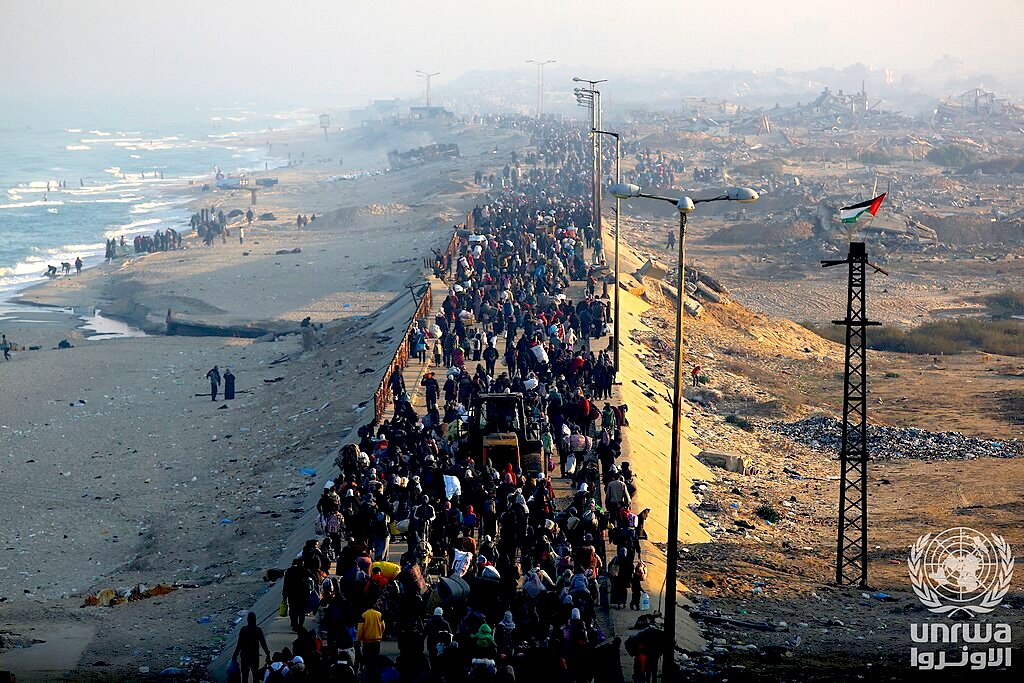
Displaced Palestinians going back to bombarded Gaza and the north via Al-Rasheed Street, crossing the bridge over the estuary of the Wadi Gaza, Jan. 28, 2025. (Ashraf Amra – United Nations Relief and Works Agency for Palestine Refugees in the Near East/ Wikimedia Commons/ CC BY-SA 3.0)
Ordinary Western citizens need not feel guilty for policies outside their control—foreign policy is rarely discussed openly in democracies and carries minimal electoral influence—but ignoring these historical truths while forming political opinions is untenable.
When we cannot confront the violence of our own governments—those we theoretically have influence over—what justification exists for condemning the aggressive responses of states or groups they target?
The leaders of these states or movements often remain oblivious to Western “critical” activist groups; even if aware, they are indifferent toward our moral or strategic critiques.
What they ask from us is simple: to restrain the violence perpetuated by our governments. If we fail in that, silence is the only respectable option.
This fixation on castigating the crimes of official adversaries has long existed but proliferated dramatically after the Vietnam War, which ended with a humiliating military defeat for the United States and a tarnished moral reputation due to wartime atrocities.
Nonetheless, tragedies such as those experienced by the “boat people” fleeing Vietnam and the Khmer Rouge’s terror in Cambodia provided ammunition for American imperialists.
They shifted focus onto these humanitarian crises in order to blame anti-war movements, implying responsibility despite the repression being an inevitable outcome post-conflict—punishment against collaborators is common after wars.
Furthermore, many fleeing were politically exiled from an economic disaster deeply caused by the war.
In Cambodia’s case, the U.S. intervention—overthrowing neutral King Sihanouk in favor of dictator Lon Nol—combined with heavy American bombing, empowered the Khmer Rouge.
Additionally, during Cambodia’s final breakdown, the U.S. halted all food aid, leaving those displaced by bombing dependent on now-absent assistance for survival.
So-called ‘Humanitarian Intervention’
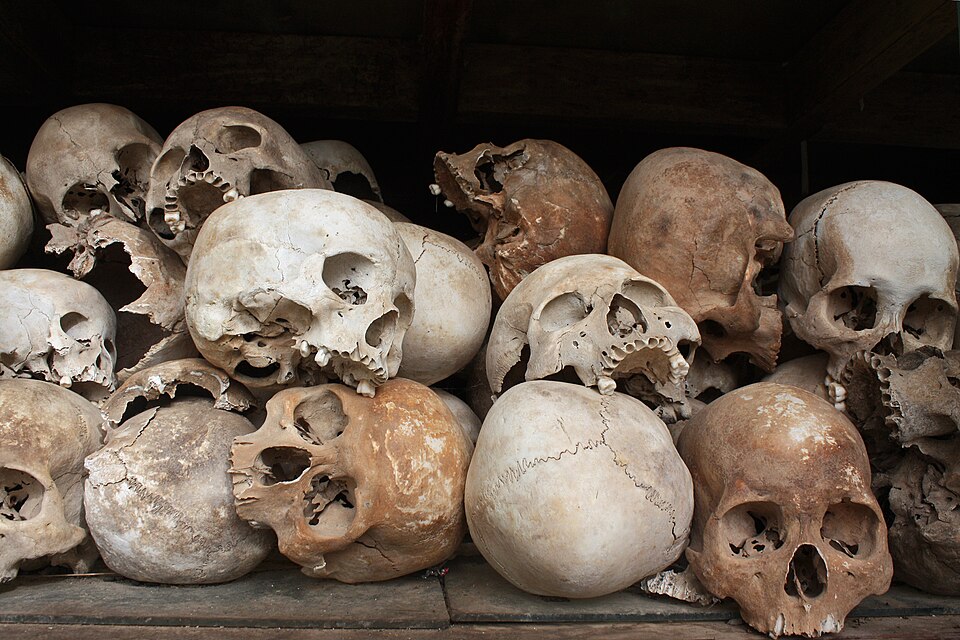
Skulls of the victims of the Khmer Rouge occupation of Cambodia in the memorial at the Choeung Ek Killing Field, Phnom Penh, Cambodia, 2012 (istolethetv, Creative Commons Attribution 2.0)
These events gave rise to the concept of “humanitarian intervention”—the supposed Western prerogative and obligation to militarily interfere in nations accused of “human rights violations,” often bypassing international laws.
This replaced the earlier anti-communist credentials that authorized U.S. actions (sometimes backing dictators), which had failed disastrously in Vietnam.
The idea spread rapidly, especially within Western Left circles, since it allowed a seemingly oppositional stance—accusing authorities of insufficient concern for human rights when exercising caution—while still aligning with imperialist goals: weakening defiant nations via internal disruption and sanctions.
The blatant double standards of this ideology were revealed when Vietnam ousted the Khmer Rouge in 1979 through a genuinely humanitarian, if not altruistic, intervention. This was immediately condemned by the very countries that had claimed exclusive authority to decide on humanitarian interventions.
Despite this, the ideology persisted, legitimizing later infringements such as the illegal 1999 war against Yugoslavia and the 2011 attack on Libya.
The Libya conflict followed the calamitous Iraq War, inflicting devastating damage internally and across the neighboring Sahel region.
Even in wars not justified by humanitarian rhetoric, like Afghanistan (2001) or Iraq (2003), Western Left discourse often presented a “neither-nor” stance: opposing both sides without endorsing either Bush or Taliban/Saddam.
Then came Ukraine: while NATO’s 1999 intervention in Kosovo to protect Albanian independence received near-universal approval, Russia’s 2022 effort to defend Russian-speaking populations in eastern Ukraine was almost unanimously repudiated.
Yet these cases are analogous: Donbas’s residents revolted against a Kyiv government installed by a 2014 coup supported by the U.S. and Germany, which pursued an anti-Russian agenda hostile to the Russian minority in the eastern regions arbitrarily assigned to Ukraine during the USSR’s 1922 formation.
The key distinction is that between 2014 and 2022, Russia repeatedly tried—unsuccessfully—to negotiate, while NATO bombed Serbia soon after the insincere Rambouillet negotiations that demanded Yugoslavia’s surrender.
Similar to Libya, the Syrian conflict unfolded over years without direct Western military intervention but with significant support for “rebels” from the U.S., Europe, and Gulf countries, enabling their takeover in late 2024.
History will judge this regime change’s impact on Syrians, but it is clear Western governments applauded it—despite the Syrian leader once being labeled a terrorist by the U.S.—particularly Israel, which used the chance to extend its illegal occupation.
Then Came Gaza
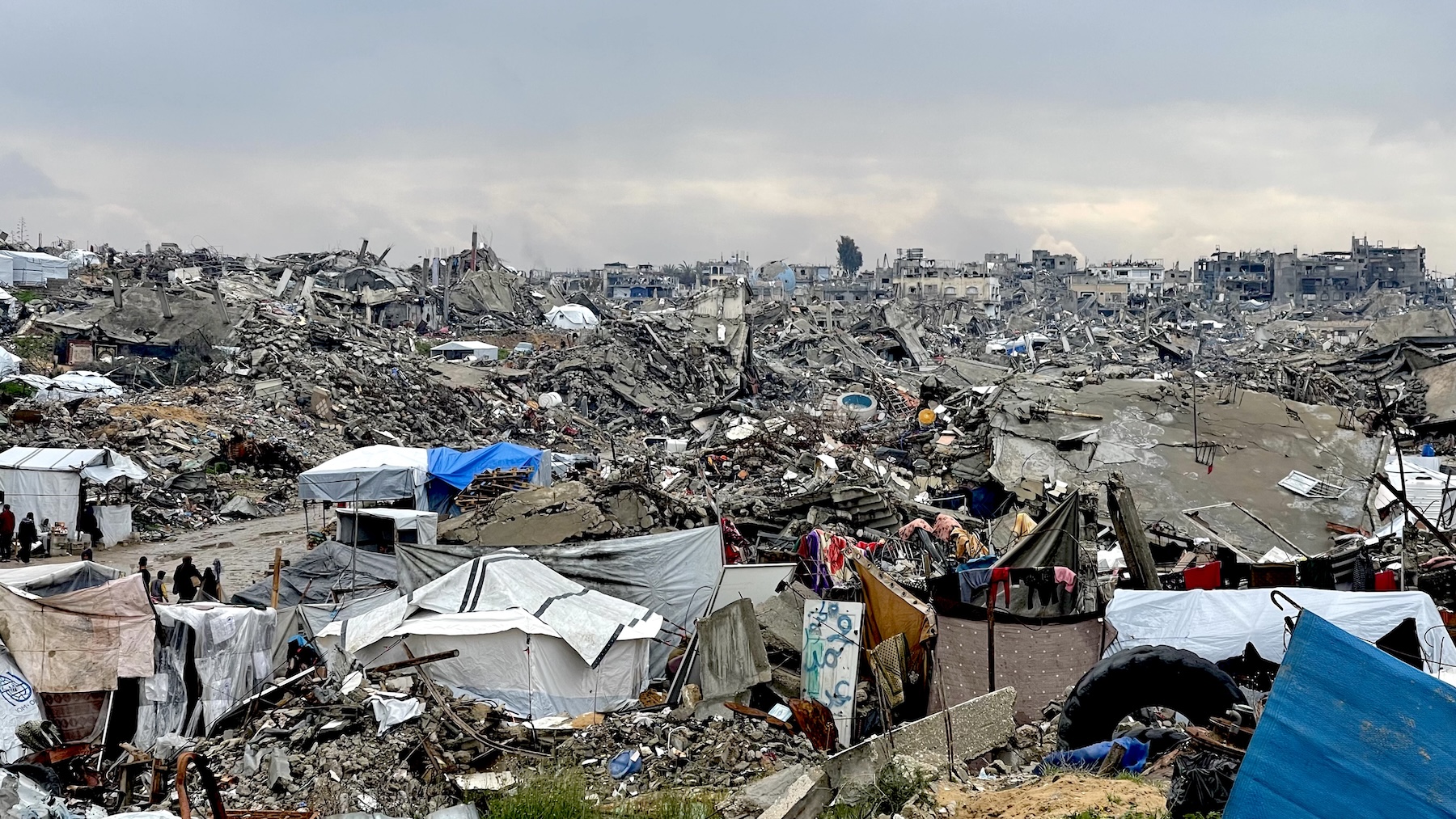
Ruins of Beit Lahia in the Gaza Strip, destroyed by Israeli bombardments, Feb. 23, 2025. (Jaber Jehad Badwan / Wikimedia Commons/ CC BY-SA 4.0)
Initially, Israel—the so-called “only democracy in the Middle East”—garnered support similar to that which the U.S. received after 9/11, with widespread sympathy for victims of brutal terrorists.
Historical grievances, blockades, and Israeli policies were disregarded; Hamas was demonized as a spontaneous evil, with any mention of Gaza’s or Palestine’s history labeling one a terrorism apologist, often triggering legal consequences in Europe.
This outpouring of sympathy effectively conveyed to Israel—and echoed the U.S. response in 2001—that “anything goes.”
However, just as the U.S. lost credibility after its extremes in Afghanistan and Iraq, Israel’s sheer brutality in Gaza eventually ignited global condemnation. Undeterred, Israel intensified violence in Lebanon and the West Bank, followed by an attack on Iran.
The Folly of the Iranian Adventure
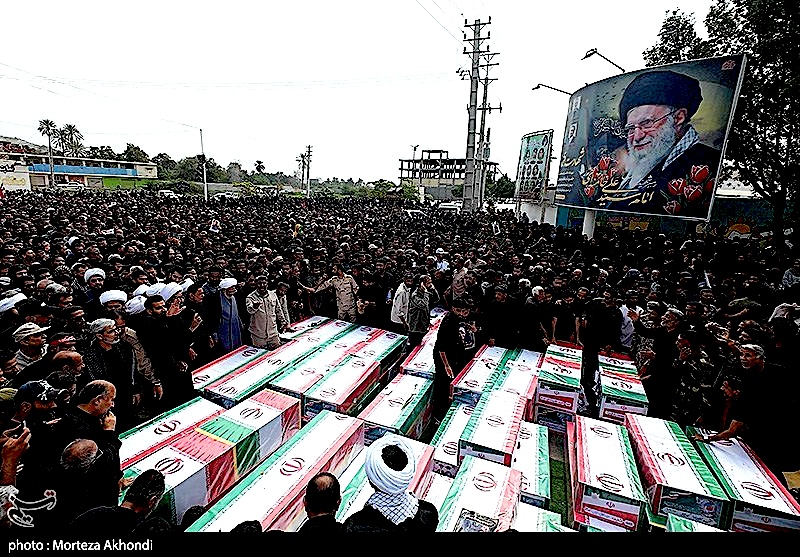
The funeral on March 3, 2026, for the victims killed by the U.S.-Israeli attack on the Shajareh Tayyebeh elementary school in Minab, Iran. (Tasnim News Agency/ Wikimedia Commons/ CC BY 4.0)
After the January protests—which were far from spontaneous—the assumption was that eliminating Iran’s leadership—and causing heavy child casualties—would bring down the “regime” so-called by the West.
Here, the U.S.-Israeli coalition erred much as Hitler did in June 1941. Despite conquering nearly all Europe, he anticipated the U.S.S.R. collapsing swiftly, based on decades of anti-communist propaganda.
When his plans faltered, he told Finland’s leader Carl Gustav Mannerheim just how astonished he was by the Soviet resilience.
While I cannot speak for the Pentagon, it is reasonable to believe a similar disbelief reigns there about the Iran attack’s outcome. Because the assault was clearly influenced by Israeli encouragement and illusions, many American generals might privately curse their “indispensable ally,” even if they cannot admit it publicly.
On top of this, China and BRICS’ growing influence, Saudi setbacks in Yemen, and the ongoing Iranian, Lebanese, and Palestinian resistance indicate the decline of the era of “humanitarian imperialism,” unilateral intervention rights, and disregard for international law that arose post-Vietnam.
The human toll of this era outside the West is staggering: the British medical journal The Lancet reports that 38 million people have died due to sanctions imposed by the U.S. and its allies—often justified under the banner of “humanitarian” reasons.
The West stands confronted by a choice: uphold its dominance at any price, or acknowledge a global order based not on self-serving rules but on international law principles—namely sovereign equality and non-interference.
If the latter path is embraced—the only sustainable alternative—then rather than denouncing it, we should commend the Middle East peoples’ resistance against an imperialism largely rationalized by our “Left” through humanitarian justifications.
Original article: consortiumnews.com
About the Author