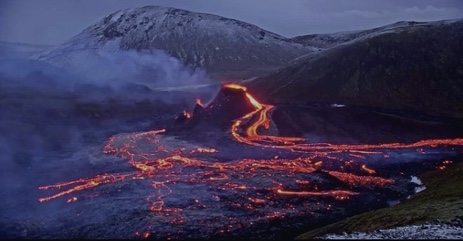
Fire to Fortune: A Year of Living Volcanically
There I stood, high up on Mount Etna’s slopes, over 9,000 feet above the Mediterranean Sea, with Sicily’s hills and plains stretching out below. The volcano was actively releasing gases.
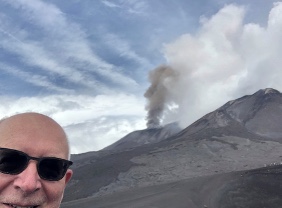
Your editor (minus obligatory hard hat) on Mt. Etna, Sicily. BWK photo.
Above the treeline, the landscape lacks soil, replaced instead by lava, ash, fractured rock, and scattered lichen. Forces like wind, rain, frost, and gravity continuously erode the terrain, but at this current geological stage, Mount Etna grows at a pace that outmatches their efforts to wear it down.
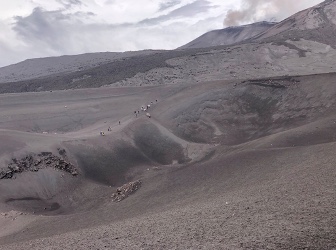
Distant hikers cross a barren volcanic landscape on Mt. Etna. BWK photo.
Close to the summit, Etna’s ground exposes primary hues: deep charcoal, rusty browns, vivid sulfur yellows, and large areas covered by fresh, light-gray ash. Every step crunches through loose cinders and small stones. Scattered across the slopes lie jagged volcanic bombs—once molten fragments catapulted from the vents and frozen mid-air.
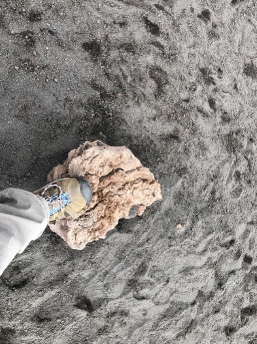
Sixty pounds of basalt, tossed from the mouth of Mt. Etna. BWK photo.
Unfortunately, there are no valuable mineral deposits here—no gold, silver, or copper. The area offers mainly basalt and volcanic ash, useful for construction, but retrieving and transporting it requires a tough descent down steep slopes. Nonetheless, careful observation reveals invaluable geological insights into how mineral deposits form.
The Forge of Hephaestus
Ancient Phoenicians coined the term “attuna,” meaning chimney, likely the root for the name Etna. This term fittingly described the smoking mountain they observed from afar ages ago.
Later, Greek settlers saw the massive peak as the home of Hephaestus, the god of the forge. This association is fitting, given Etna’s imagery: molten heat rising like from a furnace, tremors resembling hammer strikes, smoke and sparks at the vents, and black slag coating its sides.
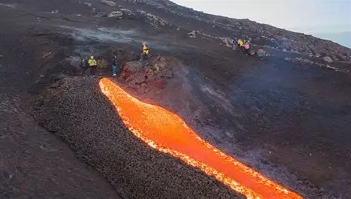
Recent lava flow from Mt. Etna. Credit Geological Survey of Italy/Italian Institute for Environmental Protection and Research
Even with modern geological understanding, wandering amidst Etna’s ash-covered landscape brings the myth of Hephaestus into a vivid, tangible reality. Essentially, Etna’s summit stands as the towering, smoky outlet of a vast system channeling energy and materials from deep inside the Earth toward the surface.
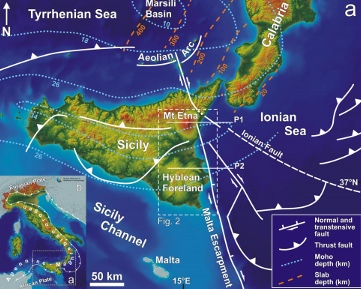
Tectonic map of Sicily/Mt. Etna and Ionian Sea. Credit NATO.
Measured from sea level, Etna looms 3,403 meters (11,165 feet) above Sicily. But if you trace its foundations eastward along extensive fault lines descending beneath the Ionian basin to the Calypso Deep—5,267 meters (17,100 feet) below sea level—the true magnitude of this tectonic structure becomes apparent.
In simpler terms, from the summit down beneath my feet, Etna is composed of layered lava flows, feeder dikes, intrusions, faults, and pathways for magma. This subsurface framework forms the operational heart of Hephaestus’s forge, moving heat and material from Earth’s interior. What appears as a solitary mountain is actually the visible peak of a vast, three-dimensional energy and mass transfer system, aligned northwest to southeast, rooted deep within the planet’s mantle.
A Geology Lesson Between Tectonic Plates
My role at Paradigm Press involves examining mining ventures, assessing their described mineral systems and ore bodies. When promising, I evaluate their potential to transition scientific interest into profitable mining. Over many years, I have investigated mineral prospects across the globe—from Alaska to South Africa, Chile to Kyrgyzstan—identifying some excellent targets and others that did not materialize.
Mineral exploration, much like life, demands persistent observation before discovery. Nothing is simply given. Understanding the geology you encounter is essential, which is why I frequently seize chances to visit purely geological settings to refresh or gain new fundamental insights that may guide me to the Next Big Thing.
The chance to observe an active Mount Etna firsthand recently brought me to Sicily, situated atop the collision zone between the African and Eurasian Plates. Notably, a year prior, I explored Iceland, where the North American and Eurasian Plates diverge, and this past summer I visited the Canary Islands, a Spanish archipelago offshore Morocco, featuring remarkable volcanic geography on the African Plate.
Beyond tourism, these volcanic systems provide important lessons in plate tectonics: convergence and divergence, subduction, slab-edge processes, regional extension, crustal faulting, thermodynamics, and mantle flow interactions.
Together, they demonstrate how tectonic forces channel energy, forge pathways, transport mass from deep inside Earth, and create chemical environments essential for mineral formation. Grasping these earth dynamic mechanisms—and volcanism itself—is the key for geologists in locating valuable mineral deposits (though some argue “it’s all good”).
While examining Etna, I encountered extensive basalt, which offers a starting point but no definitive conclusions. To unravel the workings of a volcano and possible mineralization, it’s necessary to reconstruct its geological history: the “deep time” context, underlying tectonic forces, magma sources, and structures directing subsurface mass flow.
Follow the Energy, Then Follow the Mass
Mount Etna remains active today. Its eruptions attract visitors, benefiting Sicily’s economy. However, volcanic ash clouds sometimes force Mediterranean airspace closures to prevent jet engines from ingesting volcanic particles, which could cause dangerous engine failures mid-flight.
For safety reasons, Italian authorities restrict access to Etna’s active vents.
More than a spectacular scene, Mount Etna—and volcanoes generally—express the surface manifestation of deep-seated earth energy and material transfer. Mineral deposits aren’t just isolated occurrences; they result from dynamic systems moving heat, rock, fluids, and dissolved elements from one location to another.
Earth’s internal heat causes melting. Buoyant magma ascends through fractures and solidifies as intrusions. Volatile gases and heated fluids separate from the magma, interacting with surrounding rock. Changes in temperature, pressure, chemistry, and permeability control whether metals remain within intrusions or concentrate in veins, breccias, replacement zones, or alteration halos.
I have observed such processes worldwide—from the massive platinum deposits near Rustenburg, South Africa, to volcanic massive sulfide deposits in the Andes, and in British Columbia’s “golden triangle.” I recall inspecting a vast lead-zinc-silver deposit at the foot of Kyrgyzstan’s Tien Shan mountains and the gold-silver belt in southern Idaho, born from North America’s movement over a deep mantle hotspot now beneath Yellowstone National Park in Wyoming.
Exploring active, young volcanoes is crucial to mineral discovery, even in mature terrains. While volcanic activity may have ceased long ago, those ancient processes shaped ore deposits, and later deformation and erosion removed upper layers or obscured evidence.
Yet remnants of original geological plumbing—feeder dikes, intrusive cores, fault corridors, hydrothermal alteration zones, and mineralized structures—often remain. These features exist on every continent, too many to enumerate.
Key questions then arise: What provided the heat? What pathways moved magma and fluids? Which structures guided their flow? Where did physical and chemical changes favor mineral deposition and preservation?
Volcanic systems dominated by basalt and island settings often clarify these relationships. Rift zones, calderas, lava plains, dike swarms, geothermal vents, collapses, and landscapes aged progressively reveal various parts of this planetary machinery. If you know how to interpret them, it’s a comprehensive textbook of geology.
The Point of the Journey
I could endlessly elaborate on my “basalt bucket list,” but to keep it brief: discovering valuable minerals and ores begins with comprehending Earth’s countless geologic experiments.
Mount Etna, Iceland, and the Canary Islands collectively tell a story recorded in dark volcanic rock about plate movements, energy transfer, mantle melting, magma migration, fluid flow, and chemical concentration. This narrative isn’t just academic; it serves as a practical guide to where mineral riches form.
These volcanic landscapes teach geologists how to reconstruct ancient energy and mass flows, recognize where minerals accumulated, where tectonic and temporal processes hid them, and where clues to their existence still lie.
That’s the essence of my trip to Mount Etna. When you learn to decipher the rocks, they point the way to the next major discovery.
That’s all for now. Thank you for subscribing and reading.
About the Author