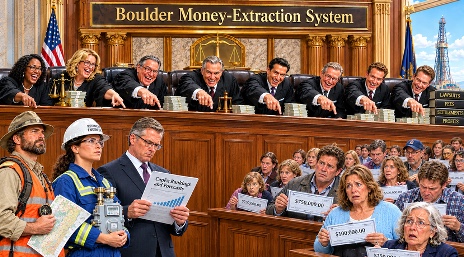
Boulder, Colorado Wants Your Money
The headline says it plainly: Boulder is after your money.
Wait a minute… You don’t live in Boulder or even in Colorado? Too bad. You’re still on the hook.
That was essentially the case presented last week before the U.S. Supreme Court in Suncor Energy v. Boulder County. Should Boulder win, consumers nationwide will bear the financial burden. And if you care about “climate change,” this lawsuit won’t alter a single raindrop or breeze. The purpose is simply to extract your money!
A “Local” Lawsuit with YOU as Unnamed Defendant
Back in 2018, Boulder filed suit against Suncor Energy Inc. (SU) and ExxonMobil (XOM), seeking compensation for hypothetical future expenses related to heat waves, droughts, wildfires, and floods. In other words, Boulder is suing over events that have not yet happened. There was no oil spill, explosion, or direct, identifiable harm to individuals or property.
The lawsuit’s core accusation is that major oil corporations cause harm because they produce hydrocarbons—which allegedly contribute to… Climate Change!
Boulder has therefore brought these oil giants into state court, demanding massive payouts. But in reality, Boulder expects YOU to cover the costs, as any damages will eventually be passed on by companies through higher prices for gasoline, diesel, jet fuel, and countless other hydrocarbon-based products.
“Hold on,” someone might protest. “Isn’t climate change a global phenomenon?”
That’s correct. Colorado doesn’t have its own separate atmosphere, nor does Boulder. And carbon dioxide molecules don’t come with a tracking number. Nobody can trace CO2 emissions directly back to Suncor, Exxon, or the countless global producers of oil, gas, coal, biomass, or even natural CO2 sources like volcanoes.
So, why Boulder? Who gave Boulder the authority to act as the “King of the World” or “Czar of the Climate?” Why can this city sue two oil companies over CO2 emissions in its local court? And what about the rest of us? Where is our lawsuit? And where’s the money coming back to ME?
Just joking… mostly. But you get the point. If Boulder wins, those companies will be pressured financially. They might even fold (which some on the Green-Left desire); or more likely, you and I pay more at the pump and on heating bills, while Boulder cashes those checks.
Maybe you’ve never even visited Colorado (I admit, I have). But it doesn’t matter. If you consume fuel, electricity, food, packaged goods, medicine, airline travel, or virtually anything transported by trucks—basically everything across the economy—Boulder’s lawsuit sticks you with the bill. You’re the silent defendant here.
From Activism to Lawfare
Years ago, my colleague Jim Rickards coined “Green New Scam” to describe much of what passes for environmental policy in certain political circles. Boulder’s case exemplifies a local climate scam wielded through unabashed lawfare; essentially, litigation is being used to achieve what activists and political allies failed to secure through federal legislation.
Boulder demands what it calls a “fair share” of “adaptation costs,” though those costs remain vague legally. At its core, this is speculation; a shakedown targeting wealthy firms that face political disfavor. Boulder chose to sue Big Oil in state court rather than going after entire nations like China or India, which burn vast amounts of coal and oil, or pursuing billions of global consumers of hydrocarbons every day.
This lawsuit is classic courthouse pressure—file claims with broad legal theories, rack up legal fees and liability risks. The process serves as punishment in itself while building leverage for a settlement.
Though this suit might be a single example, if Boulder succeeds, expect many more. It would open the door to widespread rent-seeking from the energy sector. According to court filings in the Suncor case, over 60 local governments have launched similar lawsuits nationwide—this is far from an isolated event.
If Boulder’s case proceeds, the price of oil, refined fuels, or any downstream product will no longer just reflect extraction, refining, and transport costs. Instead, the price will include enormous markups to cover relentless, endless legal challenges and claims across myriad state laws.
Litigating the Global Atmosphere in a County Courthouse
The claims Boulder brings include nuisance, trespass, unjust enrichment, conspiracy, and other state law causes of action. Boulder asserts the companies produced and promoted fossil fuels while deceiving the public about climate risks, leaving taxpayers to bear the vague “adaptation costs.” The defendants reject liability, arguing that federal law prevents lawsuits based on global emissions.
Procedurally, Suncor and Exxon sought to “remove” the case to federal court. After a complex legal journey, it remains with Colorado courts, so the oil companies asked the Supreme Court to address the issue of “venue.” This is where matters stand after last week’s oral arguments.
Notably, Justice Alito recused himself, presumably because of stock holdings in SU or XOM (he didn’t specify). As a result, only eight justices will decide, making a 4–4 tie possible, which would leave the case in Colorado courts.
Remember, CO2 in Colorado is chemically identical to carbon dioxide from China, India, Russia, Europe, ocean-going vessels, aircraft, factories, farms, and billions of vehicles globally. There’s no way to tightly account for every molecule in our atmosphere. But this is American jurisprudence, where a small local area like Boulder can try to extract damages for worldwide economic activities.
What, Exactly, Is Defective?
At oral arguments, Boulder’s lawyer likened the case to standard product liability law. Really? Then where is the defect? Usually, tort claims are made when a faulty product causes harm—like defective brakes or contaminated food. Product liability hinges on a recognizable flaw, product, and injury.
But Suncor’s, Exxon’s, and others’ hydrocarbons perform exactly as expected. Gasoline powers engines; diesel transports goods; jet fuel flies planes; natural gas heats homes and feeds chemical plants; petroleum feeds asphalt, plastics, lubricants, fertilizers, medical products, and countless other essentials.
Legally, Boulder’s alleged “defect” isn’t a malfunction of these products. Indeed, Suncor and Exxon can rightly claim their products function perfectly and are widely used daily across continents, with CO2 as a known byproduct of combustion.
In short, Boulder cannot make an ordinary product liability case. Instead, it is complaining about the long-term, cumulative effects of modern civilization’s entire energy infrastructure. This issue is not proper for state courts. Except for the money, which again, YOU will pay.
Colorado’s Courts Are Knocking at Your Front Door
Let’s keep it simple: follow the money! A legal win for Boulder would open endless liability against energy companies tied to climate-related weather, infrastructure damage, and poorly defined “future adaptation” costs. No company executive, investor, or insurer could predict which city might sue next, what actions would trigger liability, or whether the same emissions could be charged multiple times.
At minimum, Boulder’s case will reduce new U.S. energy projects, even though demand will persist—guaranteeing higher prices. Consumers will pay more for fuel, heat, electricity, and countless other essentials.
And who knows what “enough” looks like? From experience, environmental activists often live in a bubble. Cost impacts, especially those borne by others, tend to be abstract to them. Ultimately, Boulder’s lawsuit is a local legal battle morphing into a nationwide, regressive “net-zero” energy surcharge.
Meanwhile, Boulder’s legal fight won’t eliminate a single molecule of CO2. Globally, hydrocarbons provide about 83% of energy (check the data). And the world will continue relying on them for the foreseeable future.
If Suncor and Exxon sell less oil, countries like China and India will simply keep burning fuel. If American firms exit the sector, others abroad will fill the gap, selling to eager customers.
That “other” producer will be overseas, beyond Boulder’s jurisdiction. Foreign producers, their lawyers, and mass-market energy consumers will mock the nonsense of Boulder’s case, the American courts enabling it, and the voters who permit this folly to threaten the U.S. energy and economy.
Bottom Line
Should Boulder prevail, environmental activists will claim a win against Big Oil, but the real beneficiaries will be trial lawyers, foreign oil producers, and municipalities copying Boulder’s playbook.
The losses will be widespread: higher costs for capital, fewer domestic energy developments, constrained supply, weaker industry, pricier food, electricity, transportation, and goods. None of these impacts will stay within Boulder’s borders; your pocketbook, bank balance, and investments will bear the brunt.
The so-called “defect” in this dispute is not about gasoline, diesel, jet fuel, or other hydrocarbon products. These fuels work reliably worldwide every day. The true flaw lies in a twisted legal system that treats global energy consumption as a local grievance and assumes corporations alone should foot the bill.
Ideally, the Supreme Court will dismiss Boulder’s suit and deliver a strong ruling to deter copycat lawsuits.
If not, the initial payments might come from Suncor or Exxon, but ultimately, the costs will come out of your wallet. So, as stated earlier, just fork it over.
That’s it for now. Thanks for subscribing and reading.
About the Author