Between 2010 and 2021, mortality rates for Americans aged 25 to 44 surged by 71.2%, climbing from approximately 140 deaths per 100,000 individuals to 239 per 100,000. This dramatic increase surpassed that of any other age group. Fatalities caused by overdoses, suicides, traffic accidents, and early onset chronic illnesses are now claiming lives during what should be the peak years.
Physician and researcher Steven H. Woolf of Virginia Commonwealth University School of Medicine detailed this study in The Milbank Quarterly. Using data from the United Nations, CDC, OECD, and a U.S. mortality database, he illustrated the widening gap between U.S. life expectancy and that of other developed nations—and increasingly many developing countries as well.
By 2023, the United States ranked 38th in life expectancy among countries with populations exceeding one million, falling behind not only Western Europe, Canada, Japan, and Australia but also nations such as Chile, Costa Rica, Slovenia, Israel, South Korea, and multiple Persian Gulf states. There were sixty countries where the chance of dying before age 40 was lower than in the U.S. This growing disparity began in the 1990s and accelerated significantly after 2010.
How Researchers Tracked the Rising Death Rates
Woolf’s approach involved analyzing decades of mortality records rather than conducting new clinical trials or surveys. His sources included the United Nations’ Department of Economic and Social Affairs, the U.S. Mortality Database, the CDC’s death-record database known as WONDER, and OECD data from 16 other affluent nations such as Canada, Japan, France, Germany, and the United Kingdom. He examined age-specific death rates from 1999 to 2023, categorizing them into five groups: infants, youth ages 1 to 24, young adults 25 to 44, middle-aged adults 45 to 64, and seniors 65 and older.
A distinct component of the research assessed data from all 50 states dating back to 1941, correlating each year’s life expectancy with the governor’s political party to evaluate if state policies affected health outcomes over time.
What’s Driving the Rise in Death Rates Among Young Americans
Drug overdoses lead the causes of death. For those aged 25 to 44, overdose deaths increased sevenfold since 1999—from about 7.7 to over 54 per 100,000—and overtook circulatory diseases such as heart disease and stroke in 2015 as the primary cause of mortality in this group. Suicide rates are highest in this cohort compared to others, climbing more than 40% between 2000 and 2023. Homicides increased 75.5% from 2014 to 2021, while deaths from motor vehicle and related accidents rose 43.5% in the same period.
What has unsettled even experts is the rising toll from disease instead of injury. Between 2010 and 2019, deaths resulting from diabetes and other metabolic and hormonal conditions surged by nearly 25% among young adults. Liver damage fatalities linked to alcohol more than doubled between 2010 and 2023, and deaths due to alcohol-related mental health disorders tripled during that timeframe. Even high blood pressure, traditionally linked with older adults, saw death rates more than double in the 25-44 age group from 2000 to 2023.
Middle-aged adults (45 to 64) experienced similar trends: increasing deaths from drug overdoses, alcohol-related liver damage, and neurological disorders, alongside a COVID-19 death rate that nearly doubled between 2020 and 2021 despite the availability of vaccines. Although older adults largely avoided these sharp increases, deaths from brain and nerve diseases doubled between 2000 and 2023, with rises also seen in deaths related to endocrine disorders and suicide.
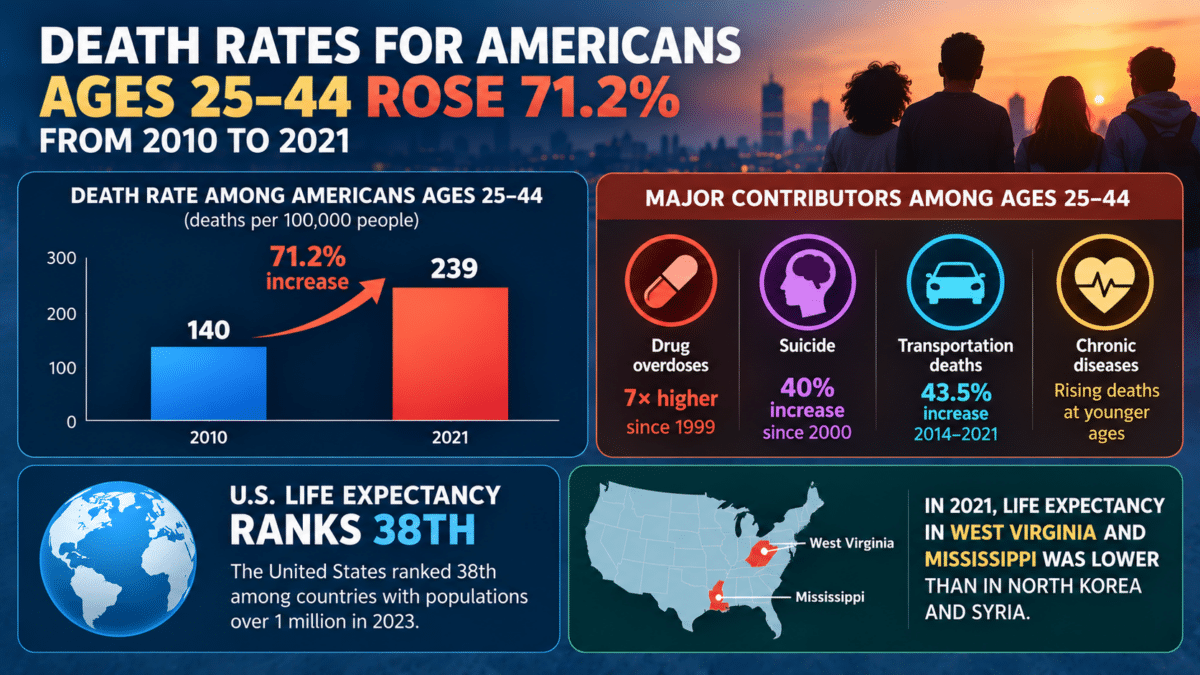 Infographic by StudyFinds
Where U.S. Life Expectancy Has Fallen the Furthest
National statistics often mask harsh localized differences. Woolf’s comparison of individual states against countries with comparable life expectancy revealed that Hawaii, the best-performing state, had figures similar to Western European nations such as Sweden and Ireland. Conversely, Mississippi mirrored countries like Libya, Venezuela, Belarus, and Syria in 2019. Conditions deteriorated further following the COVID-19 pandemic; by 2021, West Virginia and Mississippi’s life expectancies equaled those in Bulgaria, Bangladesh, and Iraq and even fell beneath that of North Korea and Syria. Nine U.S. states—including Oklahoma, Tennessee, Kentucky, Alabama, and Mississippi—had lower life expectancy than Palestine and Iran.
Woolf’s extensive review of state data since 1941 showed that states governed by Republicans typically experienced stagnant or declining life expectancy, a trend that became particularly apparent after 2010 and intensified during the COVID-19 pandemic, which Woolf describes as a “natural experiment.” Variations in state policies regarding mask mandates, business restrictions, and vaccine rollout correlated with mortality differences visible within weeks. Red states endured the most significant COVID-era drops in life expectancy, even after adjusting for factors like poverty and preexisting health conditions.
Other researchers highlighted in the review noted that Americans born after 1970 display elevated death rates from heart disease, cancer, and injury-related causes compared to prior generations. They attributed the current plateau in U.S. life expectancy to “multilayered social, biological, and generational forces.”
Why America’s Death Rates Keep Climbing
Woolf identifies five main contributors to America’s poor health outcomes: the absence of universal health care coverage, riskier personal behaviors such as higher calorie intake and firearm possession, intensified income inequality and poverty, urban designs favoring automobiles over walkability and green spaces, and public policies that prioritize individualism over collective welfare more than peers in other nations. Although each factor is well-known, the analysis emphasizes that viewing overdoses, suicides, and chronic disease separately overlooks the broader issue: these are all manifestations of a common systemic neglect.
This is the paper’s most compelling argument. Other developed countries did not attain longer life spans by chance; they established universal healthcare, robust social safety nets, and strict consumer and environmental safeguards decades ago, which now reflect in their citizens’ mortality data. The U.S. has never lacked solutions; rather, the problem lies in insufficient political will to implement them. Unless that changes, the gap in life expectancy between Americans and those in many other nations will continue widening.
Original article: studyfinds.com
About the Author