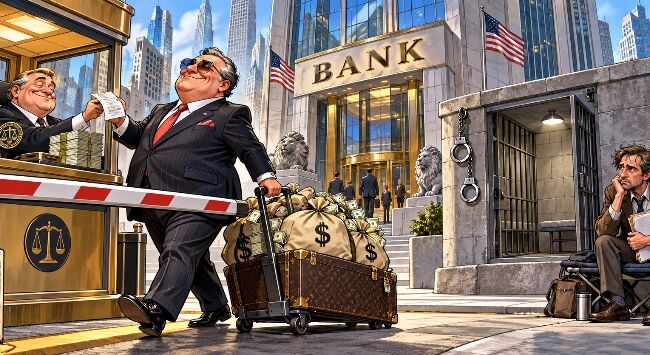
Too Big to Nail
Everett Stern spent nights on a camping cot simply because he fulfilled his duty.
Back in 2010, he worked as a compliance officer at HSBC, stationed in a secluded back office in New Castle, Delaware. He observed billions of dollars flowing to drug cartels, sanctioned governments, and terrorist organizations. He documented these findings and escalated them. When the bank chose to ignore the warnings, he took his concerns directly to the FBI.
This led to a $1.92 billion settlement in 2012. According to Stern’s calculations, that amount equaled roughly five weeks’ worth of HSBC’s profits. Not a single banker faced charges, let alone jail time.
Stern ended up losing his profession, savings, and every connection he had within finance. Unable to afford a bed, he took to sleeping on a cot in a 300-square-foot apartment while working as a waiter at P.F. Chang’s.
Just this week, he penned an open letter addressed to Treasury Secretary Scott Bessent. It quickly went viral on X, with good reason.
Fourteen Years Later…
On Tuesday, the US Treasury imposed $1.2 billion in penalties on Bank of America, marking the third largest fine in the agency’s history. Of that, $750 million goes to the Office of the Comptroller of the Currency, representing its biggest enforcement action ever.
The bank acknowledged it deliberately violated the Bank Secrecy Act by failing to timely report over $5 billion in suspicious transactions. More than $1 billion of these were linked to what the Treasury defines as priority national security threats: Chinese money laundering operations, fraud, and trade-based laundering heavily tied to the southwest border. An additional $11.6 million settlement addressed apparent sanctions violations involving Iran, Russia, narcotics trafficking, and global terrorism.
The Treasury also noted the bank failed to fix these issues despite agreeing to a cease-and-desist order in 2024. In simpler terms, the bank got caught, vowed to correct its behavior, and failed to do so.
Bessent emphasized that this enforcement sends a firm message: no institution, regardless of size, is exempt from the law.
Yet, once again, no individual faced prosecution.
Stern responded to the Secretary with a message that was both courteous and piercing: fines alone are ineffective.
The Twelve-Day Fine
Let’s break down the numbers Stern worked out for HSBC.
Bank of America reported earnings of $9.1 billion for the second quarter this year, averaging about $100 million each day. The $1.2 billion penalty equates to just twelve days of profits.
Twelve days, for failing to report five billion dollars in suspicious activity — transactions tied to dealers supplying fentanyl to American youths, as the Treasury itself identified.
This fine is paid from the bank’s capital, which belongs to shareholders such as pension and index funds, as well as individual 401(k) holders. The officials responsible for the 2024 cease-and-desist order won’t bear any financial responsibility. Instead, next quarter’s earnings call will discuss “operating leverage.”
How the Toll Booth Works
Fines are distributed among countless shareholders, so no one feels the immediate pain. The board remains complacent. Regulators receive their check and issue a press statement.
Now, contrast that with a single executive handcuffed and taken into custody. That scenario shifts the risk calculus for all executives in financial institutions nationwide, instantly. This is Stern’s core argument — and it holds true. He believes that incarcerating one banker would have a greater deterrent effect than every fine ever imposed by the Treasury combined.
So why does the system keep opting for financial penalties?
One word: fear.
In 2013, Attorney General Eric Holder told the Senate that some banks had become so massive that prosecuting them could damage the economy. Although he later retracted his remarks, the concept of “too big to fail” had already transformed into a Frankenstein’s monster.
Given that Bank of America currently holds $109 billion in unrealized losses from Treasury bonds, this anxiety is even more intense.
Consider also that fines generate revenue. Treasury recorded a neat $1.2 billion inflow on Tuesday. Legal prosecutions are costly and time-consuming, often spanning years. A settlement offers a swift and guaranteed payout wrapped neatly.
Finally, recognize the incentive this creates: each penalty justifies expanding compliance departments both inside the bank and within regulating bodies. The workforce in compliance roles grows on both sides.
Regrettably, the fine no longer represents a cost of doing business. It has become the business. The government sells the pass, and banks pay for it.
Tetzel’s Price List
History reveals that the Church faced similar issues through harsh lessons.
In 1517, Dominican friar Johann Tetzel traveled through Germany, promoting indulgences. Catholic teaching said indulgences could reduce temporal punishment after the guilt for sins had been forgiven.
These were never intended to grant permission to sin. However, Tetzel’s sales pitch made these spiritual remissions sound like commodities one could purchase. Part of the funds raised went toward rebuilding St. Peter’s Basilica in Rome.
A monk in Wittenberg challenged this practice. Martin Luther’s Ninety-Five Theses sparked the Protestant Reformation and fractured Western Christianity.
The Church ultimately confronted the problem at the Council of Trent, reaffirming the doctrine but condemning financial abuses. In 1567, Pope Pius V eliminated indulgences linked to payments.
Sadly, Washington has learned none of these lessons. It continues collecting money while those responsible remain free.
In fact, Treasury’s system is even worse. Indulgences never excused future wrongdoing. A bank fine that spares executives responsible encourages further violations.
Everyone watching understands that consequences can be negotiated—provided you have the funds.
The Last Whistleblower
Why has no Bank of America employee stepped forward like Stern did?
His answer is telling: everyone in American banking knows Stern’s fate.
This is the hidden toll of the current system. It absolves the guilty while punishing the conscientious. The next honest individual simply resigns to silence.
Credit Where It’s Due
This penalty surpasses any previously imposed by Bessent’s predecessors. For the first time, the Treasury forced the bank to explicitly admit willful violations. This acknowledgment exceeded anything HSBC conceded.
Still, fines are all the Treasury can impose. The Justice Department must bring prosecutions. Stern recognizes this, which explains why his initial request is for a referral, not an immediate conviction.
The encouraging news: Stern’s three proposed reforms are attainable under this administration:
- Refer the executives who set the thresholds, not the analysts processing reports.
- Eliminate the “too big to jail” doctrine, since a bank cannot simultaneously be too big to fail and too big to jail.
- If a bank that claims the American name won’t uphold American values, reconsider its charter.
These changes demand only a Secretary bold enough to dismantle this toll collection system.
Wrap Up
Before entering the FBI in 2010, Stern paused at the Great Seal in the lobby and read the inscription beneath: Justice is the defense of our liberty.
He believed that statement then, and he wants to maintain that belief now.
Don’t just take my interpretation. Listen to his.
He paid dearly for the chance to speak out and laid his case before the person who can make a difference. Read the letter, then judge for yourself whether Tuesday’s fine was a true penalty or simply a receipt.
When a nine-figure bank fine is just another toll, that will end only when bankers are led out in handcuffs from their gleaming skyscrapers.
About the Author